Why This Series Runs on Thursdays
A hometown paper in Moline recorded a young man's summer in 1953. Nineteen years later he wrote the sentence this book takes as its warrant.

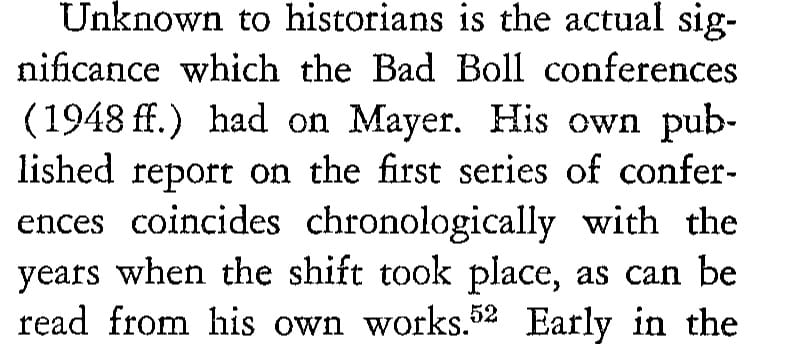
On 14 August 1953 the Dispatch of Moline, Illinois, ran the sort of item small papers have always run: a local young man had been abroad, and here was where he went. “Coal Valley Man Tours 10,000 Miles in Europe During Year as Student.” The itinerary is dutiful and complete. Among the stops, he “took part in the Bad Boll Theological Conference near Stuttgart,” and was “a guest of the theological faculty in Berlin shortly after the June 17 revolution.”
He was twenty-two, a fourth-year seminarian, born on an Illinois farm in November 1930. His name was Edward H. Schroeder.
The paper could not have known what it had. That casual phrase — shortly after the June 17 revolution — is a dateline for something that did not happen. The workers rose in East Germany on 17 June 1953, and in the inter-zone tension that followed, the Berlin session of that summer’s conferences was cancelled. The two remaining German-soil conferences met at Bad Boll instead. A hometown paper in Illinois, recording a young man’s summer, had incidentally noted the week the enterprise lost a city.
A seed-bed
The word seminary comes from the Latin seminarium, a seed-bed — the nursery plot where Roman growers started plants that were meant to be lifted and set out somewhere else. It is an agricultural word before it is an ecclesiastical one, and it carries a claim about time: what is in the seed-bed is not yet where it will end up. Whoever coined the usage was betting that you cannot tell, looking at the plot, what the field will look like.
In the summer of 1953 Schroeder was in the seed-bed. He was not an essayist at Bad Boll. He read no paper, chaired no session, and appears in no roster of commissioners. He was a student who happened to be in the room.
Nineteen years later
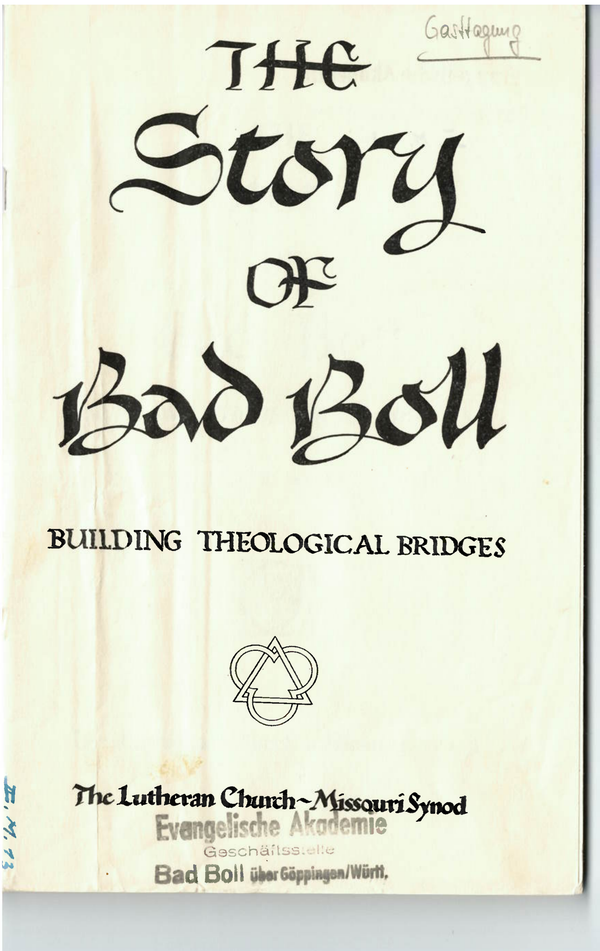
In 1972, two years before Seminex, Schroeder published an article in the Concordia Theological Monthly on what he called Law-Gospel reductionism in the history of the Missouri Synod. Most of it is an argument about F. E. Mayer — a professor at Concordia Seminary, one of the American essayists at Bad Boll, and a man whose theology, Schroeder argued, moved substantially in his last years.
On page 245 he set down a sentence that this book takes as its warrant.
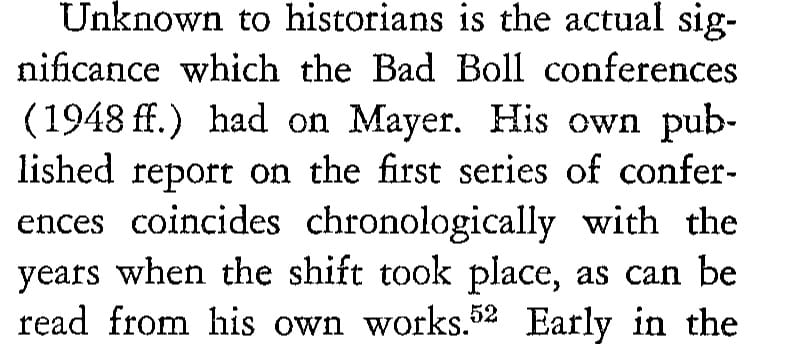
Read it again for what it does not say. It does not say Bad Boll caused anything. It says the significance is unknown to historians — that something consequential happened in those summers and the people whose job it was to notice had not noticed. That is a narrower claim than a verdict and a harder one to dismiss. It is also, fifty-odd years on, still largely true.
Three roads
This book argues that Bad Boll was a crossroads, and that three roads ran out of it.
One led to a parish church on Oldenstädterstraße in Uelzen, in August 1952, where a committee was appointed that became the first executive committee of what is now the International Lutheran Council. One ran through the young man in the Moline clipping, to the 1972 article, and to what happened at Concordia Seminary in 1974. The third ran toward the fracture of the Synodical Conference, where Bad Boll was one factor among several and the word used against it was unionism.
None of those roads is a straight line, and this series will not pretend otherwise. But they all pass through the same seven summers, and the documents are in the file.
Why Thursdays
After Seminex, Schroeder spent a decade writing a weekly letter for the Crossings Community under the title Thursday Theology. He died in St. Louis on 1 March 2019, at eighty-eight.
Crossings still sends it. Every Thursday, under the same masthead — that the benefits of Christ be put to use — seven years after the man who wrote it stopped being able to. The most recent arrived last week.
So: a Thursday series, about the conferences a future Thursday Theology writer attended at twenty-two, arguing that those conferences were one of the roads to the church he ended up in. The seed-bed is a good enough figure for the whole enterprise. What was planted at Bad Boll was lifted and set out elsewhere, and the men who did the planting mostly did not live to see the field.
What this series will do
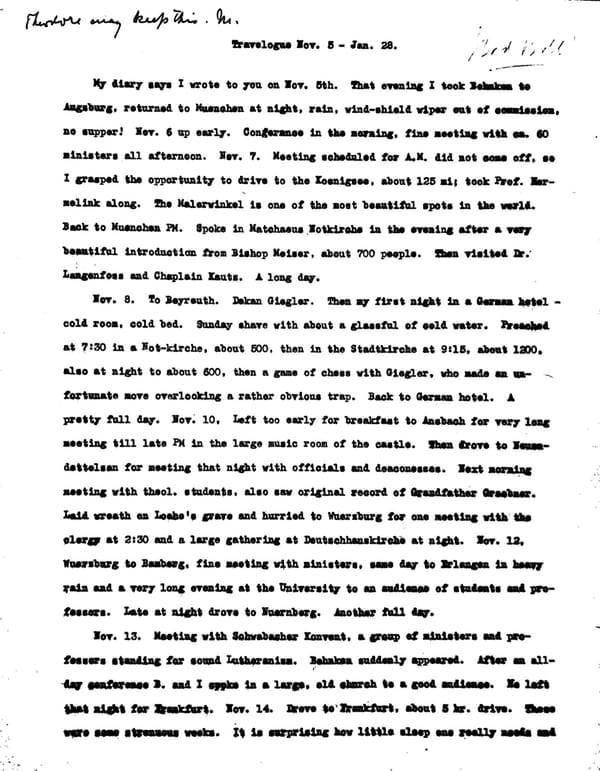
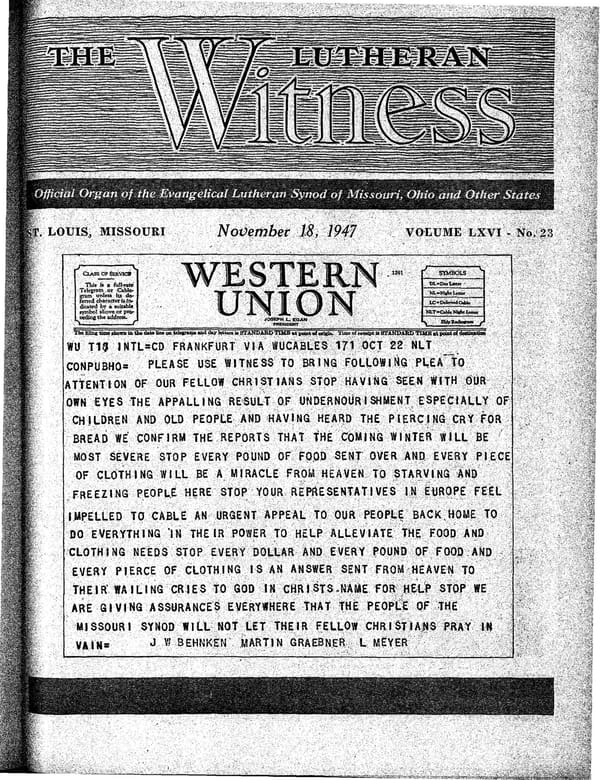
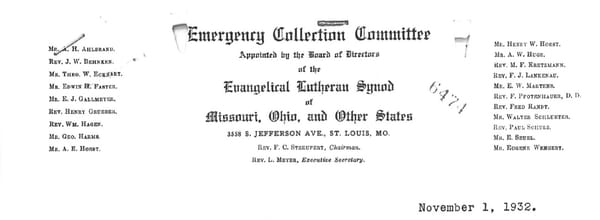
Eighteen Thursdays, beginning 3 September and running to the end of the year. Each post reproduces one document from the archive — a letter, a cable, a programme, a page of a travel diary — and asks the question that document raises. No post gives away a chapter’s argument. Each gives away one document.
The book is Bad Boll: Missouri at the Crossroads, forthcoming from Concordia Historical Institute. If you have material, a correction, or a memory of any of this, the address is info@badbollbook.com. Corrections are the point.
The next post comes 3 September. It begins in 1932, with a letterhead.
Sources and notes: The clipping is “Coal Valley Man Tours 10,000 Miles in Europe During Year as Student,” The Dispatch (Moline, Ill.), 14 August 1953, 13, which supplies the itinerary, the Bad Boll and Berlin sentences, and Schroeder’s return to Concordia Seminary, St. Louis, for his fourth and final year. His own sentence is Edward H. Schroeder, “Law-Gospel Reductionism in the History of the Lutheran Church — Missouri Synod,” Concordia Theological Monthly 43, no. 4 (1972): 245, whose footnote marker sends the reader to F. E. Mayer, The Story of Bad Boll (1949). That Schroeder travelled with Richard P. Baepler and studied under Werner Elert at Erlangen in 1952–53 is recorded by Donn R. Wilson, “Conflict-Generating Trends Preceding the Missouri Synod Schism in 1974,” Journal of the Lutheran Historical Conference 7 (2017): 242. The cancellation of the 1953 Berlin session after the workers’ rising of 17 June, and the two conferences that met at Bad Boll in its place, are treated in chapter 7 of the book; the Uelzen meeting of August 1952, and the committee appointed there that became the first executive committee of the International Lutheran Council, in chapter 10. Seminarium is the Latin for a seed-bed — the nursery plot, not the field.
Researched and written by Dr. Albert B. Collver III, from the archives behind the forthcoming book Bad Boll: Missouri at the Crossroads (Concordia Historical Institute). Corrections, recollections, and documents of your own are welcome at info@badbollbook.com.
© 2026 Albert B. Collver III · Thursdays at Bad Boll. Archival documents are reproduced by courtesy of the holding institutions, as credited; the research, text, and annotations are the author’s. Please cite or link rather than republish.