Reformation Day, 1948
Five weeks before Bad Boll opened, Hermann Sasse wrote President Behnken the paper he would never deliver there. On Reformation Day he wrote the other letter.

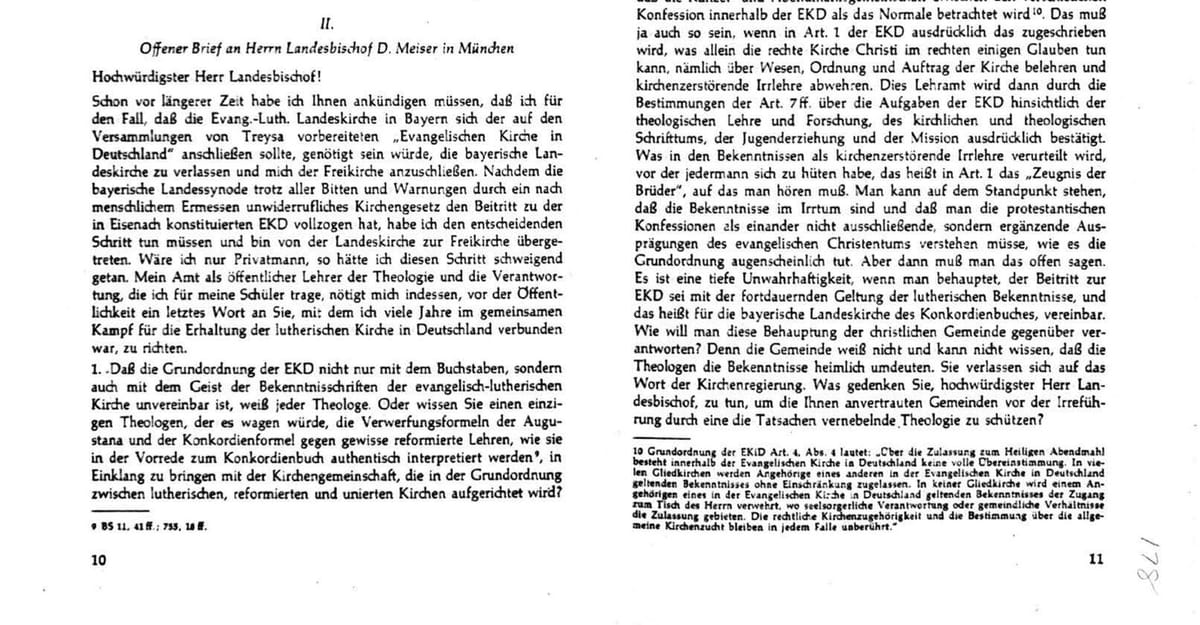
The letter carries the date of the feast.
Erlangen, 31 October 1948. It is addressed to Landesbischof D. Hans Meiser in Munich. It was printed in the last 1948 number of the free-church paper Der Lutheraner, published in Frankfurt, a namesake of Walther’s old St. Louis periodical. And it says what Hermann Sasse had been telling his bishop in private since February: that he could not remain in a church that had decided to become something other than the church he had joined. In September the synod of the Evangelical Lutheran Church in Bavaria had voted to enter the new Evangelical Church in Germany, the EKiD. On Reformation Day its best-known theologian left. “After the Bavarian state synod, in spite of all pleas and warnings, by a church law, irrevocable according to human judgement, completed the accession to the EKD constituted in Eisenach, I had to take the decisive step and transfer from the state church to the Free Church.”
He did not have to explain the date. Every German Lutheran of his generation knew that the Prussian Union had been proclaimed for the Reformation jubilee of 1817, and that Claus Harms had answered it from Kiel with ninety-five theses of his own. The seventy-fifth warned the unionists not to carry out their work “over the bones of Luther. It will rouse him, and then—woe unto you!” Sasse would quote that thesis to pastors a few years later, in the fifteenth of his Letters. A hundred and thirty-one years after the Union chose its day, he chose the same one.
The open letter belongs to a chapter of the book, and the chapter can keep it. This post is about the letter that came before it, the one that was meant for Bad Boll.
Five weeks before
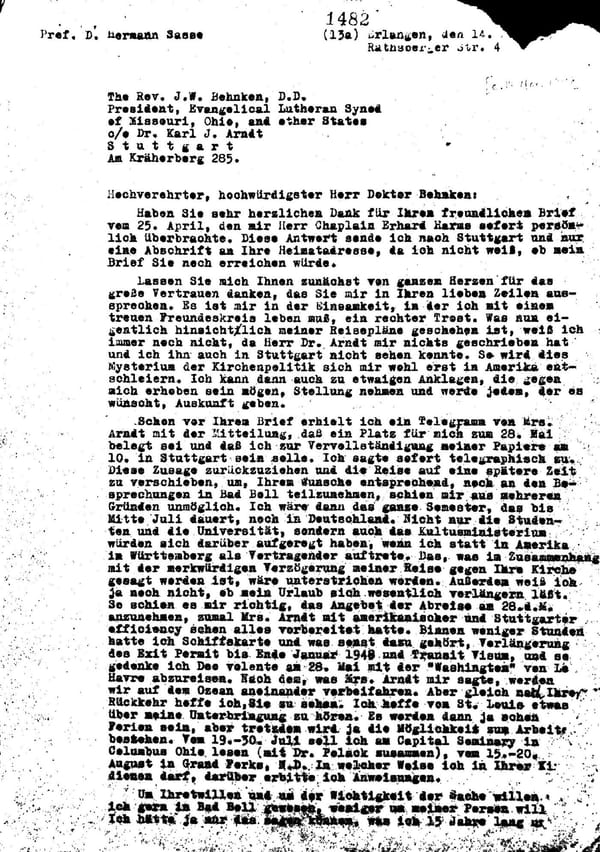
On May 14, 1948, Sasse sat in Erlangen and typed six pages to J. W. Behnken, President of the Missouri Synod, who was already in Germany. The typescript shows the hurry: dropped words, misspellings, a malapropism or two. He addressed it in care of Karl Arndt in Stuttgart, “since I do not know if my letter will still reach you,” and sent a copy to Behnken’s home in St. Louis in case it did not.
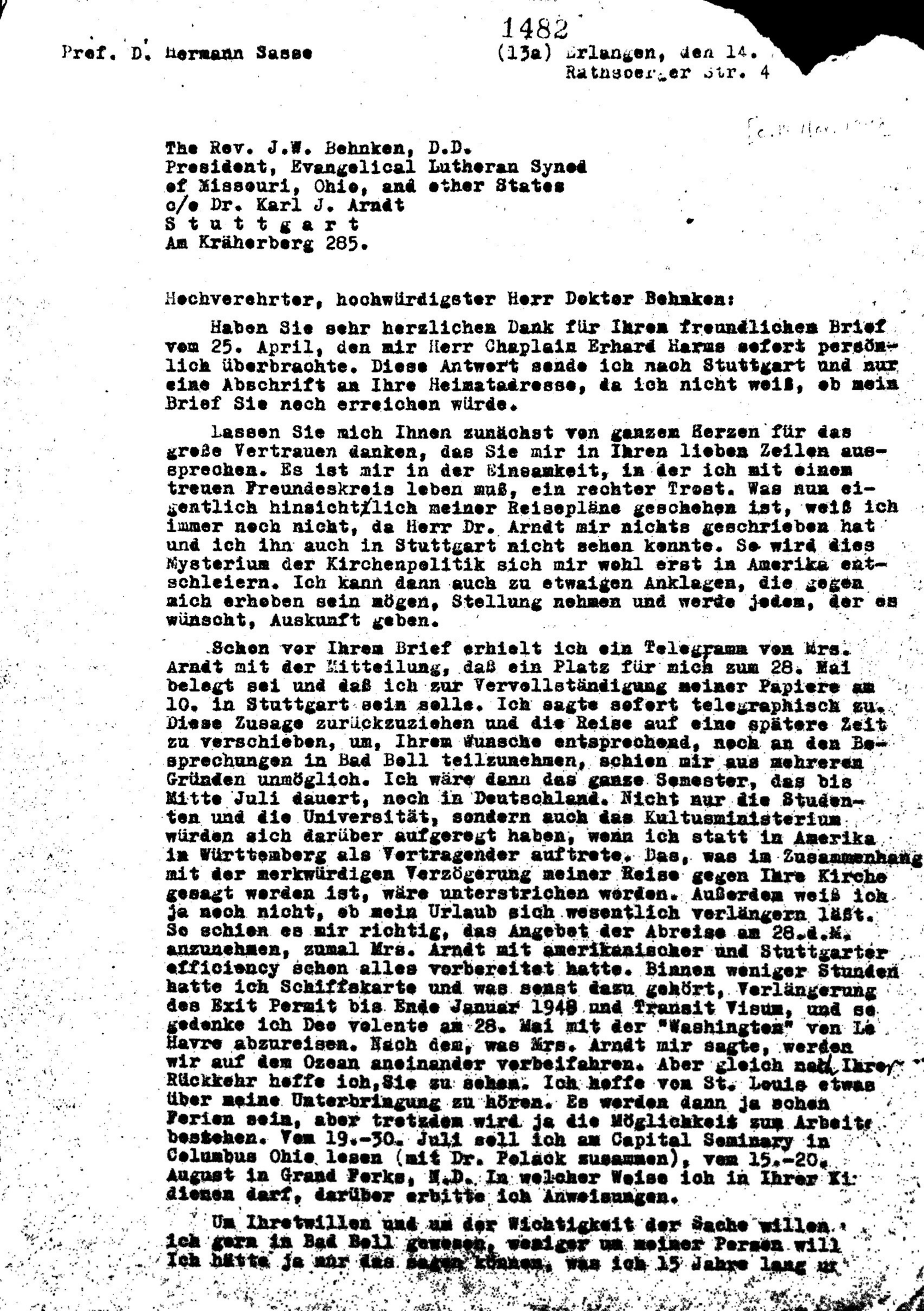
Behnken’s letter of April 25 had reached him by the hand of Chaplain Erhard Harms. Readers of this series know what the spring of 1948 had been. In February Arndt had cabled Behnken that Sasse’s planned visit to Concordia Seminary had to be cancelled for the sake of the conferences: “decide between Boll Sasse.” Behnken had been reluctant to cancel. Now, with the first conference weeks away, he was asking Sasse to postpone America and come to Bad Boll instead.
Sasse said no, and the reasons are a small portrait of a German professor in the spring of 1948. Mrs. Arndt had already telegraphed him a berth, the Washington out of Le Havre on May 28, and had done the paperwork “with efficiency befitting both an American and one from Stuttgart.” The semester ran to mid-July; the students, the university, and the Bavarian Ministry of Culture would all want to know why a man on leave for America had turned up in Württemberg. And then the sentence that shows he understood the cable without having seen it: “Whatever is said against your church with respect to this odd delay in my trip would only be underscored.” He had heard that something was being said about him. He did not know what. “So, this mystery of church politics will only be unveiled to me in America. I can also comment on any charges that may be brought against me and will provide information to anyone who wishes.”
So he put into the letter what he would have said in the room. “I would have said what I have already said for the past 15 years to bishops, theologians, and church officials—in more than a thousand printed pages and in numerous lectures. May I tell you, most venerable Dr. Behnken, from the efforts of these long, fruitless discussions about understanding our situation, as a contribution to the discussion, so to speak?”
What follows is the Bad Boll paper that Bad Boll never heard. I translated it, with Charles Schaum, for the Concordia Historical Institute Quarterly in the winter of 2020; the German original is in the Behnken administration files at CHI. Reading it again this October, with the Reformation Day letter beside it, is what prompted this post. The two documents are five months apart and they are the same argument. One is addressed to the man who could have acted on it.
What he would have said
Four things, and he numbers none of them, because he is writing fast.
First, the diagnosis. Nothing that could be said at Bad Boll would stop “the development that has been moving forward for a quarter of a millennium in the sphere of German Protestant territorial churches, and whose logical end is general unionism.” Orthodoxy had held it off around 1700; the Awakening had held it off after 1817; nothing would hold it off now, because Barmen and Treysa had already “rejected a confessional solution to the churchly question.” It did not matter that the EKiD called itself a federation. The name “church” was “not just a ‘blemish’ (Schlink), but it is a fundamental flaw.” And the flaw had reached the pews: “Lutheran and Reformed are names for theological schools within the Protestant Church. Since the theologians have said this to the people, our congregations no longer understand it any differently.”
Then the paragraph that is the reason this letter is still read. “For several centuries now, we theologians, bishops, members of consistories and, above all, professors, have learned the great art of hiding our true thoughts behind our words, practicing the same with ever-increasing virtuosity. In front of the congregation, one confesses with the tone of heartfelt conviction the birth of Christ from the Virgin Mary (natus ex Maria Virgine), but privately one opposes it as mythology. And it is considered to be the epitome of catechetical art to explain Luther’s main section ‘On the Sacrament of the Altar’ in a Calvinistic or Zwinglian way. Who still blushes at that?”
The myth that covered it, he said, was the myth of the Church Struggle. The victory over the German Christians “was not achieved by the Church, as the official myth of the ‘Confessing Church’ states, but by Roosevelt, Churchill, and—Stalin!” The territorial churches were “great religious social entities which live in the fiction that they are Christ’s Church. Therefore, their leaders think sociologically when they should think theologically. ‘Where two or three million are gathered…’, there is Church.”
Second, the assignment. “The most important task of the Bad Boll talks is to make a serious attempt to unmask the hidden, sociological thinking about the church and to bring about reflection on the theological nature of the church. It is, perhaps, the historic task of the Missouri Synod and the churches close to her, to call Lutheranism to that.” Neither the Lutheran World Federation nor the big churches would listen; he said so. Then the warning that reads, seventy-eight years later, like a forecast: “I also would like to urgently warn our American brothers against letting themselves be further impressed by the erudition of our German theology. Anyone who has looked behind the scenes of the theological literature of our time knows how much theological scholarship and the hollow art of disputation mix together.”
He gave Behnken the questions to ask. “How do you Germans say this to the congregation? What stake does the congregation have in your theology? How does your congregation think about the great life-questions of the church? Maybe the congregation doesn’t think about it at all? … Do you even have a congregation that can judge doctrine?” A theology without a congregation behind it “is a professor-theology of theology professors. It does not build the church. For it can only bring forth schools and schools of thought.”
And then, to the President of the Missouri Synod, the request: “Please, esteemed President, spare the German churchmen and theologians nothing. It is a work of mercy when you call us down from the lecturer’s desks and consistorial conference tables that hover above the clouds to the reality of the congregation where the Church actually lives, if it is there at all.”
He knew what the Germans would say about Missouri, because he had heard them say it. “And when you are then kindly made aware of the ‘simplicity’ of Missourian theology, which is so much talked about, then confess the great word of Tertullian against the theological dialecticians of his time: ‘Our instruction comes from the porch of Solomon, who had himself taught that the Lord should be sought in simplicity of heart.’ Here lies the strength of your synod.”
Third, the practical goal. The conferences “must lead to a strengthening of the position of our free churches.” For a hundred years the free churches had been “the conscience of the Lutheran Territorial Churches,” and they would have to remain the conscience of Lutheranism in Germany “even if the EKiD now devours everything.” The bishops would not carry it; the VELKD would not carry it, “which will only be a new edition of the Lutheran Council within the German Evangelical Church.” On the man who would open Bad Boll five weeks later, one sentence: “Certainly, a man like Bishop Meiser wants the Lutheran Church. But he is not prepared to pay the price, and certainly not his synod, his church government—and his successor.”
So, to Behnken: “Make sure, esteemed Doctor Behnken, that your American Lutherans get a little more respect and do not fall for the myth of large numbers. A church like Breslau or the former ‘Saxon’ Free Church actually has more importance than the territorial churches of Schleswig-Holstein or Hamburg.” The free-church theologians would “do very well at the tournament of Boll”; what they needed from Missouri was help with the tools of modern scholarship, which Lutherans “cannot leave to the Reformed and the Catholics.” The image he reached for was the Exodus. “When we depart the Egypt, that is, secularized church, we want to take the vessels of gold and silver with us. We also promise not to cast from them a golden calf.”
Fourth, the obstacle. He named it himself as “the last, and indeed the only, serious obstacle to Free-Church agreement: the question of verbal inspiration.” That Scripture is verbally inspired he and his friends did not doubt; that was what separated them from Elert and Althaus. But he would not sign the later dogmaticians or American fundamentalism. “I will believe that the hare is a ruminant if God commands me to believe. But I cannot find such an order in Leviticus 11. We must have the same freedom as Luther regarding what is human in the Bible—no more than that, but also no less. We cannot live in a church from which Luther would be expelled.” The question he put to Missouri was whether there could be fellowship with men who reached Pieper’s conclusions “by way of an exegesis of Holy Scripture that fully recognizes its human side, its genuine historical character.” His proposal was modest: “for us on both sides to first sit down together and spread out our materials and methods before us and take note of them.” The argument that would follow him to Australia and back to St. Louis is all there, in one paragraph, in May of 1948.
He closed with the weather. The pneumonia was healed; his wife had been up from the flu since yesterday; “We just cannot stand the winters in unheated rooms anymore.” “There is hardly any coal in Bavaria, and the forests are ruined.” And a last line for Behnken’s journey, “which in human terms is as important as Walther’s journey to Neuendettelsau and Erlangen—and hopefully more successful. Loehe and Walther must now come together and bring together the faithful Lutheranism of the world!”
He had also written, without drama, that by the time the conferences met “the decision on the EKiD will have been made, and the talks will be overshadowed by this decision.”
What happened instead
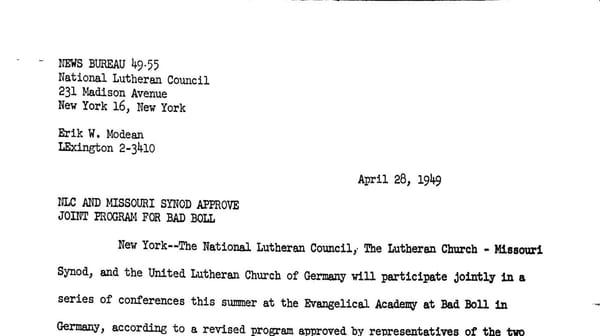
He sailed on May 28 and reached St. Louis on June 5. Bad Boll opened on June 23 with Bishop Meiser’s address. On July 10–13 the church assembly at Eisenach adopted the EKiD’s constitution; the Bad Boll session that followed it took up Eisenach, and the free-church men in the room heard the Missourians defend the bishops’ word “federation” with the bishops’ own arguments. Hans Kirsten, who was there, never forgot it.
In September the Bavarian synod voted to join. Sasse was still in St. Louis. On September 28 he typed a mimeographed essay for his American friends, “The End of the Lutheran Territorial Churches in Germany.” Its second paragraph: “The Evangelical Church in Germany is neither a church nor is it evangelical.” The Lutheran Church in Germany, it said, “now survives only in the Free Churches.” On the night before he left St. Louis, F. E. Mayer and Theodore Graebner, home from Bad Boll, came to plead with him not to leave the Bavarian church.
He went home and wrote to Meiser on Reformation Day. On December 1 the first Letter to Lutheran Pastors went out from Erlangen, mimeographed; within months he would write that he scarcely knew how to pay the postage.
Missouri’s reaction is in its own files. In November Meiser was in St. Louis, addressing the Concordia faculty at dinner. On December 3 Graebner wrote to Henry Hamann in Australia that no Missourian who had been at Bad Boll would agree with Sasse’s assessment: “Both of these men are suffering from war psychosis and Sasse besides has some very strong frustrations.” On January 17, 1949, Arndt wrote to Lawrence Meyer that it was “unfortunate that Der Lutheraner here published Sasse’s letter in the manner it did,” and gave his advice: “not to be fooled by Sasse. Your future course still lies with the VELKD and Bishop Meiser.” In February Arndt reported Sasse’s “public withdrawal from the Lutheran Landeskirche (It is now reported that he is planning to emigrate to Australia.)”
It was reported correctly. The Sasses sailed from Genoa on August 12, 1949, and landed at Melbourne on September 12. Four days later he gave his first lecture at Immanuel Seminary, Adelaide. The subject was “The Lutheran Church in the World Today.”
Simplicity of heart
“Spare the German churchmen and theologians nothing,” he had asked. The Germans at Bad Boll were spared a good deal. Sasse was spared nothing, first by his own church and then by the Missourians whom he had come to call “our last hope,” the hope of a confessional Lutheranism he could no longer find at home.
But the letter of May 14 is not a bitter document, and that is the thing to notice about it on this anniversary. It is a man handing his argument to someone else because he cannot be in the room to make it, and trusting him with it. He asked Missouri, when the learned men smiled at its simplicity, to answer that the Lord is sought in simplicity of heart. Five months later, on the day the Union had chosen for itself in 1817, he did the simple thing himself.
Sources and notes: Sasse’s letter to Behnken of May 14, 1948, is in the Office of the President, Behnken Administration, Concordia Historical Institute; every quotation from it follows the translation by Albert B. Collver III with Charles P. Schaum, “Letter to J. W. Behnken from Hermann Sasse Regarding the Bad Boll Conferences—May 14, 1948,” Concordia Historical Institute Quarterly 93, no. 4 (Winter 2020): 25–40. The open letter is Hermann Sasse, “Offener Brief an Herrn Landesbischof D. Meiser,” October 31, 1948, Der Lutheraner (Frankfurt am Main), no. 12 (1948): 116–18, reprinted in Lutherische Blätter 30 (1978): 10–16. Sasse’s letter to Bishop Meiser of February 11, 1948, and Letter 15, “The Results of the Lutheran Awakening of the Nineteenth Century,” with Claus Harms’s seventy-fifth thesis and the date of the Prussian Union, are in Letters to Lutheran Pastors, vol. 1, 1948–1951, ed. and trans. Matthew C. Harrison (St. Louis: Concordia, 2013); “The End of the Lutheran Territorial Churches in Germany” (September 28, 1948) is in The Lonely Way: Selected Essays and Letters, vol. 2, 1941–1976 (St. Louis: Concordia, 2002), 215–22. Mayer and Graebner’s visit on the eve of Sasse’s departure, and Hans Kirsten’s recollection (Einigkeit im Glauben und in der Lehre, 102), follow Matthew C. Harrison, “Hermann Sasse and EKiD—1948: The Death of the Lutheran Church,” Logia 4, no. 4 (October 1995): 41–47, adapted as the introduction to Letters to Lutheran Pastors, vol. 1. The “decide between Boll Sasse” cable is relayed in Lawrence Meyer to J. W. Behnken, February 3, 1948, Behnken Administration, Folder 49; Graebner’s letter to Henry P. Hamann of December 3, 1948, is in the Theodore Graebner Papers, Box 43, and the press release “Dr. Sasse Joins Faculty of Australian Seminary” of October 11, 1949, in Box 44; Arndt’s letters to Lawrence Meyer of January 17 and February 1949 are in the Lawrence B. Meyer Papers, Box 4, Bad Boll Correspondence 1949 — all at Concordia Historical Institute. The book treats Sasse in chapter 5; the letter of May 14 is printed in full in Appendix A.
Researched and written by Dr. Albert B. Collver III, from the archives behind the forthcoming book Bad Boll: Missouri at the Crossroads (Concordia Historical Institute). Corrections, recollections, and documents of your own are welcome at info@badbollbook.com.
© 2026 Albert B. Collver III · Thursdays at Bad Boll. Archival documents are reproduced by courtesy of the holding institutions, as credited; the research, text, and annotations are the author’s. Please cite or link rather than republish.