The Fourth Film
Propaganda is a Latin word about gardening: propagare, to root a new plant from a pinned-down shoot. In December 1947 Bishop Meiser asked the Americans to guard against it. After supper in 1948, they showed films. Three were about the Synod’s work. The fourth told a story about a German church.

The printed program the participants held in their hands at Bad Boll in 1948 gives the evenings a German word: Filmvorführung, a film showing. It comes after Abendessen, supper, and before Abendandacht, evening devotions, in the slot from half past eight. F. E. Mayer, in his account of the daily schedule, tells what was shown. After the evening lectures on the Synod’s work, “These lectures were supplemented by films on vacation Bible schools, Walther League activities, our colleges and seminaries, the Call of the Cross, prepared by Synod’s Department of Publicity and Missionary Education.”
Three of those four titles describe themselves. A film about vacation Bible schools shows children in a church basement. A film about the Walther League shows young people at a rally. A film about the colleges and seminaries shows a campus. The fourth title describes nothing. The Call of the Cross is fifty-one minutes long, and until August of this year no one working on the book had watched it. A video copy made by someone else, encoded in 2013, sat on a hard drive, never transcribed. When it was finally played, the reason the title says nothing became clear. The fourth film is not a documentary. It is a drama, and the drama is about a German church.
Propagare
Propaganda is a Latin word about gardening. Propagare is what a vinedresser does when he bends a shoot to the ground and pins it so that it roots and becomes a new plant: to propagate, from pro-, forward, and pangere, to fasten. The Church borrowed the word in 1622, when Pope Gregory XV founded the Congregatio de Propaganda Fide, the Congregation for Propagating the Faith, to oversee missions. For most of three centuries the word stayed mostly in church business. It acquired its present taste in the twentieth century, in the mouths of ministries that had nothing to do with faith, and by 1947 no German churchman could hear it without a shudder.
That is the word Bishop Meiser used, as Karl Arndt recorded it, in Arndt’s living room in Stuttgart on December 3, 1947, at the first planning meeting for the conferences, when he asked that the Americans “guard against propaganda as our object.” Readers of this series met the sentence in September. The Americans agreed. The conference would be a Begegnung, an encounter, not a mission to the Germans. And then, six months later, after supper, the lights went down.
What the Germans watched
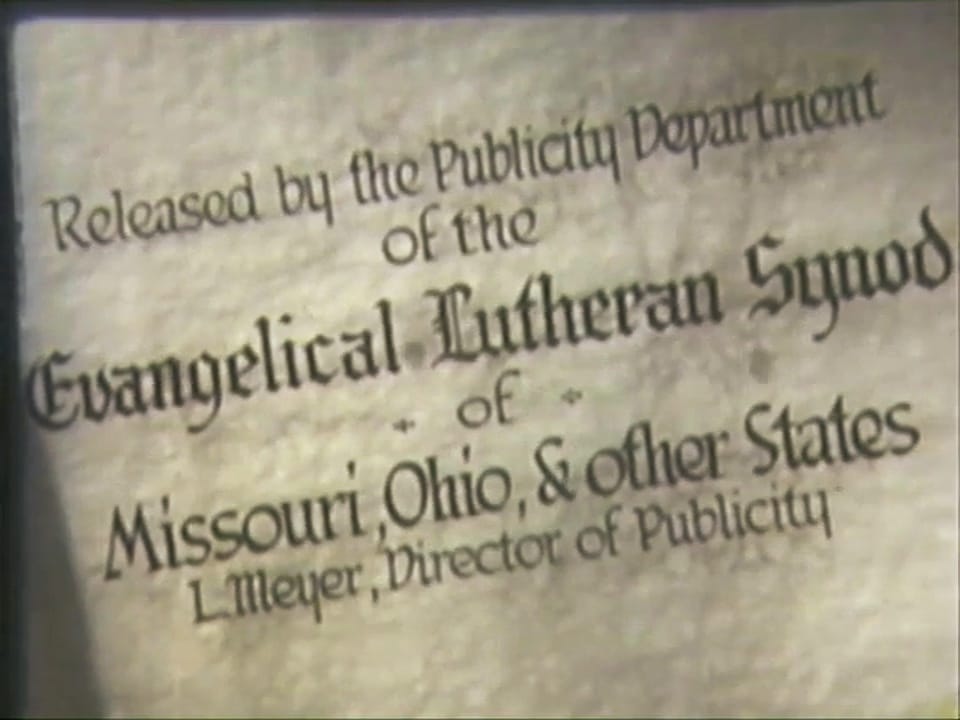
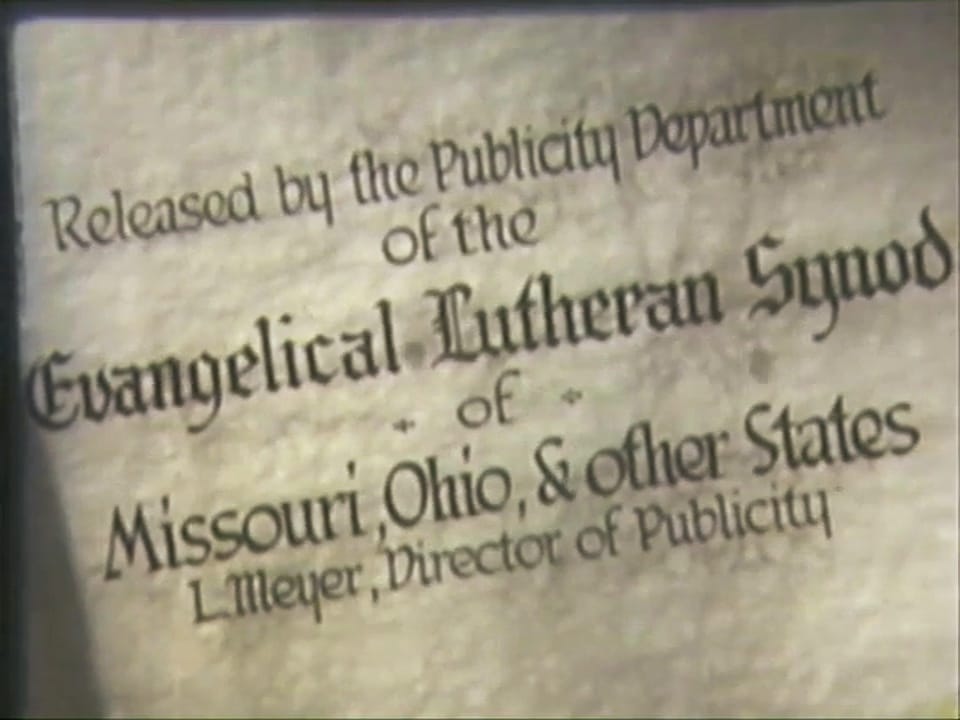
The film opens with a title card: “Released by the Publicity Department of the Evangelical Lutheran Synod of Missouri, Ohio, & other States. L. Meyer, Director of Publicity.” Lawrence Meyer, the reader will remember, was also the executive director of the Emergency Planning Council, the body that paid for and organized Bad Boll. The name on the credit card and the name that signed the Council’s reports to the Synod are the same name.
The story it tells is the Missouri Synod’s own founding story, the Saxon emigration of 1838 and 1839, staged with actors. It begins in a superintendent’s office in Saxony. A protest has come in from a congregation: the new hymnal has dropped “O Bleeding Head and Wounded,” as the film renders the hymn. The superintendent explains how he handles such letters. “I go through them very carefully, just. And then I file them, so.” A pastor baptizes a child “in the name of liberty, equality, and fraternity.” A layman who can no longer come to the Lord’s Table with a clear conscience is told, “You are too narrow about such things. If our church and its forms do not suit you, you can go elsewhere.”
Then the superintendent visits a young pastor who has preached that death came into the world through Adam’s sin. “That is what our Lutheran confessions teach,” the young man answers. “And to these I am pledged.” The superintendent corrects him: “You are pledged not to the words, but to the spirit of the confessions.” The young pastor is C. F. W. Walther.
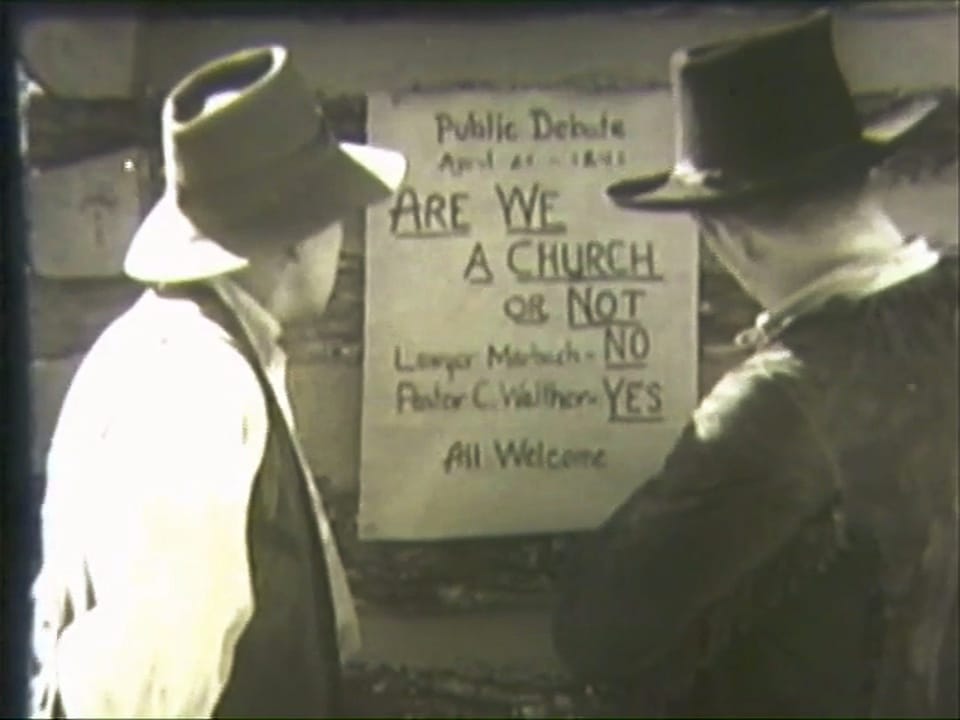
The rest follows the story as the Synod has always told it. Seven hundred people, five ships, Bremen to New Orleans in November 1838. The Amalia lost with everyone aboard. Perry County, the log-cabin college, sickness, hunger, and the question that nearly ended the colony: whether people who had left the church of their fathers were still a church at all. The camera lingers on a placard: “Public Debate, April 21, 1841. Are we a church or not. Lawyer Marbach, no. Pastor C. Walther, yes. All welcome.” Walther wins. The first issue of Der Lutheraner (The Lutheran) rolls off the press with its motto, “God’s Word and Luther’s doctrine pure shall to eternity endure,” and the narrator closes on a century of growth: “the past is prologue. It is the call of the cross.”
The room it was shown in
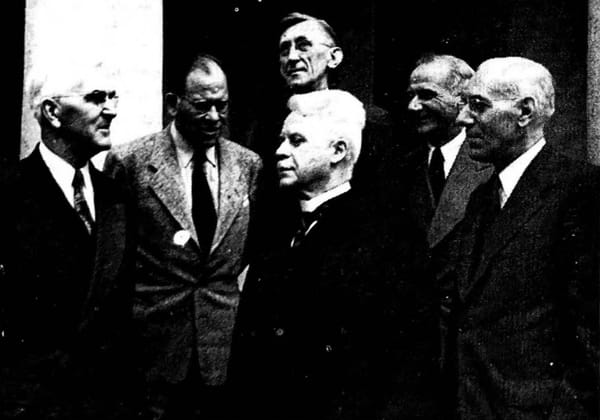
Now set the film in the room. The audience, on any given evening, was eighty to a hundred and twenty pastors and professors of the German territorial churches: Württemberg, Bavaria, Hannover, Saxony. A few were Free Churchmen and Old Lutherans, whose own churches had already left the territorial churches. They had spent the morning on the Augsburg Confession with an American and a German lecturer and the afternoon in discussion, and they had been told, and had believed, that this was an encounter between equals. After supper they watched a film in which a German territorial church is the villain, in which a superintendent who holds his pastors to “the spirit of the confessions” rather than the words is the man the faithful must flee, and in which the founders of the Missouri Synod are shown crossing an ocean to get away from him.
The film was not made for Bad Boll. The credit card uses the Synod’s old name, retired in 1947, and the narration counts “a century of growth” from the log-cabin college of 1839. It was made for the centennial of the Saxon immigration, for American congregations, and the Synod’s own convention records date it. “Call of the Cross” was the name of the whole centennial program. The 1938 convention in Saint Louis heard President Pfotenhauer thank a donor for a conference of District committeemen held “in connection with the Centennial Call of the Cross project in September, 1937” (1938 Proceedings, p. 10); its Board for Elementary Education reported serving “as advisory members of the Call of the Cross Centennial Committee” (p. 105); and the convention resolved that it “recognize the efficient work which has been done by the Centennial Call of the Cross Committee and that this committee be encouraged to continue its work” (p. 328). Three years later, at Fort Wayne, the 1941 convention thanked the Department of Publicity and Missionary Education, which “was eminently successful in producing The Call of the Cross, the sound film portraying Synod’s early history,” and on the strength of it asked the department to build a visual-education program (1941 Proceedings, pp. 155–56). The film was made, then, between the 1938 and 1941 conventions, under the centennial program and before the Synod’s first professionally produced feature, The Power of God, of 1941. By the time it reached Bad Boll it was nearly ten years old, and it was packed for Germany with the other three. It was also the first film shown. President Behnken’s published diary for Thursday, June 24, the first full day of the first series, records supper at a quarter past seven, devotions at eight (the printed program had put devotions after the films; on the first night, at least, they came first), and then: “At about 8:20 P.M. the first movie was shown, the film produced by our Synod at the time of the Saxon Immigration Centennial. This surely aroused much, very much interest among the German preachers. I had to answer all kinds of questions after the showing.” He does not say what the questions were. The documents do tell what the Synod said about the evenings to an audience outside the church. The Military Government, which had cleared the Americans’ travel, received a report that the participants were leaving with “a better understanding . . . of the Christian democratic principles upon which the political, social, and economic structure of the United States are founded,” and that the evening presentations on American church life showed the benefits of “joining the church by conviction rather than by being born into church.” Theology, the report said, “must be translated into life.”
What the Synod understood itself to be doing in those evening hours, and what it reported itself to be doing, were not the same document.
Two arguments after dark
The received story is that the evenings at Bad Boll were light relief, a way of showing the Germans what an American church body does with its money. The films of Bible schools and campuses were exactly that.
The fourth film was something else. It was not propaganda in Meiser’s sense. Nobody used it to recruit German pastors into the Missouri Synod. It was, rather, an argument, and a good one, delivered in the only form that reaches everybody in a room after a long day. By day the seminars re-examined the Augsburg Confession, article by article, in the hope of finding that Germans and Americans confessed the same faith. By night the screen supplied Missouri’s account of what happens to a church that subscribes that confession in spirit only. The two arguments were not contradictory. They were the same argument, made twice, once in the lecture hall and once in the dark, and the second one had a shipwreck in it.
Whether the Germans took it that way, none of them wrote down; Behnken’s questions after the showing went unrecorded. An Old Lutheran pastor, in Mayer’s collection of testimonies, wrote that German clergy had thought Missouri “a sect which is dominated by tradition,” and that the impression changed “in the first two or three days” of the conference. What changed it, he said, was what he heard in the lecture hall: “a living, vibrant orthodoxy based on a continuous restudy of the Scriptures and the Confessions.” His is the only verdict on record, and it credits the lecture hall. Whether the ships stayed with anyone longer, nobody wrote down.
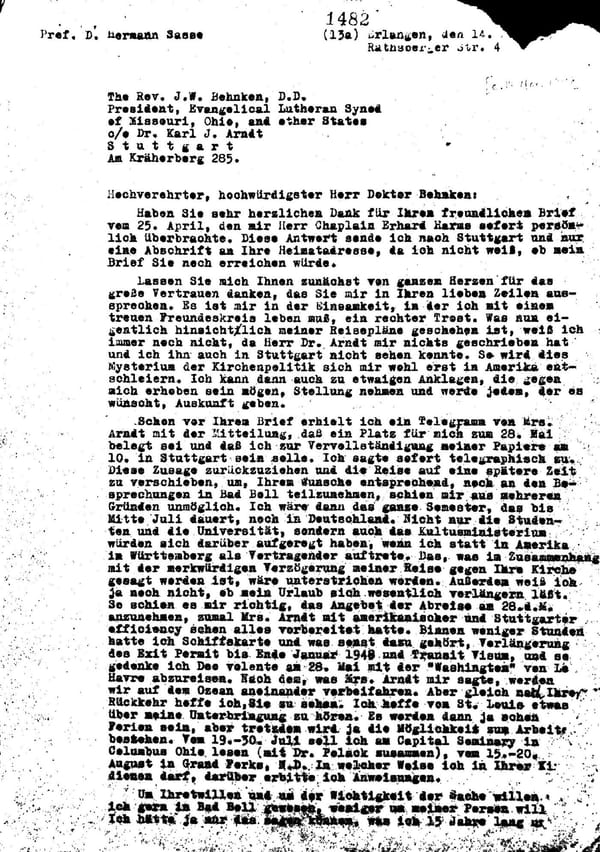
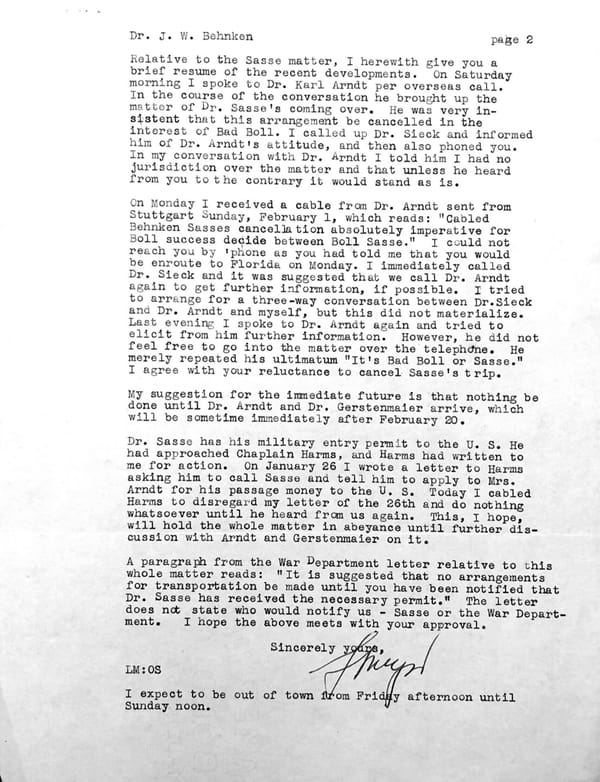
Next Thursday the series turns to the man who was not in the room. In May 1948 Hermann Sasse wrote President Behnken a letter naming the one question Bad Boll would have to face. He had been invited to Saint Louis to teach. He crossed the ocean that summer. He was not permitted to teach.
Sources and notes: The evening schedule and the four films are named in F. E. Mayer, The Story of Bad Boll: Building Theological Bridges (Saint Louis: Concordia Publishing House, 1949), 12; the printed German program of 1948, Concordia Historical Institute, schedules the Filmvorführung after supper. The film itself is The Call of the Cross (Publicity Department of the Evangelical Lutheran Synod of Missouri, Ohio, and Other States; associate producer Hardcastle Films, Saint Louis), preserved at Concordia Historical Institute; its lines are transcribed from a video copy of the print. The Centennial Call of the Cross Committee is recorded in the Proceedings of the Thirty-Seventh Regular Convention (Saint Louis, 1938), 10, 105, 328; the film’s production in the Proceedings of the Thirty-Eighth Regular Convention (Fort Wayne, 1941), Report of Committee 13, 155–56, and The Power of God in the 1944 Proceedings; all are readable page by page at chi-archive.collver.biz (LCMS Convention Proceedings, volumes 1938 and 1941). The report to the Military Government is “Meeting of American and German Lutheran Theologians at Bad Boll, Wuerttemberg, June 23 to July 25, 1948,” National Archives, RG 260, quoted in James Strassburg, “Reviving the Heartland,” Journal of the Lutheran Historical Conference 5 (2015): 77–78, 83. Behnken’s diary for June 24, 1948, is J. W. Behnken, “Dr. Behnken’s Letters, II,” Lutheran Witness 67 (10 August 1948): 255–56. Bishop Meiser’s request is recorded in Karl J. R. Arndt, “Missouri and Bad Boll, 1948,” Concordia Historical Institute Quarterly 52, no. 1 (1979): 4. The book treats the evenings in chapter 4.
Researched and written by Dr. Albert B. Collver III, from the archives behind the forthcoming book Bad Boll: Missouri at the Crossroads (Concordia Historical Institute). Corrections, recollections, and documents of your own are welcome at info@badbollbook.com.
© 2026 Albert B. Collver III · Thursdays at Bad Boll. Archival documents are reproduced by courtesy of the holding institutions, as credited; the research, text, and annotations are the author’s. Please cite or link rather than republish.