Decide Between Boll and Sasse
Decide is a Latin word about cutting: decidere, to cut off. In February 1948 a cable from Stuttgart demanded a cut — Bad Boll, or Hermann Sasse in Saint Louis. No document records the decision ever being made. The file simply goes cold, and that is the story.

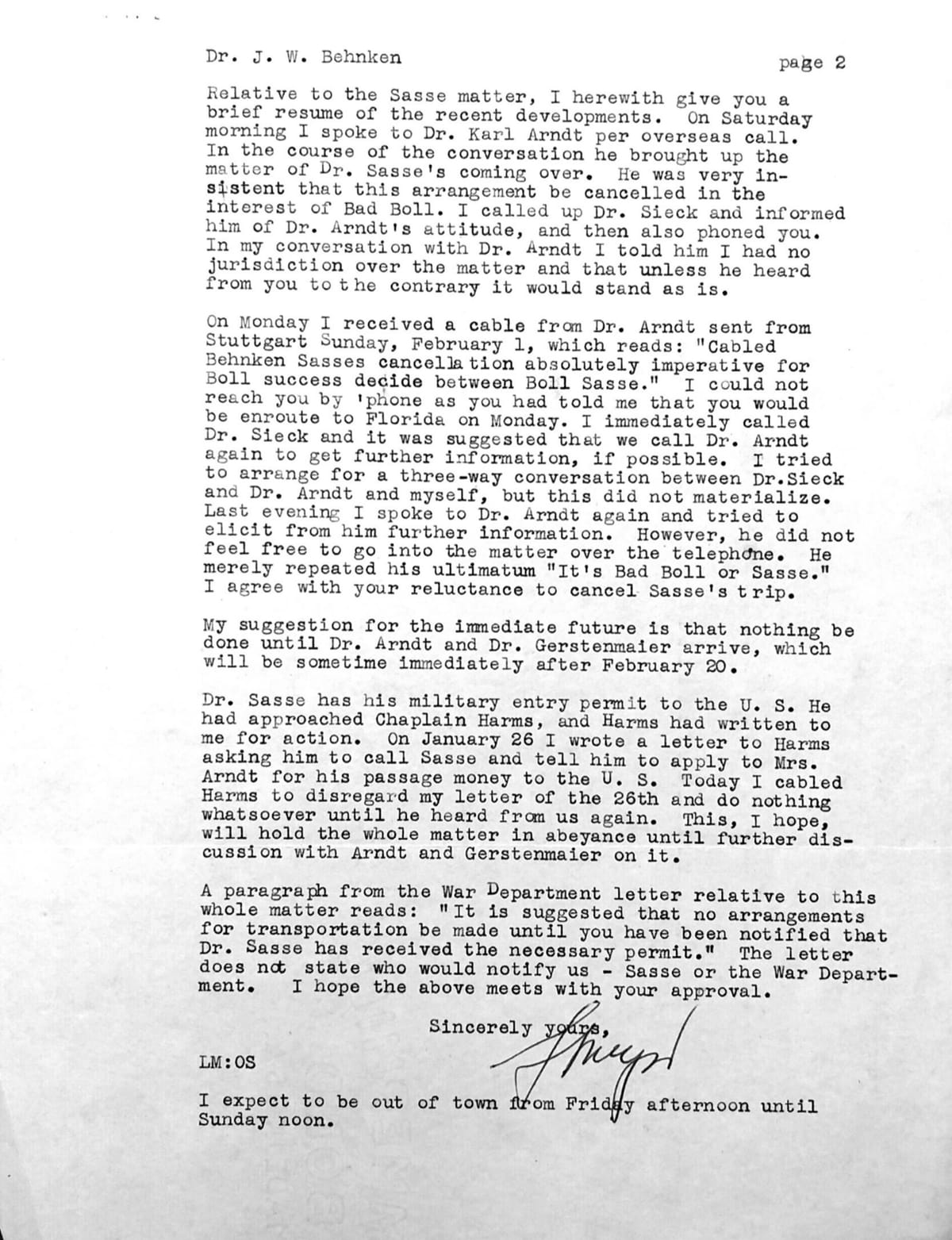
On the first Monday of February 1948, a cable reached Lawrence Meyer's desk in Saint Louis. It had been sent from Stuttgart the day before — Sunday, February 1 — and Meyer set its text down for the record in a letter two days later, exactly as the wire delivered it — its opening two words reporting a second cable Arndt had sent to President Behnken directly:
Cabled Behnken Sasses cancellation absolutely imperative for Boll success decide between Boll Sasse.
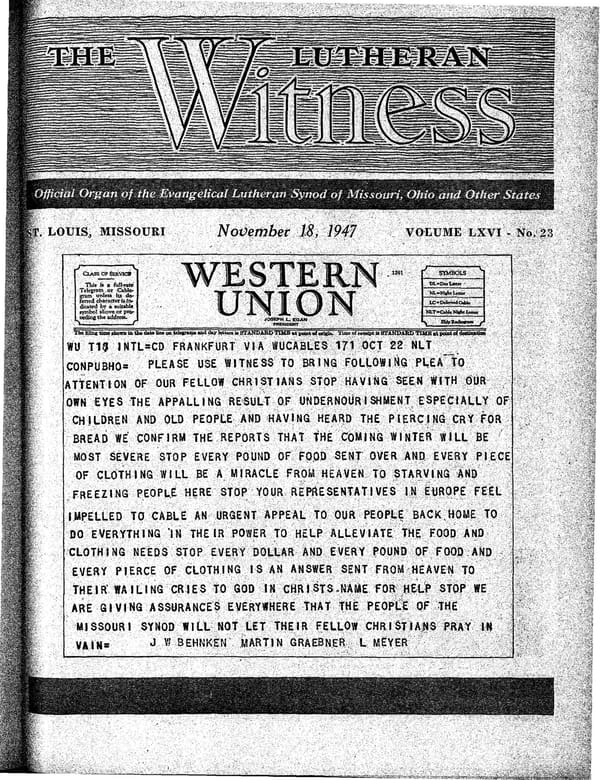
The sender was Dr. Karl Arndt, the reader's acquaintance of last week: host of the December living-room meeting, Chief of the Religious Affairs Branch of the Military Government for Württemberg-Baden, the Missouri Synod's indispensable friend inside the occupation. The name to be cancelled was Hermann Sasse of Erlangen — the professor whose parting word to the Missouri visitors of 1945 this series quoted two weeks ago, the one that was already in print by February 1946: "If American Lutheranism fails Germany, then Lutheranism in Germany is dead."
What the cable demanded to have cancelled was not a lecture. It was a life's turn. On December 12, 1947, the faculty of Concordia Seminary, over President Sieck's signature, had applied to the Civil Affairs Division of the Department of the Army to admit "Dr. Hermann Sasse of the University of Erlangen, Germany (American Zone), to serve as an exchange professor during the next semester." The application named his courses — theological trends in Europe in the nineteenth century, and the theological scene in Europe in the twentieth — guaranteed his expenses to twelve dollars per diem, and called him "one of the leading Lutheran theologians of Europe." By the end of January the arrangement was days from execution: Sasse held his military entry permit, and Meyer had written an army chaplain named Harms to call Sasse and tell him to apply to Mrs. Arndt — the same Mrs. Rosine Arndt of last week's guest list — for his passage money.
Then came the weekend.
The weekend, hour by hour
The letter in which Meyer relayed the cable to President Behnken — who was traveling, and had to be reached in care of a pastor's house in Orlando, Florida — reconstructs the whole sequence, and it is worth walking slowly, because this is as close as the record comes to the moment the enterprise chose.
On Saturday morning, January 31, Meyer and Arndt spoke by overseas telephone, and it was Arndt who raised the matter: "He was very insistent that this arrangement be cancelled in the interest of Bad Boll." Meyer answered like the committeeman he was: "I told him I had no jurisdiction over the matter and that unless he heard from you to the contrary it would stand as is." On Sunday, Arndt cabled. On Monday, Meyer — unable to reach the traveling Behnken by telephone — called President Sieck of the seminary, tried and failed to arrange a three-way call to Stuttgart, and finally got Arndt on the line again that evening. Arndt "did not feel free to go into the matter over the telephone. He merely repeated his ultimatum 'It's Bad Boll or Sasse.'"
Ultimatum is Meyer's own word for it, and it is the exactly right one: Latin for the last thing — the word after which there are no more words. On Tuesday Meyer typed his account for Behnken, and put his own position in one sentence that deserves to be remembered whenever this episode is told: "I agree with your reluctance to cancel Sasse's trip."
Nobody in Saint Louis, in other words, wanted to do it. Meyer's proposal was the committeeman's reflex once more — hold everything: "My suggestion for the immediate future is that nothing be done until Dr. Arndt and Dr. Gerstenmaier arrive, which will be sometime immediately after February 20." He had already acted on his own advice: "Today I cabled Harms to disregard my letter of the 26th and do nothing whatsoever until he heard from us again." And he quoted a paragraph from the War Department's own letter — "It is suggested that no arrangements for transportation be made until you have been notified that Dr. Sasse has received the necessary permit" — followed by a line of dry Saint Louis wit that the file has kept for seventy-eight years: "The letter does not state who would notify us - Sasse or the War Department."
Decidere
Decide is a Latin word about cutting. Decidere is de- plus caedere, to cut: to decide is to cut off — the same blade that lives in incision and concise. A decision, in the word's own logic, is the stroke that severs one future from another. The cable demanded exactly that: decide between Boll Sasse, four words with no room in them for both.
Here is the remarkable thing, and the reason this post exists: no one, so far as the record shows, ever made the cut. There is no document with Behnken's answer to the cable. There is no minute recording a vote, no letter of cancellation, no denial and no approval. The seminary's visa file, opened December 12, 1947, trails on through follow-ups until September 17, 1948, and then simply stops — no terminating act, nothing to quote, a docket gone cold. And yet the thing was cut. The professorship never happened. He never taught in Saint Louis. The reader who wants to know what became of him — and what the cancellation cost the Missouri Synod in the decades that followed — is asking the right question, and the book gives it a chapter; this series will come back to him more than once before Christmas.
Last week's post laid down a rule: trust the paper made at the time, and say plainly when the paper falls silent. This is what the rule looks like in practice. The temptation — every historian knows it, and every family genealogist too — is to write the missing sentence yourself: Behnken yielded, or the committee decided, or Arndt prevailed. The file supports none of them. What the file shows is an ultimatum, a reluctant president, a hold order — and an outcome. Institutions, like families, make some of their largest decisions this way: not by the stroke that cuts, but by the drift that buries. Anyone who has watched a project die of "abeyance" in their own congregation or company knows precisely how no one killed the Sasse professorship.
Filed under the wrong name
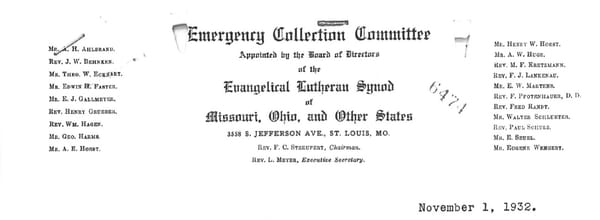
There is a coda, and it concerns the letter itself — the two typed pages reproduced here. The letter is unmistakably Lawrence Meyer's: it sits on Emergency Planning Council letterhead that carries his name as Executive Director, his dictation initials close it, and it opens — the reader of last week's post will smile — "Dear Praeses:", the executive director of an American church body addressing his own president by the old Latin title, the same one Petersen carried in Arndt's living room. F. E. Mayer, the Saint Louis professor, appears in the letter only in the third person — once as a member of the advisory committee, once among the proposed essayists.
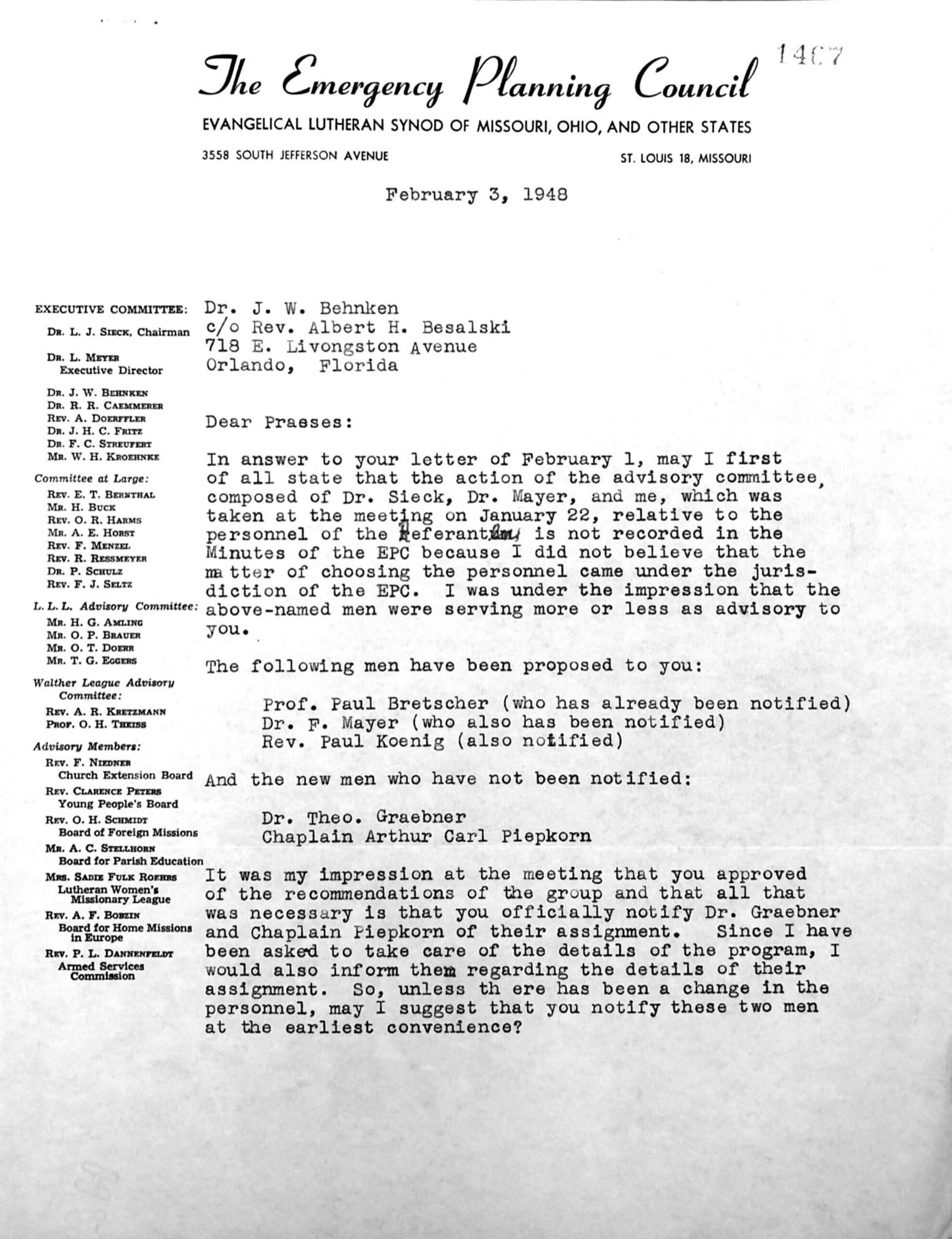
Yet in the archive the letter is filed under F. E. Mayer's name, and the error has propagated: as late as 2022 it was cited in print as Mayer's. One vowel separates Meyer from Mayer, and the reader has now met both men often enough to feel the difference — the executive who moved the money and the professor who wrote the theology. The misfiling is small, but it is a parable of the larger silence. The two standard accounts of Bad Boll do not mention Hermann Sasse at all — not in a roster, not in a footnote. A man can be cut out of a story twice: once by cable, and once by filing.
Why did Arndt judge Sasse fatal to Bad Boll? The documents do not say; the cable asserts and never argues. But a characterization published in 2025 is worth setting beside it. Hermann Ehmer's history of the Württemberg church, describing Arndt's years at Religious Affairs, says of him: Er begegnete der Kirchenleitung durchweg mit Sympathie — he encountered the church leadership, throughout, with sympathy. The verb is begegnen; the reader learned it last Thursday. Arndt was the territorial bishops' friend and the man they went to — that was precisely what made him valuable — and Sasse, in those very weeks, was the territorial churches' most unsparing confessional critic, a man whose standing with his own bishop was already strained. A characterization is not a document, and the book is careful to keep the two apart. But it is consistent with everything the file does show: the man who guarded the bishops' goodwill judged that the Begegnung could not survive the presence of their sharpest dissenter in Missouri's own seminary.
Next Thursday the waiting ends. The ships have sailed, the invitations have come back, and on a June evening in 1948, in a converted spa in the Swabian hills, the encounter itself finally begins.
Sources and notes: The lead document is Lawrence Meyer to J. W. Behnken, February 3, 1948, Concordia Historical Institute — on Emergency Planning Council letterhead and over Meyer’s signature, though filed, and cited as late as the 2022 publication of Sasse’s Open Letter, under F. E. Mayer’s name; all quotations from it, including Arndt’s cable of February 1, 1948 as there relayed, follow the page images. The Concordia Seminary visa application is Louis J. Sieck to Chief, Civil Affairs Division, Department of the Army, December 12, 1947, Concordia Historical Institute; its docket runs to September 17, 1948 with no denial, approval, or cancellation located. Sasse’s 1946 sentence is J. Behnken and L. Meyer, “Europe Cries, ‘Help!’” Lutheran Witness 65 (1946). Hermann Ehmer’s sentence on Karl Arndt is from his Württembergische Kirchengeschichte: Von der Christianisierung bis zur Gegenwart (Stuttgart: Calwer Verlag, 2025), 698, and is quoted as a historian’s characterization, not a contemporary document. The book treats the episode in chapters 3 and 5.
Researched and written by Dr. Albert B. Collver III, from the archives behind the forthcoming book Bad Boll: Missouri at the Crossroads (Concordia Historical Institute). Corrections, recollections, and documents of your own are welcome at info@badbollbook.com.
© 2026 Albert B. Collver III · Thursdays at Bad Boll. Archival documents are reproduced by courtesy of the holding institutions, as credited; the research, text, and annotations are the author’s. Please cite or link rather than republish.