“It Is Written”
Write comes from an Old English word about scratching: writan, to cut a mark into wood or stone. The Greek gegraptai, “it is written,” began the same way. In 1954 the fullest summer of the conferences ran under those words, six conferences in seven weeks, and ended with nine questions still open.

The theme of the seventh summer is three words long, and every word in it is older than the enterprise, older than the Synod, older than the language it was announced in. Es steht geschrieben, “It is written,” is the formula with which the tempted Christ three times answered the devil in the wilderness. Beneath the German and the English stands one Greek verb, gegraptai, a perfect tense whose force English needs a whole clause to carry: it stands written, and it remains standing.
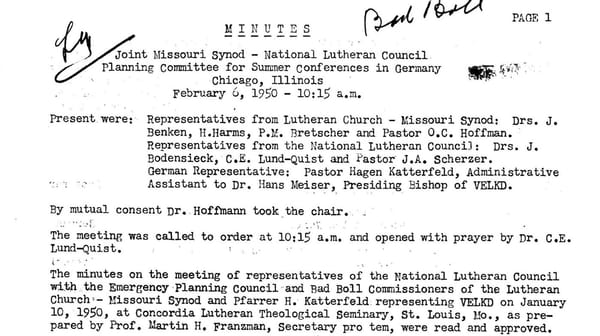
A church that had spent six summers being asked, in every register from academic courtesy to open exasperation, what exactly it meant by calling the Scriptures the Word of God could hardly have chosen a plainer banner for the seventh. It appears the church did not choose it alone. The German church wire was already reporting the conference theme as Es steht geschrieben in July; seven weeks after the last session of 1954 closed, Pastor Hagen Katterfeld, whose Munich office had handled the German side of the programs for most of the conference years, published his own report under the same three words. In 1954 the enterprise and its German secretary were at last writing under one title.
Writan
Write comes from an Old English word about scratching. Writan meant to cut or score a mark into something, wood or stone or bark, and its German cousin reißen still means to tear. The Greek went the same way: graphein, to write, began as scratching a line, and a graphe was the mark left behind. In both languages the oldest sense of writing is a cut that stays. That is what gegraptai carries and what a perfect tense is for. Something was done once, and its result is still here. The seventh summer was seven weeks of two churches asking each other what it means that the cut is still here.
Six conferences, four soils
The six commissioners of 1954 were half new. Bretscher, Harms, and Naumann of Springfield were veterans. Fred Kramer of Springfield, Pastor Alfred Trinklein of New York, brought to show the Europeans an American parish at work, and Professor Alfred von Rohr Sauer of the Saint Louis faculty were making the circuit for the first time, and Sauer kept, from the first airport to the last, a day-by-day typescript diary. It is the book’s principal witness for the year, and the change of narrator matters for a reason the middle of this post must record. F. E. Mayer, whose Story of Bad Boll carried the first conferences to the Synod, was not aboard the plane.
London came first, from June 29, at the Lutheran Church House in Collingham Gardens. On arrival the commissioners telephoned Pastor Norman Nagel of Luther-Tyndale Memorial Church, Kentish Town, for the details of the program; readers of this series met him in August, in the post on the shining star of materialism, and know who he was and who he would become. Kramer led a Bible study on the Tower of Babel, “because of the many displaced people at the conference this selection was very appropriate,” and the study divided into five language groups, German, English, Polish, Lithuanian, and Latvian. Naumann read on “God Has Spoken Through Man in the Holy Scriptures,” and the fault line showed at once: “The Polish and Baltic pastors seemed to be quite sympathetic toward our view of inspiration, but the men from Germany who were trained at the universities have difficulty reconciling their critical approach to the Bible with our viewpoint.”
Bad Boll opened on July 7: eighty pastors, four discussion groups, two essays a morning, as a rule one American and one German. Sauer stated the shape of the whole argument in a sentence this series has been approaching since October: “Two lines of arguments are usually followed: first, the Missouri Synod paper is questioned because of the narrow stand which it takes on verbal inspiration. Secondly, the German paper is debated from the viewpoint of dialectic theology by students of Barth and Bultmann and Ebert.” The sessions file past in his pages like depositions. Professor Wittenberg of Neuendettelsau, an ally by the measure of most of these years, drew one line: “We were all quite shocked at Wittenberg’s willingness to admit errors in Scriptures.” In the group sessions Sauer pressed Adolf Koeberle, essayist of the first Bad Boll and this one, on an analogy both men accepted, that Scripture wears humble human form as Christ wore a servant’s. If it holds, Sauer argued, it holds at the decisive point: the Christ who assumed our weakness was without sin, and the Scripture that assumes human speech is without error. Koeberle would carry the analogy as far as weakness and no further. Sauer’s last word in his own pages was “I still maintain that the analogy implies the infallibility of Scripture in the strict sense,” an American commissioner ending the argument where he began it, which is, in miniature, the history of the whole series.
Even the entertainment argued. At the Geselliger Abend, the convivial evening the hosts arranged, a skit “that pictured each of the Missouri Synod delegates as an animal in the Zoo got a real rise from the group.” Sauer’s verdict tells the temperature of the seventh year: “Our men sensed that the talk bristled with subtle barbs pointed at our theology, but I thought that for the most part the skit was done fairly and on the level.” Six years earlier the two sides had circled each other with formal addresses. Now they knew each other well enough to tease.
Berlin, and a death
On July 15 the delegation flew to Berlin. The conference the 1953 rising had cancelled met again at the Johannesstift in Spandau, under the same German hands, and the theological weather had not softened. On the first morning Dr. Walter Dress of the University of Berlin read on “God Has Spoken in the Holy Scripture,” Naumann followed with the Missouri paper, and the session ran straight into plenary debate: “the opposite views of Scripture proposed by Dress and Naumann immediately called forth a wave of sharp challenges from the German brethren. The chairman, Dr. Kimme, tried to present a compromise at the close of the session, but I think both sides felt that the differences between us were insurmountable.” Insurmountable is a strong word in a diary otherwise disposed to hope.
But the Berlin week’s deepest impressions were not doctrinal. The pastors of the East Zone were present again, and Sauer set down their testimony: no youth work permitted, scholarly publication smothered under pretexts of paper shortage, and, most quietly devastating, the home front of the catechism: “Children are being trained to split their personalities between Christianity — which they learn at home — and Communism which is drilled into them in school.” His summary was one sentence: “The brethren in the East Zone are a heroic lot.”
The closing sermon at Spandau was Katterfeld’s, and Sauer’s note on it carries the year’s heaviest sentence in a subordinate clause: “In his remarks he also referred to the death of Professor Fred Mayer who played such a prominent role in the first European Conferences.” Frederick Emanuel Mayer had died on July 20, 1954, while the delegation sat in Berlin, two days before a German pastor, preaching to German pastors, told the conference what it had lost. He was sixty-one. Cancer of the spine had first attacked him in 1949; through five years of it he finished The Religious Bodies of America, taught, when he could, from a wheelchair, and kept his post at the Concordia Theological Monthly, as his colleague William Arndt wrote in the memorial, “from 1940 to the day when he joined the saints in glory.” Arndt closed on the sentence that could stand over Mayer’s whole public career: “In his contacts abroad he loyally stated and defended the position of The Lutheran Church — Missouri Synod, which both here and abroad altogether too often is misunderstood, caricatured, and maligned.” Readers of this series have been hearing Mayer’s voice since the first conference. From here the record speaks through other men.
Strasbourg and Gothenburg
The circuit went on, because circuits do. At Oberursel the commissioners met the three German Free Churches and, for once, an audience that largely agreed: “This one was much more peaceful and cordial than the second and third,” Sauer wrote, “because we met with people who share the same theology which we do.” At Strasbourg, in a rented labor-union hall called the House of the Artisans, some thirty pastors met from August 4 under President Kreiss, who interpreted throughout, and Dr. Theo Süss of Paris read on inspiration. Sauer’s account of the hour states the European settlement more compactly than any other document in the book: “During the first hour I thought he agreed exactly with our Missouri position. He quoted freely from Pieper’s Dogmatics. Then, however, he had to come to the point of mistakes in Scripture and here he took the same viewpoint which the other Europeans took: Sure there are mistakes.” An hour of Pieper, and then the reservation. The sentence is the seventh summer in a single line.
The last leg was one the enterprise had never attempted. On August 9 the delegation flew to Gothenburg, where Bishop Bo Giertz met them at the airport and the next morning “welcomed the 21 participants to the conference: 11 Swedes; 2 Norsemen; 2 Danes; 6 Americans, and invited them to sit at the conference table.” It was the first and only Scandinavian conference of the series, held in the parish house of the bishop’s own cathedral, around a table small enough for real conversation, and it produced the year’s frankest exchanges. When the evening discussion reached the infallibility of Scripture, Naumann argued that a right doctrine of inspiration is necessary for sound pastoral work, and the Danish pastor Richard Fangel “slapped his knee... and said, ‘That beats everything! That means that we Danes are not really pastors!’”
The bishop closed with twelve theses, “Under the Word,” and two of them mark where the most confessionally serious of the Scandinavians stood: “A particular doctrine of Inspiration is not to be found in the Scripture. If man is under the Word, such a doctrine is not necessary. If man is not under the Word, such a doctrine will be without benefit, even though it be acknowledged in theory”; and, “The Bible is more like a work of art (painting) than a set of minutes or the proceedings of a meeting.” Yet the same table, in the same closing session, produced the plainest European affirmation of Missouri’s position recorded anywhere in the seven years. Professor Hugo Odeberg of Lund said: “Es gibt im Neuen Testament eine eindringliche Lehre von der Verbalinspiration,” there is in the New Testament an insistent doctrine of verbal inspiration. The dissent and the affirmation sat across one table on one morning. Any account of what Europe thought of Missouri’s doctrine in 1954 must hold both.
Nine questions
What had the seven weeks settled? The German side answered in print, within weeks, and its answer is the document this post’s title comes from. Katterfeld’s “Es steht geschrieben” is the enterprise’s own self-audit. He sets the two questions against each other as the conferences had heard them for seven years. The Germans asked Missouri: “Are you not Fundamentalists, who teach a mechanical interpretation of the Bible, a magical evaluation of the Bible, a ‘fourth God’ next to the Trinity, a ‘paper Pope’? And where does the Missouri Synod find the right to make this special doctrine the criterion for joining or not joining with other churches?” The “paper Pope” was an old jibe; Franz Pieper had recorded it in Missouri’s own dogmatics thirty years before and answered it there. Missouri asked the Germans: “Is Scripture really God’s Word for you, or do you first use reason... to cull from this very human Bible-book that which can surely be designated as God’s Word?”
Katterfeld, no partisan of the Missouri doctrine, recorded movement: the prejudices began to disappear, he wrote, when the Missouri Synod expressly distinguished its position from Fundamentalism. And in the same report he set down, in a parenthesis, the concession that runs beneath the rest of the book: “(Of course, the question of verbal inspiration being determinative for church fellowship was never satisfactorily answered by Missouri for the Germans.)”
Then he listed what seven years had not settled. Nine points, in his own numbering: the problem of theopneusty, the God-breathedness of Scripture, in terms of Law and Gospel; whether Holy Writ has a doctrine about itself; whether the Word of God is to be equated with Holy Writ, or is different; how far harmonization and differentiation are justifiable; whether biblical criticism eases or endangers the approach to Scripture; the difference between the Bible’s world-view and ours; an approach to the problem of inerrancy; the evaluation of Holy Writ extra usum, apart from its use; and whether Luther teaches verbal inspiration. The book says the list should be read twice, once as an agenda and once as an audit. Every question on it had been opened at Bad Boll by 1949. Every question on it was still open in 1954. And the reader who carries the list forward twenty years will meet every item again, at Saint Louis, in a quarrel this series reaches in December. The nine questions are the enterprise’s most precise legacy: not a settlement, but a syllabus.
Why the questions would not close, Bretscher explained in the sharpest single formulation that survives. “The fundamental difference is the relation of Christology to Scripture.... It became evident that the Germans proceed from Christology to Scripture (‘was Christum treibet’),” what urges Christ, Luther’s touchstone. For them, “whatever in Scripture has no direct bearing on Christ, is of secondary, if of any, import.” The six days of creation are “a theological opinion of the sacred writer”; “the fall is true, but the story of the fall is a myth.” Bretscher asked them how they got that way. “I was told, ‘Through Luther and the Aufklärung (rationalism).’” Two ways of holding the same Bible, each claiming Luther. The conferences did not create the difference; they made it precise, and a difference stated precisely can be worked on, where a difference felt vaguely can only be feared.
Closing a ledger
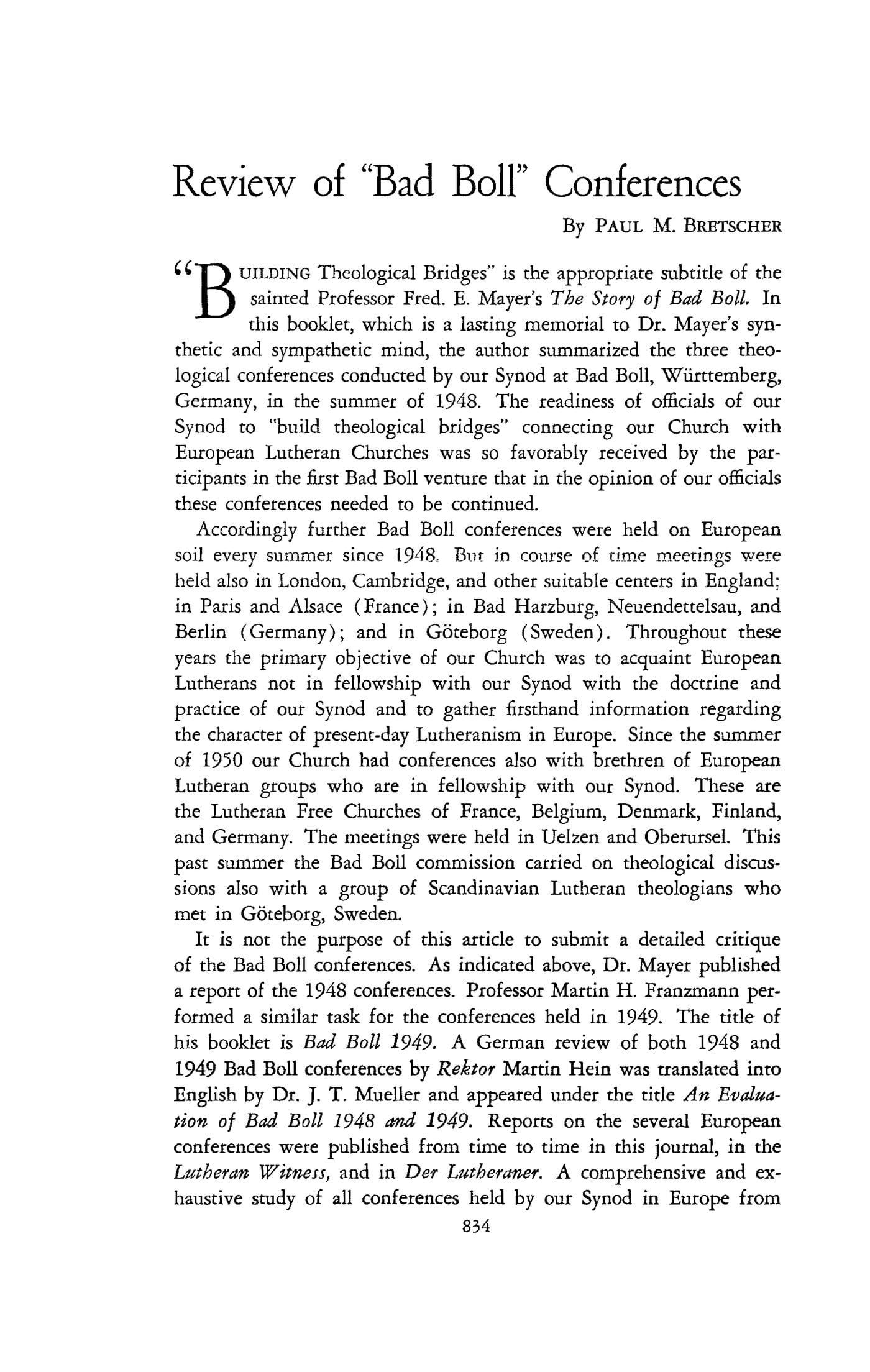
In November Bretscher published the only account ever written from inside the enterprise that surveys all seven summers: the themes year by year, the bishops, some seventy European essayists, and the sum, “about 1,800 members of the Lutheran clergy in Europe attended one or more Bad Boll conferences.” His verdict is the settled sentence of a careful accountant: “it must be said with thanks to the Lord of the Church that our Synod accomplished what it set out to do when it planned and arranged these conferences.” He did not say the work was finished. He said the Synod had done what it set out to do. Those are different claims, and the difference is where the seven summers end.
In December the commissioners met to plan an eighth, and resolved to find the money to mail an essay by Roehrs, “Das Wort im Wort,” the Word in the Word, to fifteen thousand Lutheran pastors in Germany. The enterprise ended its fullest year still doing, at scale, the one thing it had always done. What became of the eighth summer, and what the money reveals at the last, is a post for December. Next Thursday, for Thanksgiving, something shorter and warmer: before Bad Boll was a theological enterprise, it was food.
Sources and notes: The 1954 circuit follows Alfred von Rohr Sauer’s typescript travel diary, Concordia Historical Institute, from which all the diary quotations are taken. The theme and its subthemes are from Paul M. Bretscher, “Review of ‘Bad Boll’ Conferences,” Concordia Theological Monthly 25, no. 11 (November 1954): 836, which also supplies the 1,800 figure and the closing verdict. Katterfeld’s report is Hagen Katterfeld, “Es steht geschrieben,” Evangelisch-Lutherische Kirchenzeitung (1 October 1954): 295–97, quoted in the translation preserved in Hans Spalteholz, “The Bad Boll Enterprise, 1948–1954” (B.D. thesis, Concordia Seminary, 1955). Mayer’s death and career are from William F. Arndt’s memorial, Concordia Theological Monthly 25, no. 9 (September 1954): 641–46; Odeberg’s sentence is as Bretscher reported it. Bretscher’s Christology-to-Scripture passage is quoted in Spalteholz, 27; the commissioners’ minutes of December 10, 1954, are at CHI. The book treats 1954 in chapter 8.
Researched and written by Dr. Albert B. Collver III, from the archives behind the forthcoming book Bad Boll: Missouri at the Crossroads (Concordia Historical Institute). Corrections, recollections, and documents of your own are welcome at info@badbollbook.com.
© 2026 Albert B. Collver III · Thursdays at Bad Boll. Archival documents are reproduced by courtesy of the holding institutions, as credited; the research, text, and annotations are the author’s. Please cite or link rather than republish.