The Professorship That Never Came
Professor comes from a Latin word about speaking in public: profiteri, the same root as confess. In May 1948 Hermann Sasse wrote President Behnken six pages on what Bad Boll would face. He crossed the ocean that summer as Missouri’s guest. The faculty that invited him to teach did not let him teach.

On June 5, 1948, the day after Concordia Seminary’s commencement, Hermann Sasse of Erlangen arrived in Saint Louis. He had come at the seminary’s invitation. Six months earlier its faculty had applied to the Department of the Army to bring him over as an exchange professor, naming his two courses, guaranteeing his expenses to twelve dollars a day, and calling him “one of the leading Lutheran theologians of Europe.” Five of the Missouri Synod’s delegates to Bad Boll had sailed from New York three days before. The two parties, as Mrs. Arndt had told him they would, passed one another on the ocean.
He stayed four months and sailed home on October 8. In those four months, by his own later account, “The Faculty of St. Louis prevented my lecturing before their students.” He was given more lecture time that summer by the Wisconsin Synod, at Thiensville, and at the Capital Seminary summer school in Columbus, than by the church whose guest he was. From Saint Louis in September he called the stay “a chain of humiliations and deliberate unkindnesses,” and he named the men he held responsible.
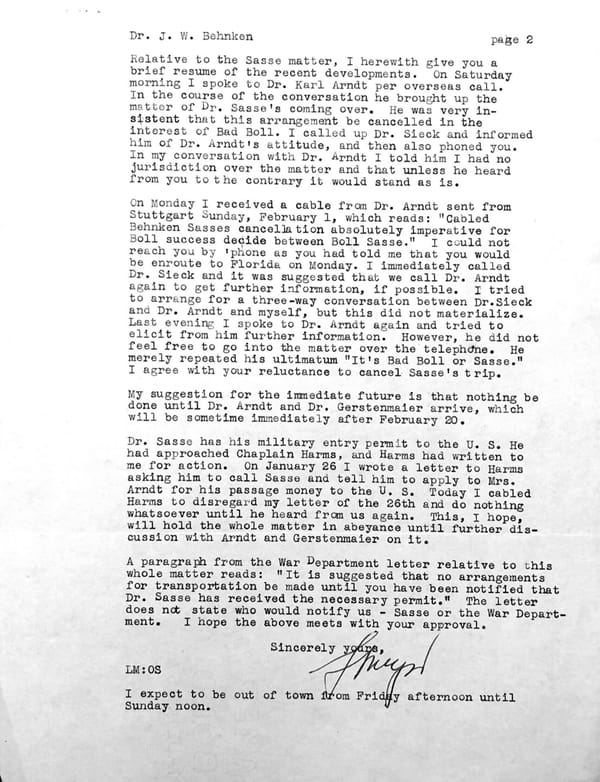
This series told, four weeks ago, how the professorship was traded away: the cable of February 1, “decide between Boll Sasse,” and the file that goes cold without a decision. That was the story from the planning side. This is the story from Sasse’s side, and the book gives it a chapter, because the two standard accounts of Bad Boll, Mayer’s of 1949 and Spalteholz’s of 1955, do not mention him at all. Not in a roster, not in a footnote, not once.
Profiteri
Professor comes from a Latin word about speaking in public. Profiteri is pro-, forth, plus fateri, to acknowledge, the same verb that gave the reader confiteri, to confess, two weeks ago. To profess is to declare something openly, before witnesses, and to be held to it. In classical Latin a professor was already a public teacher, a man who declared openly what art he taught; the Church used the same verb for the religious who professed vows and for the Christian who owned the faith in public. The Augsburg Confession is a confessio; the men who taught it in the universities were professores. The two words are the same act, one made by a church and the other by a man.
Sasse was a professor in both senses, and in 1948 the second sense cost him the first.
The letter of February 11
Ten days after Arndt’s cable, and, so far as his letter shows, knowing nothing of it, Sasse wrote to Behnken from Erlangen. He enclosed a copy of a letter to his own bishop, Hans Meiser of Bavaria. The Erlangen theological faculty, the historic training ground of confessional Lutheranism in Germany, had voted to call Ethelbert Stauffer to its chair of New Testament, over Sasse’s dissenting vote. Stauffer was a former Mennonite and, in Sasse’s judgment, a firm supporter of the Reformed doctrine of the sacraments. “You understand,” Sasse told Behnken, “that for me, this is the status confessionis.”
The phrase is a term of art. It names a situation in which the confession itself is at stake, so that what would ordinarily be a matter of indifference, a faculty appointment, becomes a matter of standing or falling. A Lutheran faculty that could no longer tell Lutheran from Reformed teaching in the chair that taught the New Testament had, in Sasse’s judgment, surrendered the thing it existed to guard. Behnken circulated both letters to President Sieck and the seminary leadership in March. No rescue followed.
Saint Louis had set down its own reasons three months before the cable. In October 1947, when a faculty committee weighed Behnken’s request to invite Sasse, a committee of three, President Sieck with Professors Polack and F. E. Mayer, listed among its “doubts about the man”: “invitation construed as taking sides” and “his role in Bavarian Church; confer with Bishop Meiser.” The faculty asked Behnken not to press the invitation “especially not until you personally have had opportunity to confer with the Bavarian Church authorities.” The invitation went out anyway. But the doubts were on paper, and they pointed to the bishops, and by February the bishops’ friend in Stuttgart was on the telephone.
The letter of May 14
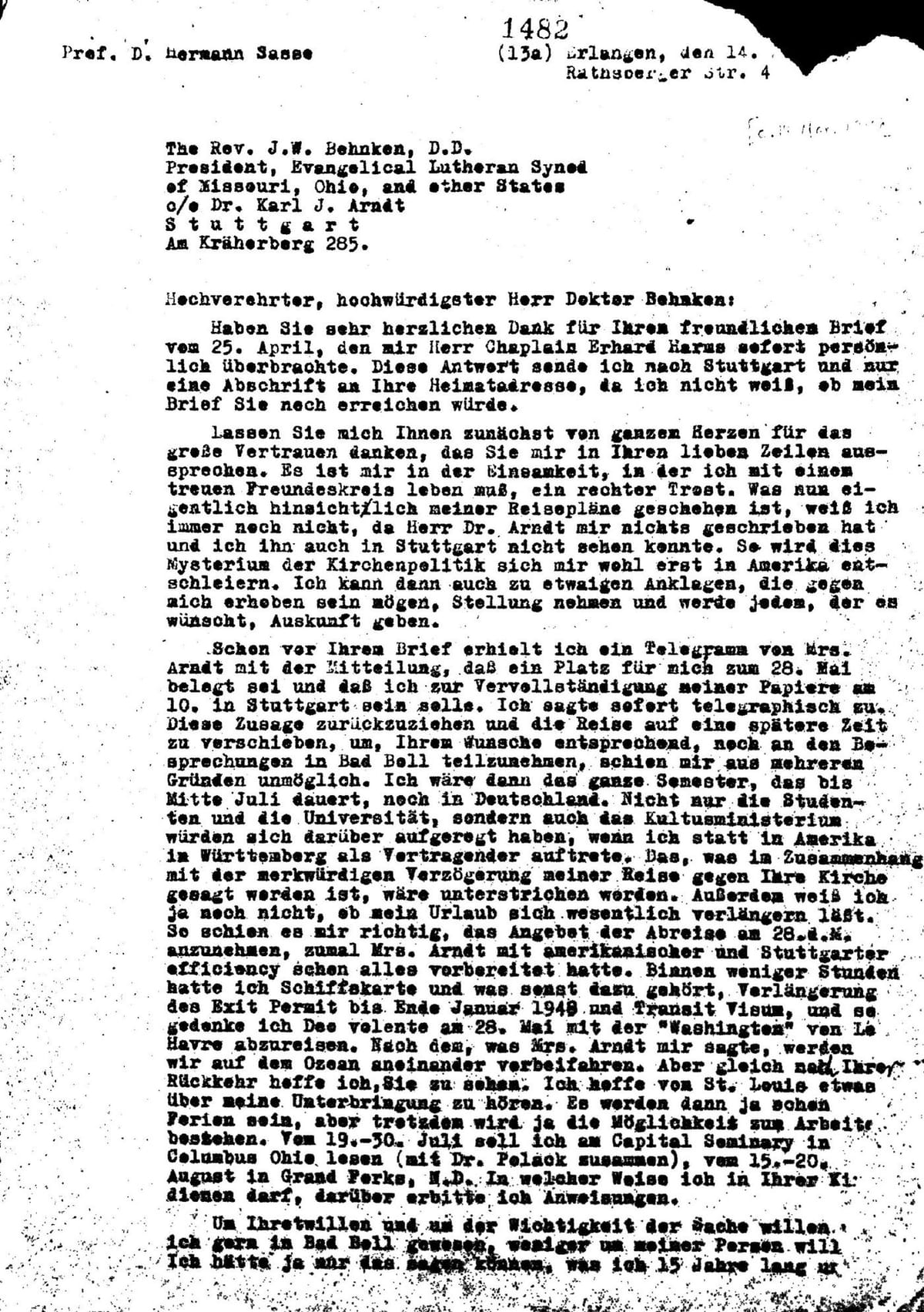
Then, on May 14, 1948, five weeks before the first seminar opened, Sasse wrote Behnken the fullest theological document in the whole Bad Boll correspondence. It runs to six close-typed pages. It was unknown to scholarship until it turned up in the Behnken files in the course of the research for this book, and it was first printed, in translation, in 2020. It is printed whole in the book’s Appendix A. What follows is the shape of it.
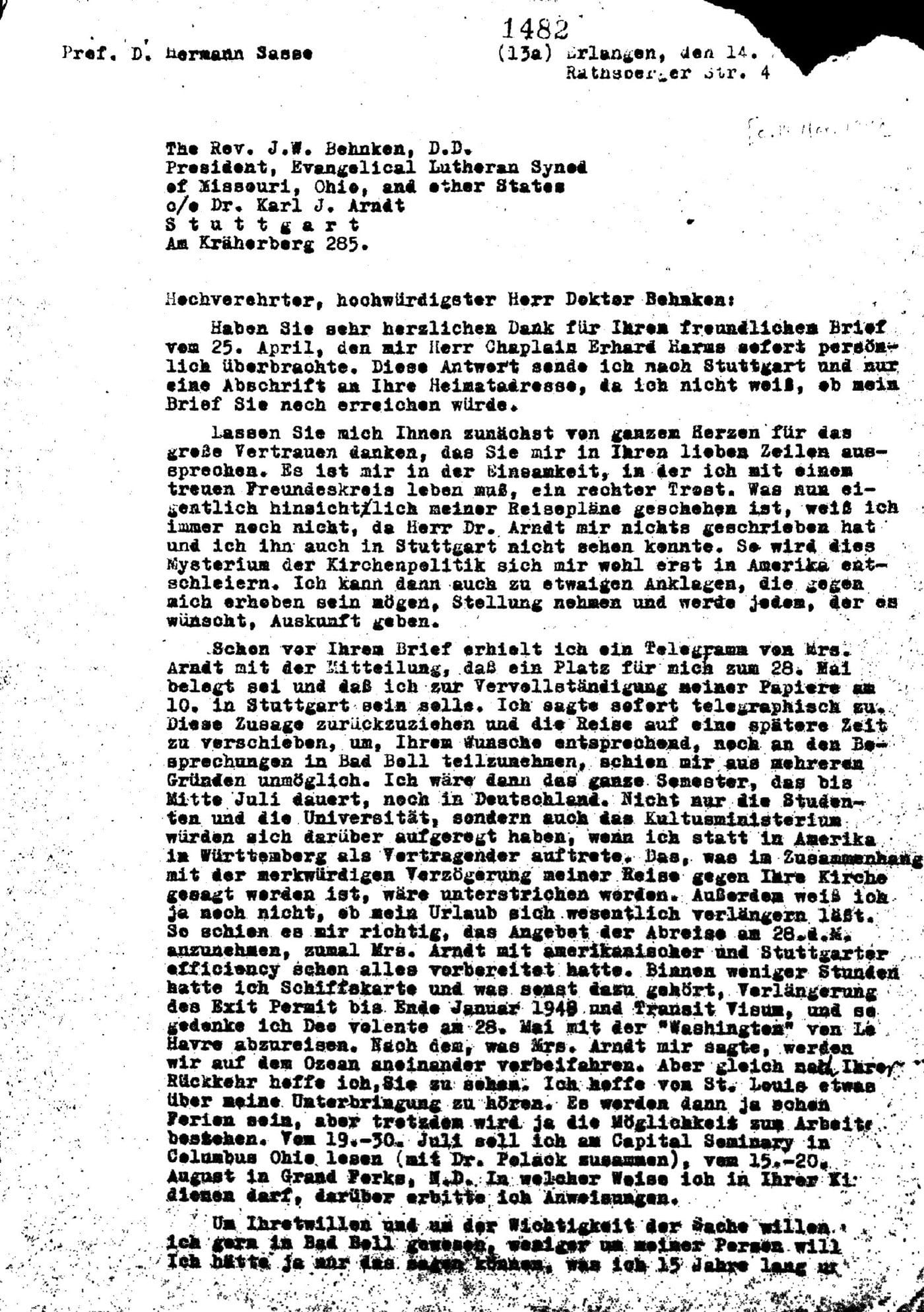
The page image shows the salutation in German, Hochverehrter, hochwürdigster Herr Doktor Behnken, “Most revered, most worthy, Doctor Behnken,” and, further down the page, an English word in the German text: Mrs. Arndt, Sasse writes, had prepared everything “with efficiency befitting both an American and one from Stuttgart.” Within a few hours he had a ticket on the Washington out of Le Havre for May 28, an exit permit extended to January 1949, and a transit visa. He would not be at Bad Boll. He had been asked to postpone his trip and attend, and he explains why he could not: he would then be in Germany for the whole semester, and “Not only the students and the university, but also the Ministry of Culture, would be upset if I were to appear in Württemberg instead of America per my agreement.” He still did not know what had become of his travel plans, or why. “This mystery of church politics,” he wrote, “will only be unveiled to me in America.”
Then he gives Behnken, “as a contribution to the discussion, so to speak,” what he had been saying for fifteen years to bishops, theologians, and church officials, “in more than a thousand printed pages.”
His first point was historical, and bleak. No theological discussion could stop what had been moving for two hundred and fifty years in the German territorial churches, “and whose logical end is general unionism.” The theologians had taught the people that Lutheran and Reformed were names for schools of thought inside one Protestant church, and the people had learned it. Worse, the theologians had learned “the great art of hiding our true thoughts behind our words”: confessing the virgin birth from the pulpit and dismissing it as mythology in private, teaching Luther’s catechism on the Lord’s Supper in a Zwinglian sense. “Who still blushes at that?” From that habit, he said, it followed that nobody was offended when something was called a church that was not one.
Another point was about the Free Churches, the small confessional bodies that had left the territorial churches over the last century. He asked Behnken not to be impressed by size: “Make sure, esteemed Doctor Behnken, that your American Lutherans get a little more respect and do not fall for the myth of large numbers.” A body like the Old Lutheran Church, he argued, mattered more than the territorial churches of Schleswig-Holstein or Hamburg. The Free Churches would have to remain “the conscience of Lutheranism in Germany, even if the EKiD now devours everything” (the EKiD being the new federation of the German territorial churches).
His third point, and the one Behnken would have felt most, came first in the letter. Sasse warned the Americans against “letting themselves be further impressed by the erudition of our German theology,” and he told Behnken how to conduct the seminars:
Please, esteemed President, spare the German churchmen and theologians nothing. It is a work of mercy when you call us down from the lecturer’s desks and consistorial conference tables that hover above the clouds to the reality of the congregation where the Church actually lives, if it is there at all.
Ask the Germans, he said, how they say their theology to a congregation, and whether they have a congregation that can judge doctrine at all. And when the Germans smile at “the ‘simplicity’ of Missourian theology, which is so much talked about,” answer them with Tertullian: our instruction comes from the porch of Solomon, who taught that the Lord should be sought in simplicity of heart. “Here lies the strength of your synod.”
The only serious obstacle
His fourth point was the one this series has been following since September. Sasse named, before anyone on either side had, the question underneath every other question at Bad Boll, “which also constitutes the last, and indeed the only, serious obstacle to Free-Church agreement: the question of verbal inspiration.”
His own position on it was neither the Germans’ nor, quite, Missouri’s. That the whole of Scripture is inspired word for word, and that this is the presupposition of both doctrine and Reformation, “is something that neither I nor any of my friends from Schwabach doubt,” the confessional circle of the Schwabach Convention. That set him apart from Elert and Althaus, his Erlangen colleagues. But it did not commit him to the doctrine of inspiration of the later Orthodox period, or to “American fundamentalism.” Then the sentence that readers of the letter remember:
I will believe that the hare is a ruminant if God commands me to believe. But I cannot find such an order in Leviticus 11. We must have the same freedom as Luther regarding what is human in the Bible — no more [than that], but also no less. We cannot live in a church from which Luther would be expelled.
The question Missouri would have to answer, he said, was whether there could be church fellowship with men who reached Pieper’s conclusions by an exegesis that fully recognized the human side of Scripture, “its genuine historical character.” What was needed was for both sides “to first sit down together and spread out our materials and methods before us.” Readers of the last two posts know what happened instead. The question came up on the third day of the first series, “incidentally and in no sense adequately,” and was never argued through.
He closed with a forecast. “In the meantime, the decision on the EKiD will have been made, and the talks will be overshadowed by this decision.” Just before the blessing, the letter turns to coal. His pneumonia was healed; his wife had been ill since December; “We just cannot stand the winters in unheated rooms anymore.” There would be hardly any heating in Bavaria the next winter either. “For that reason alone, I would like to stay in St. Louis for a few winter sessions.”
Then the blessing, which measures how much he still hoped. Behnken’s journey, he wrote, was “in human terms as important as Walther’s journey to Neuendettelsau and Erlangen — and hopefully more successful.” “Loehe and Walther must now come together and bring together the faithful Lutheranism of the world!” he wrote.
What the summer did
He did not stay in Saint Louis for the winter. He was not permitted to teach there for the summer. The faculty that had called him one of the leading Lutheran theologians of Europe in December gave him no lecture hall of its own from June to the end of September, while three of its members, with four other Missouri men, went to Germany to hold seminars with the bishops he had just described. Sasse’s own explanation, given years later, was that the faculty “were at that time for the Landeskirche against the Free Churches” (the territorial church). The faculty’s memorandum of the previous October, “invitation construed as taking sides,” points the same way in its own words.
The book is careful here, and this post will be too. No document records a decision to keep him out of the classroom, any more than one records the cancellation of the professorship. What the record shows is a warm invitation, a set of doubts, an ultimatum from Stuttgart, and a guest who spent his summer lecturing to other people’s churches. Institutions do not always decide things. Sometimes they simply arrange to have been busy.
Behnken, for his part, came home in August writing that Bad Boll “seems like a dream to me.” The man who had written him six pages in May, warning him against exactly that, was in Milwaukee that month, addressing the Synodical Conference. As the book’s author has written elsewhere, Sasse’s warnings “had faded from the Missouri Synod’s memory, even from the memory of his staunchest ally, John Behnken.”
The forecast, meanwhile, was coming true on schedule. In the very weeks of the conferences, the German churches were voting on the constitution of the EKiD. Sasse sailed home on October 8. On October 31, Reformation Day, he did the most public thing of his German career, and that is next Thursday’s post.
Sources and notes: The seminary’s application is Louis J. Sieck to Chief, Civil Affairs Division, Department of the Army, December 12, 1947, Concordia Historical Institute; the faculty committee’s memorandum of October 29, 1947, and its draft letter of October 30 are at CHI, 200-SAS, as quoted in Ronald R. Feuerhahn, “Hermann Sasse and North American Lutheranism,” Logia 4, no. 4 (1995): 16. Sasse’s dates in America, his lectures at Thiensville, Columbus, Milwaukee, and Grand Forks, and his later words “The Faculty of St. Louis prevented my lecturing” (to Tom Hardt, August 1, 1960) and “a chain of humiliations” (to Hans Kirsten, September 10, 1948) follow Feuerhahn, 16–18, and Kurt E. Marquart, Anatomy of an Explosion (1977), 55. The letters of February 11, 1948 (with its enclosure to Bishop Meiser) and May 14, 1948, are in the J. W. Behnken Papers, Concordia Historical Institute; the May letter was first published in translation by Albert B. Collver III and Charles P. Schaum in Concordia Historical Institute Quarterly 93, no. 4 (2020): 25–40, and both are printed in full in the book’s Appendix A. Behnken’s “like a dream” is to Karl J. R. Arndt, August 14, 1948, CHI. The book treats Sasse in chapter 5.
Researched and written by Dr. Albert B. Collver III, from the archives behind the forthcoming book Bad Boll: Missouri at the Crossroads (Concordia Historical Institute). Corrections, recollections, and documents of your own are welcome at info@badbollbook.com.
© 2026 Albert B. Collver III · Thursdays at Bad Boll. Archival documents are reproduced by courtesy of the holding institutions, as credited; the research, text, and annotations are the author’s. Please cite or link rather than republish.