1948: The Augsburg Confession
Confess comes from a Latin word about speaking: confiteri, to acknowledge openly. In June 1948, three days after Germany changed its money, 311 German churchmen came to a Swabian spa to read the Augsburg Confession with Missouri. The question of Scripture came early and was never argued through.

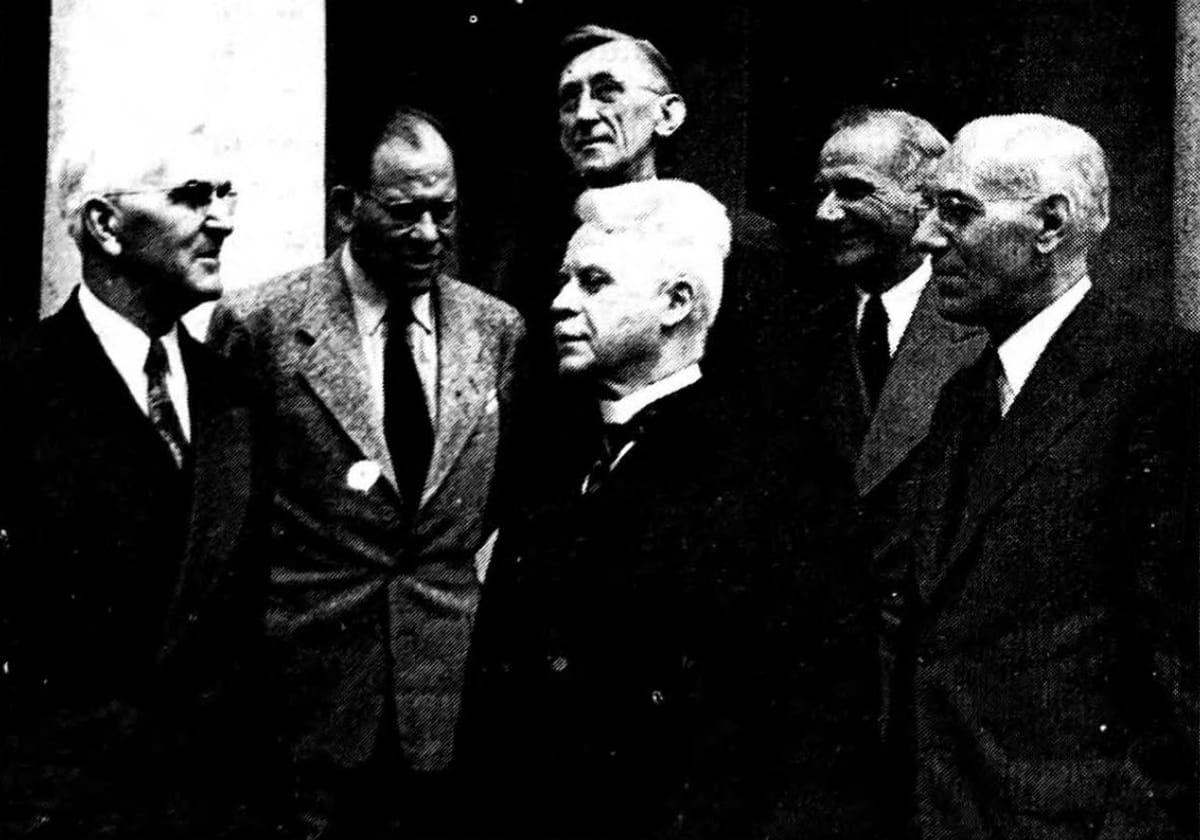
Three days before the first seminar opened, Germany changed its money. On Sunday, June 20, 1948, the western occupation zones introduced the Deutsche Mark, and the Reichsmark savings of every pastor invited to Bad Boll became nearly worthless overnight. The Russians, caught by surprise, “quickly issued their Klebemark and made travel out of the Russian zone of occupation practically impossible.” The Klebemark, the “paste-mark,” was the old Reichsmark note kept valid by a pasted-on coupon. Karl Arndt, writing thirty years later with the file in front of him, judged that the currency reform “almost wrecked all three Bad Boll sessions.”
President Behnken called on Bishop Wurm in Stuttgart on June 22 and heard it firsthand: “nothing has happened which so deeply shocked the German people as the currency reform. Everybody talks about it. Everybody worries about it.”
They came anyway. Two weeks ago this series left the reader at the door of a converted spa in the Swabian hills, with the ships sailed and the invitations answered. Last Thursday it stepped aside for a hymn. This week the door opens.
Such a time as this
The Americans reached Bad Boll at 4:30 on the afternoon of Wednesday, June 23. By suppertime some eighty-five guests had registered, “a far greater number than we anticipated,” Behnken wrote, given the chaos of the money. At eight o’clock the Eröffnungsgottesdienst, the opening service, began with ninety-four present. Behnken preached on Esther 4:14: “Who knoweth whether thou art come to the kingdom for such a time as this?” He reported home: “The singing resounded wonderfully. Our men were kind enough to say afterwards that I had struck the right chord.”
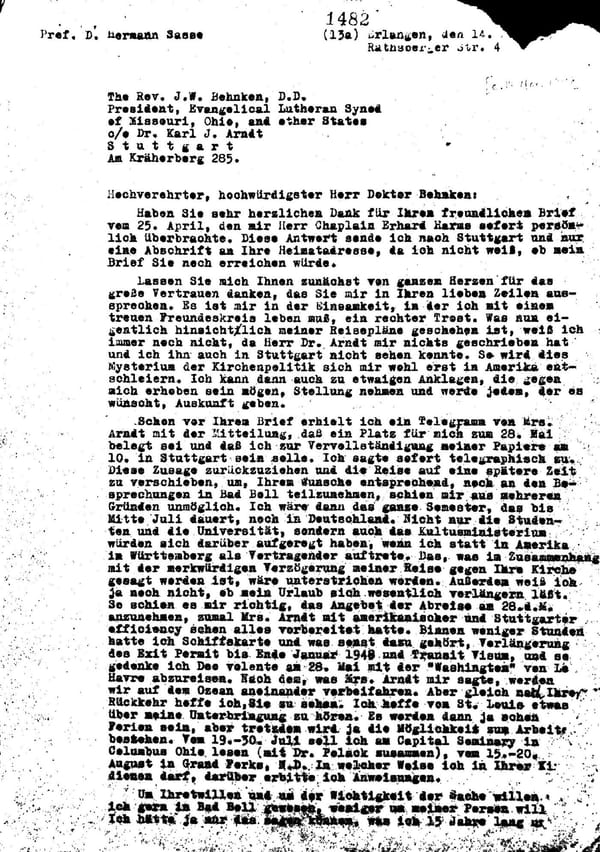
The more remarkable chord came from the German side. Bishop Hans Meiser of Bavaria was the man who, six months earlier in Karl Arndt’s living room, had asked Missouri to guard against propaganda. Now he gave the welcome:
God never takes something from us without giving us a greater gift in return. This greater gift is our meeting on the basis of the Augsburg Confession. This Begegnung is unprecedented, erstmalig. . . . The first and foremost problem at Bad Boll is: We must again rehabilitate ourselves as Lutherans.
Readers of this series have met Begegnung before. It means encounter; it was the invitation’s own word, printed over Behnken’s signature, and now a German bishop was saying it back. Erstmalig is plainer: first-time, without precedent. The word to mark, though, is rehabilitate. Chapter 1 of the book finds the Missouri men using it privately about the Germans, as a thing to be done to them. Here a German Landesbischof, the bishop of a territorial church, used it about his own church, as a thing it had to do. Rehabilitation imposed and rehabilitation confessed are different things, and that difference explains much of why Bad Boll worked.
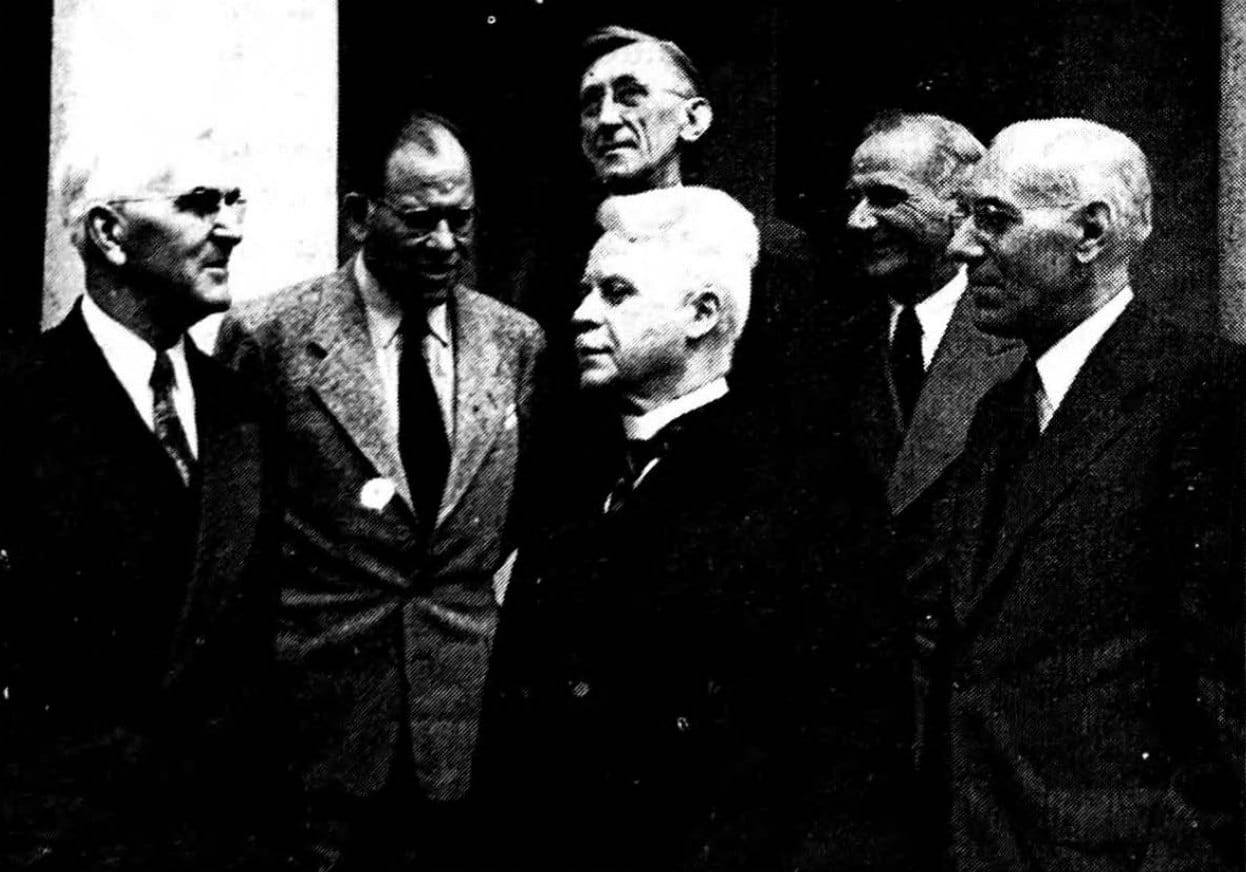
Confiteri
Confess comes from a Latin word about speaking. Confiteri is con-, wholly or together, plus fateri, to acknowledge, a cousin of fari, to speak, from which English also has fame and fable. To confess is to say a thing out loud and own it. The Augsburg Confession of 1530 was exactly that: a statement of faith, signed by princes who were prepared to be held to it and read aloud before the Emperor at Augsburg on June 25, 1530.
The calendar offers a coincidence. The first Bad Boll series opened on June 23, 1948, so the anniversary of that reading fell in its first days. Whether anyone in the room remarked on it, the accounts used here do not say.
The design was simple and demanding. There were three series of nine days each: June 23 to July 2, July 6 to 15, and July 16 to 25. The first day was for arrival and the opening service; the second treated the significance of the Augsburg Confession. Six days on doctrinal articles of the Confession followed, each introduced by an American Referent, or lecturer, and answered by a German co-lecturer, and the ninth drew conclusions. Lectures ran in the morning and discussion in the afternoon, and everything was conducted in German. Every participant received the critical edition of the Confession prepared for its four-hundredth anniversary in 1930, whose editor, Heinrich Bornkamm, sat among them. The American program stayed the same all summer. The German side rotated, so that by late July the Missourians had faced a considerable cross-section of German theology: Elert of Erlangen, Thielicke and Koeberle of Tübingen, Schlink and Brunner of Heidelberg, Asmussen, Kinder, Merz, and more.
The third day
The question that mattered most came early. By Paul Bretscher’s precise later testimony, it came “on the third day of the first nine-day session.” The Germans asked directly whether the Missouri Synod made the verbal inspiration of the Scriptures the major premise of its theology.
The American answer eased the way, Schmidt thought. The Americans rejected “every mechanical interpretation” of inspiration. They cautioned against overloading the word. Then they put the doctrine in an unexpected place:
The doctrine of the inspiration of Scripture does not stand in the relationship of a priori, but of a posteriori to our theology. It is not the broad basis upon which the pyramid of dogmatics is built up. . . . We are concerned in upholding complete inerrancy and absolute authority of the Holy Scriptures.
A priori means “from what comes before”: a premise you start from. A posteriori means “from what comes after”: a conclusion you reach. Wolfgang Schmidt, an Oberkirchenrat (a senior councillor in a territorial church’s administration), reported the American position with evident appreciation: “They said that they would not say: ‘I believe in the Gospel, because the Bible is verbally inspired,’ but ‘I believe in verbal inspiration, because the Gospel has won in me.’” Helmut Thielicke pressed from the other side: “Does the Bible not speak very often according to the forms of the natural science of ancient times and their views of the universe? Does not the doctrine of verbal inspiration create a shallow, legalistic conception of the Bible?”
Then the matter was dropped. When Schmidt’s account appeared in English, Bretscher attached a footnote, the only one he added to the whole article:
The situation was this: the doctrine of inspiration was discussed on the third day of the first nine-day session incidentally and in no sense adequately. . . . We never got around to discussing the doctrine of inspiration with any degree of fullness. In the second and third nine-day sessions the doctrine of inspiration did not come up at all.
Yet Mayer’s account has Adolf Koeberle of Tübingen, in the third series, “expanding on the doctrine of inspiration” in his lecture; Bretscher evidently did not count a lecture as a discussion. Nobody reopened the argument. Schmidt remembered the talk coming back to verbal inspiration repeatedly; Bretscher, correcting him, confined it to one day early in the first series, “incidentally and in no sense adequately.” Either way, the question that divided the two churches most deeply was never argued through. Both sides let it rest, politely, and, as later posts will show, only for a time. The a posteriori sentence has a career ahead of it, and this series will follow it into the 1970s.
What they found
Where the seminars found agreement, it was real. On justification, by grace, through faith, for Christ’s sake, Americans and Germans worked in substantial accord, and every later Bad Boll summer built on it. On the Lord’s Supper, Wilhelm Schwinn put the shared confession plainly in the second series: “In opposition to a complete emptying of the Lord’s Supper or a magical concept of it, we must maintain that the Lord is truly present in, with, and under the elements.” These were churches that had spent a century drifting apart. For them, hearing in, with, and under affirmed across the lectern was no small thing.
Where the seminars did not agree, they said so. On the doctrine of the Church, and above all the standing of the single congregation, Schmidt’s report is candid: “We could not reach agreement on this question, although the German theologians conceded the truly ecclesiastical nature of the individual congregation when it stands on its own.” Unlike his account of the inspiration debate, this sentence drew no American footnote.
On the first weekend, Behnken drove to Munich with an Army chaplain and preached at the chaplain’s Sunday military service, and after dinner the party drove out to Dachau. His published account is spare: “We saw the ovens and the apparatus used to cremate the bodies of 238,000 prisoners. . . . The saddest impression a person carries away is that all this was planned.” The man who spent his mornings on the Augsburg Confession spent that Sunday afternoon at the crematoria. The seminars have to be read with that afternoon in mind.
Three hundred eleven men attended the three series (110, 80, and 121) by the count of the commissioners’ final report, drafted at Bad Boll on July 25. Roughly a fifth of those invited could not come, casualties of the currency and the closed zone border. The rest came from Württemberg and Bavaria, Hamburg, Hannover, and Schleswig-Holstein, and, across a zone border the currency had all but closed, from Mecklenburg in every series and from Thuringia and Saxony in the third.
What they said afterward has a common note, which is surprise. A pastor of the Old Lutheran Church wrote: “During the past years, the general impression of the German clergy about the Missouri Synod was that it is a sect which is dominated by tradition and which thoroughly lacks any research faculties and scholarship. In the first two or three days of the Bad Boll convention, this impression . . . gradually underwent a change.” A bishop wrote: “Our meeting with your team of the Lutheran Church which can say: ‘We believe, teach, and confess,’ has made a deep impression upon us German theologians who are still suffering from the aftereffects of an unbiblical subjectivism.” We believe, teach, and confess is the recurring phrase of the Formula of Concord, and it is confiteri once more: saying the thing aloud and owning it.
Two things to guard against
Behnken came home and wrote to Arndt that “everything seems like a dream to me.” On August 29, before the autumn’s congratulations had settled into history, he wrote something more careful to F. E. Mayer:
[T]here are two things against which we must guard: 1) an overestimation of the results. Let us adopt a policy of awaiting developments before we render opinions re influence upon VELKD and EKiD; 2) an underestimation of the results.
(The VELKD was the new federation of Germany’s Lutheran territorial churches, constituted at Eisenach that July; the EKiD, the Evangelical Church in Germany, was the wider Protestant federation.) It is a good rule for historians, and the book tries to write under it. It is also a good rule for anyone who has come home from a synod convention, a mission trip, or an ecumenical dialogue and felt that something happened. Something did happen at Bad Boll in 1948. A church body that German academic theology had dismissed as a sect was received, after five weeks of argued doctrine, as a church that could say we believe, teach, and confess. What it did not do was settle the question raised on the third day. That question waited, and it did not wait quietly.
Next Thursday: the evenings. After supper, in the hours from a quarter past eight until ten, Bad Boll heard about the Synod’s work, in lectures and on film. Three of the films were about that work. The fourth told a different story.
Sources and notes: The currency reform is described in Karl J. R. Arndt, “Missouri and Bad Boll, 1948,” Concordia Historical Institute Quarterly 52, no. 1 (1979), 21–22, which also reproduces the commissioners’ final report of July 25, 1948, with the attendance figures (29). Behnken’s arrival, sermon, and Dachau visit are from J. W. Behnken, “Dr. Behnken’s Letters, II,” Lutheran Witness 67 (1948), 255–56. The daily schedule, Meiser’s opening address, Koeberle’s lecture, the American reply on inspiration, Schwinn, and the German testimonies are quoted from F. E. Mayer, The Story of Bad Boll: Building Theological Bridges (Saint Louis: Concordia Publishing House, 1949), 12–13, 24, 26, 40, 57–58. Schmidt’s report and Bretscher’s footnote are from W. [Wolfgang A.] Schmidt, “A Theological Discussion with the Missouri Synod in Bad Boll,” Lutheran Quarterly 1 (1949): 78–85. Behnken’s letters of August 14 and 29, 1948, to Arndt and Mayer are at Concordia Historical Institute. The book treats the 1948 conferences in chapter 4.
Researched and written by Dr. Albert B. Collver III, from the archives behind the forthcoming book Bad Boll: Missouri at the Crossroads (Concordia Historical Institute). Corrections, recollections, and documents of your own are welcome at info@badbollbook.com.
© 2026 Albert B. Collver III · Thursdays at Bad Boll. Archival documents are reproduced by courtesy of the holding institutions, as credited; the research, text, and annotations are the author’s. Please cite or link rather than republish.