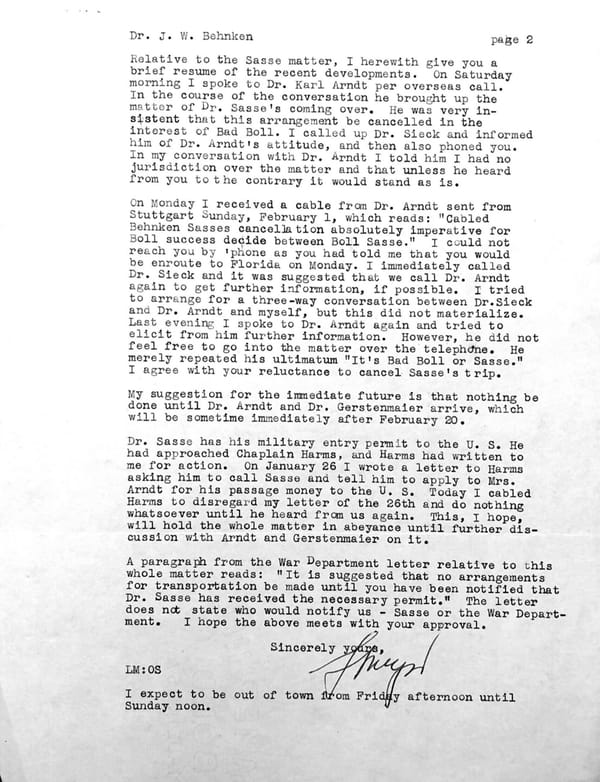
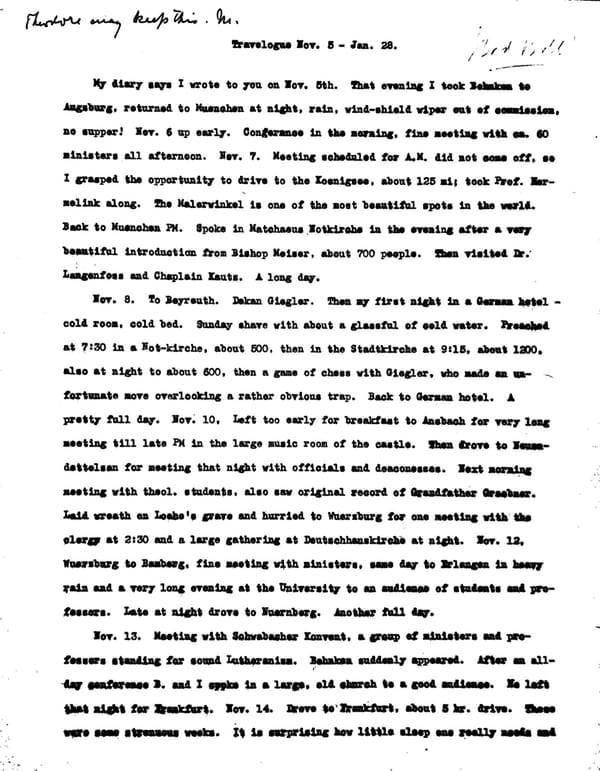
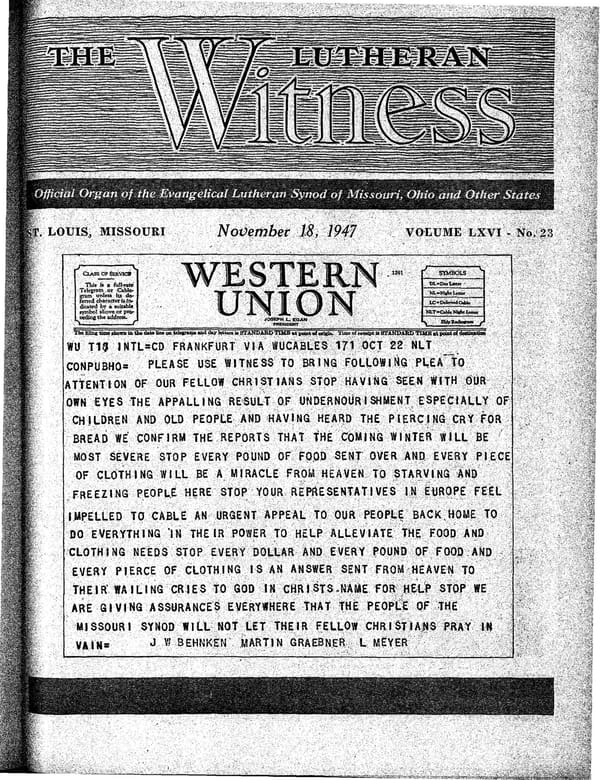
Ebenezer
Ebenezer is Hebrew for "stone of help." It is also the name of a Welsh tune that two Bad Boll men turned into one of the Missouri Synod’s best-loved hymns. Did the conferences have anything to do with "Thy Strong Word"? The documents say more than a coincidence and less than a cause.

In the seventh chapter of First Samuel, after a battle the Israelites had expected to lose, the prophet Samuel set up a stone between Mizpeh and Shen and gave it a name: Ebenezer, from the Hebrew eben ha-ezer, "the stone of the help." His explanation is one line long: "Hitherto hath the LORD helped us." A stone of help is a marker set up afterward, where the help was received, so that people who come later will ask what happened there.
The name travelled to Wales, where it stood over the doors of a great many chapels, and one of them, Ebenezer Chapel in the village of Rhos, gave it to a tune. EBENEZER, a vigorous minor melody by Thomas John Williams, who worshipped in that chapel, was written, by his own account, in 1896, and was in print by the following year. It came with a better story than most. In Wales it was called Ton-y-Botel, "the tune in the bottle," because it was said to have been found sealed in a bottle washed ashore on the Llŷn coast. A London paper printed the legend. The truth, as the Methodist hymnologist J. T. Lightwood later told it, was that a young man, asked at a private engagement where the tune came from, had laughingly told his friends a tall tale, and the tale travelled with the tune as it spread from one Welsh village to the next. Tunes, like families, get the origin stories they deserve, and not always the ones that happened.
That is worth remembering, because the hymn that made EBENEZER a Missouri Synod possession has an origin story too, and this post is about testing it.
The story as it is told
"Thy Strong Word Did Cleave the Darkness" is no. 578 in the Lutheran Service Book. Its text is by Martin H. Franzmann, professor of New Testament at Concordia Seminary in Saint Louis, and its origin can be told, unusually, in the words of both men who made it. On October 7, 1954, the seminary's students sang it for the first time at morning chapel, and the preacher that morning was Walter E. Buszin, the seminary's professor of church music. "After we had chosen this tune," he told them, "we contacted Prof. Martin H. Franzmann of our Seminary faculty and requested that he prepare for this tune a text which might relate itself closely to our Seminary." Franzmann built the text on the seminary's motto, Anothen to phos, "The light comes from above." Nineteen years later, writing to Buszin's widow after his death, Franzmann said he had been reminded of him most forcibly when the seminary sang the hymn, "for which he suggested the melody and for which he encouraged me to write the words."
Buszin's daughter, Constance Buszin Seddon, who grew up next door to the Franzmanns on the seminary campus, supplies the rest. Her sister Barbara remembered a story their mother told: Buszin, at work in his study on some large project, came upon the Welsh tune and ran out the front door and across the yard to the Franzmann house with it. "Can you do something with this? I'm too busy right now." The hymn was wanted for the seminary's baccalaureate procession, and four stanzas proved too few. In her telling, Buszin also told Franzmann it lacked a stanza on the cross, and Franzmann supplied "From the cross Thy wisdom shining," now the fourth stanza; the one contemporary document is the autograph Franzmann sent him, headed "To W. Buszin, Cross-stanza." A closing doxology followed in 1959. Ten years later the Synod's Commission on Worship put the whole hymn into its Worship Supplement as no. 747, and a misprint there turned the singers' "hope" into "hopes," as it has stayed ever since. The hymn's reception, she adds, drew Franzmann back to hymn writing, a gift he had let lie since the 1930s, and it led the seminary's procession every year until 1997.
Fred Precht's companion to Lutheran Worship agrees on the year and the motto, though it does not mention Buszin. There is, at least, no bottle in any of the accounts.
Two men from Bad Boll
What none of these accounts connects is that both men had been to Bad Boll.
Franzmann was a Missouri Synod essayist at the conferences in 1949, and again in 1953, when he read "Christ, the Hope of Glory" in Paris and at Bad Boll. Buszin went in 1951, with other professors from the seminary. It was his first journey to Europe, and he read a paper in Strasbourg, at Bad Boll, and in Berlin under the title Das Wechselverhältnis von lutherischer Theologie und christlichem Kultus, "the reciprocal relationship between Lutheran theology and Christian worship." It was never published. He was for many years chairman of the Synod's Commission on Worship, Liturgics, and Hymnology, the body that would eventually put "Thy Strong Word" into its first hymnal, the Worship Supplement of 1969. When the Bad Boll commissioners met in the seminary on September 26, 1951, to hear the reports of that summer and plan the next, Buszin and Franzmann were both in the room.
That is a convergence. It is not yet a connection. Seminary colleagues who live next door to each other collaborate whether or not either of them has crossed the Atlantic. The question is whether anything from Bad Boll can be found in the hymn itself.
The question Bad Boll kept asking
It can, and the route runs through the subject the conferences argued about more than any other: Holy Scripture.
From the first summer the Germans pressed the Americans on verbal inspiration. Martin Hein's evaluation of the 1948 and 1949 conferences records the objections plainly: "Verbal Inspiration is a Roman Catholic doctrine. It is a Calvinistic teaching." It does not do justice to the human side of Scripture. Wolfgang Schmidt's report of 1949 in the Lutheran Quarterly gives Helmut Thielicke's form of the charge: "Does not the doctrine of verbal inspiration create a shallow, legalistic conception of the Bible?" The Americans answered, Schmidt wrote, by explaining the human side of the Bible "as a condescension of the Holy Spirit."
In the winter of 1954 the same questions came home. Students at Concordia Seminary asked for a fuller discussion of verbal inspiration than the classroom allowed, and nearly four hundred of them took part in six hours of discussion. Franzmann's contribution, printed that October in the Concordia Theological Monthly, reads like the reply to a German colleague across a conference table. It is often said, he writes, that verbal inspiration neglects the human side of the Bible, but "the fault does not lie in the terms or in the basic intention of the doctrine." The doctrine, rightly held, is "an act of thanksgiving and adoration." It speaks of "that mighty condescension of God" by which God, speaking in the words of men, restores those words "to the primordial power, adequacy, and truth with which He endued them at the Creation."
A strong word, in other words, that at its first speaking cleft the darkness. The essay and the hymn come from the same year.
The paper and the hymn
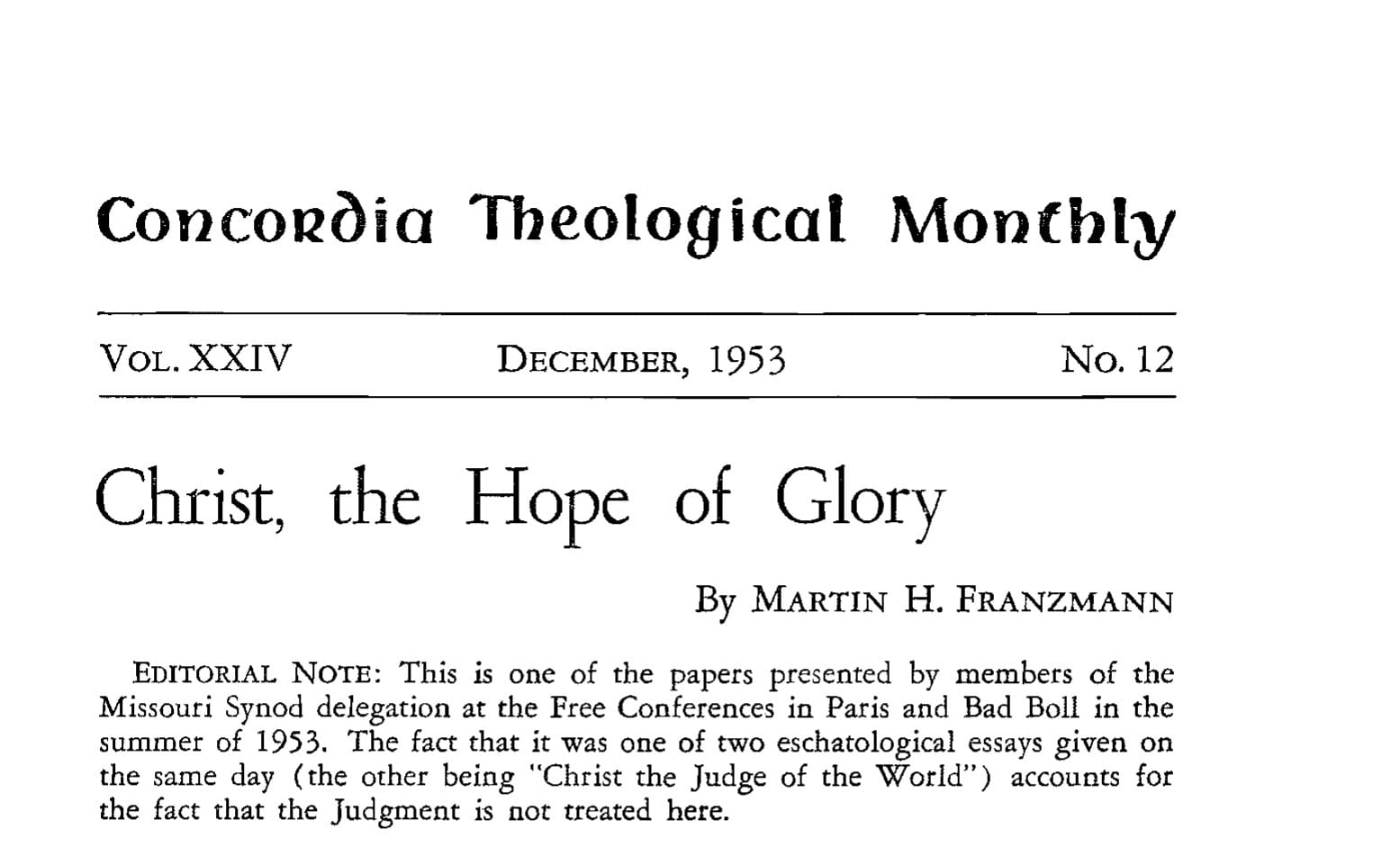
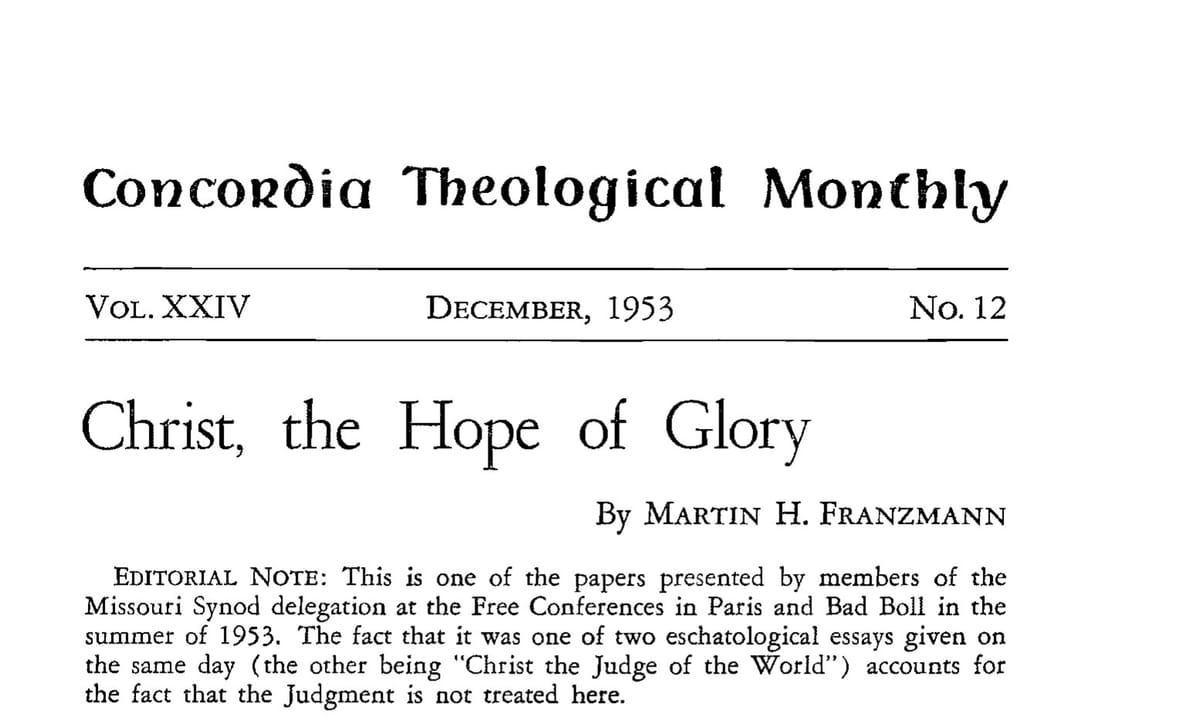
The closer match, though, is the paper Franzmann read at Bad Boll itself. "Christ, the Hope of Glory" (Concordia Theological Monthly, December 1953) is organized under five marks of the Church's hope: it is centred on Christ, it waits for God's own act of deliverance, it hopes for the whole person and the whole creation, it is practical, and it is doxological. All five are in the hymn. The chart below sets each stanza beside the passage it most resembles, with a line or two from "A Ransom for Many," the paper on the Ransom that Franzmann prepared for the same summer's conferences.
Because the text of "Thy Strong Word" is under copyright by Concordia Publishing House, we cannot reproduce it here word for word. We encourage you to take down a hymnal and read it for yourself: it is no. 578 in the Lutheran Service Book (no. 328 in Lutheran Worship). The chart gives only the opening words of each stanza, so that you can follow along.
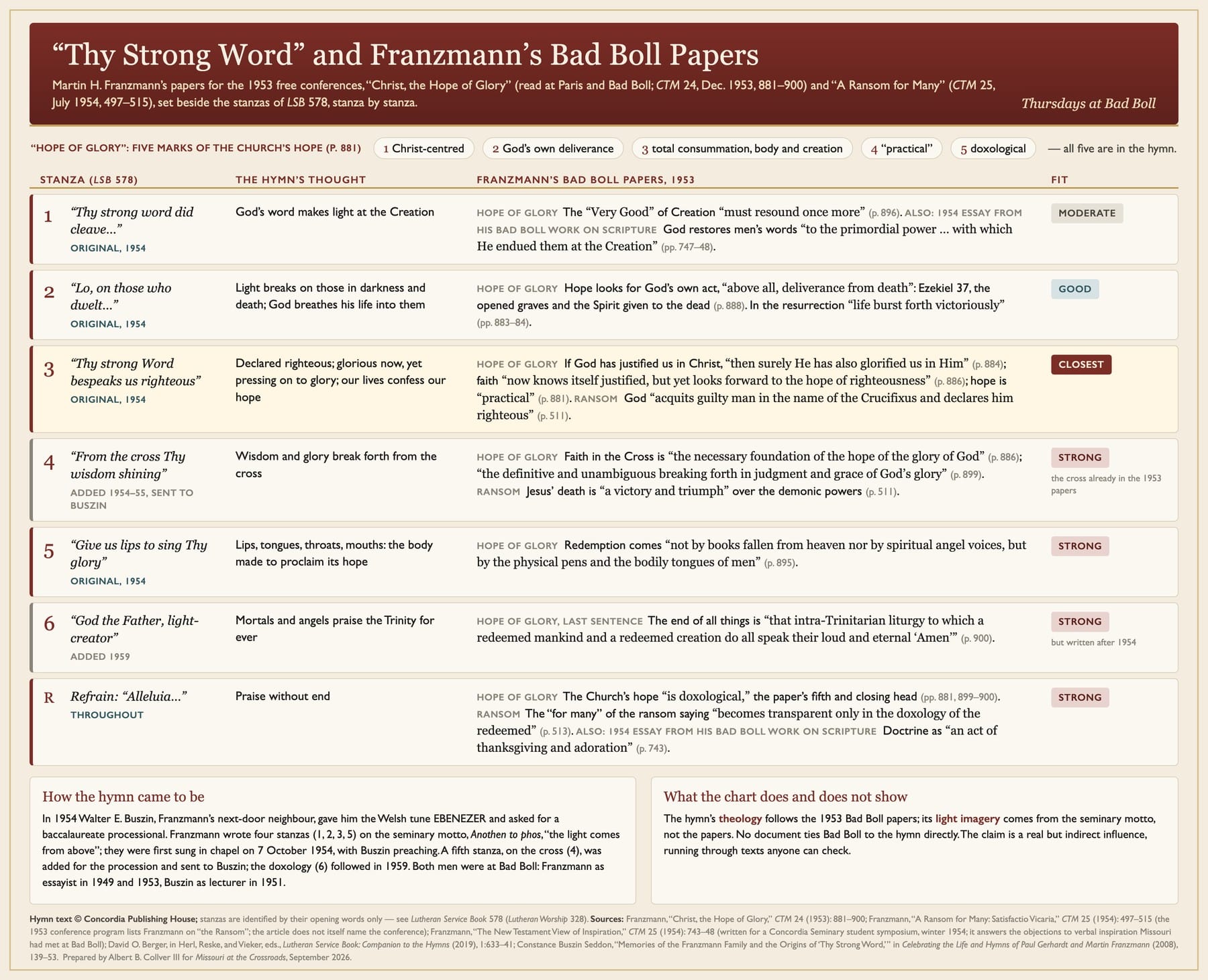
Two notes keep the chart honest. The four stanzas marked 1954 are the original hymn; the other two came afterward. The fourth stanza was added for the procession and sent to Buszin, whose daughter remembers him asking for the cross; but its theology is already in the Bad Boll paper's claim that the cross is the foundation of glory, written a year before the stanza. The sixth stanza came in 1959, so its likeness to the paper's closing sentence shows how long the thought stayed with Franzmann, not what he had in mind in 1954.
What the evidence will bear
Here is what cuts the other way, set down before anyone has to find it. The light that shines through every stanza is not in the essays; it comes from the seminary's motto, exactly as the reference books say. No letter, minute, or reminiscence yet found says that Bad Boll had anything to do with the hymn. Neither Buszin's chapel sermon, nor Franzmann's letter, nor his daughter's loving account says anything of Bad Boll in connection with the hymn. And a theologian carries his theology everywhere; Franzmann would have believed in the hope of glory had he never left Saint Louis.
What remains is this. The hymn's movement, from justification to a glory already given and still awaited, from the cross to bodily praise, from creation to the end of all things, is the movement of a paper Franzmann wrote for a Bad Boll audience a year earlier. Its confidence in the strong word is the confidence he defended, in the same year, against the objections Missouri had heard at Bad Boll since 1948. And the stanza that joins the two was written for, and sent to, the other man from Bad Boll. That is not a cause. It is an influence, minor and indirect, running through documents anyone can read. It is also one of the few places where the conferences reached the pews without passing through a convention resolution.
Hitherto
The organ piece that opens and closes the Thursdays at Bad Boll podcast is written in the idiom of EBENEZER. It was chosen in August for the sound of it. Only in choosing it did I stop to ask whose hymn the tune carries, and this post is what came of the asking.
Congregations will sing "Thy Strong Word" again this Sunday, most of them without a thought for Saint Louis in 1954 or a spa in Württemberg in 1953, and that is as it should be. Hymns are for singing, not for footnotes. But a stone of help is set up so that someone will ask what happened there. Samuel's stone answered with a single line, and so, in its way, does Franzmann's hymn: hitherto the Lord has helped us, by a strong word that is still being spoken.
A print edition of this post, with the figures and footnotes, is available as a PDF: Ebenezer (Thursdays at Bad Boll, 2026).
Sources and notes: The origin of “Thy Strong Word” follows David O. Berger’s entry in Joseph Herl, Peter C. Reske, and Jon D. Vieker, eds., Lutheran Service Book: Companion to the Hymns (St. Louis: Concordia Publishing House, 2019), 1:633–41 (no. 578), which quotes Buszin’s chapel address of October 7, 1954 (Concordia Historical Institute); Franzmann’s letter to Margaret Buszin of July 9, 1973, is printed in Constance Buszin Seddon, “Memories of the Franzmann Family and the Origins of the Franzmann Hymn ‘Thy Strong Word,’” in Daniel Zager, ed., Celebrating the Life and Hymns of Paul Gerhardt and Martin Franzmann (Fort Wayne: Concordia Theological Seminary Press, 2008), 139–53, n. 17, a paper given at the Good Shepherd Institute in November 2007. See also Constance R. Seddon, “Three Generations of the Family Buszin: Part Three,” Concordia Historical Institute Quarterly 83 (2010): 22–64, esp. n. 74, which also records Buszin’s 1951 journey to Bad Boll; “The Story That Inspired ‘Thy Strong Word,’” CPH Blog, October 25, 2022, adapted from Eternal Anthems: The Story Behind Your Favorite Hymns (St. Louis: Concordia Publishing House, 2022), 165–66, and Fred L. Precht, Lutheran Worship Hymnal Companion (St. Louis: Concordia Publishing House, 1992), no. 328, which also gives J. T. Lightwood’s account of the Ton-y-Botel legend. The hymn’s first hymnal printing is Worship Supplement (St. Louis: Concordia Publishing House, 1969), no. 747, authorized by the Commission on Worship of The Lutheran Church–Missouri Synod and the Synod of Evangelical Lutheran Churches. The hymn text is copyright Concordia Publishing House; see Lutheran Service Book 578. Franzmann’s essays are “Christ, the Hope of Glory,” Concordia Theological Monthly 24 (1953): 881–900, and “The New Testament View of Inspiration,” in “Essays on the Inspiration of Scripture,” Concordia Theological Monthly 25 (1954): 738ff. (Franzmann’s section at 743–48), with Richard R. Caemmerer’s headnote on the winter-1954 student symposium. The chart also quotes Franzmann, “A Ransom for Many: Satisfactio Vicaria,” Concordia Theological Monthly 25 (1954): 497–515; the 1953 conference program lists Franzmann on “the Ransom,” though the article does not itself name the conference. The opening page of “Christ, the Hope of Glory” is reproduced from the scan at Scholarly Resources from Concordia Seminary. Buszin’s 1951 lecture is listed in Kirby L. Koriath, Music for the Church: The Life and Work of Walter E. Buszin (Fort Wayne: Concordia Theological Seminary Press, 2003), and in the bibliography of Johannes Riedel, ed., Cantors at the Crossroads (St. Louis: Concordia Publishing House, 1967), which also records his chairmanship of the Commission on Worship (the sources date it variously from 1949 or 1951). The objections to verbal inspiration are from Martin Hein, An Evaluation of Bad Boll 1948 and 1949, trans. J. T. Mueller (1949), and Wolfgang A. Schmidt, “A Theological Discussion with the Missouri Synod in Bad Boll,” Lutheran Quarterly 1 (1949): 78–85. The commissioners’ meeting of September 26, 1951, is from Paul M. Bretscher’s unofficial minutes, Concordia Historical Institute. The book treats Buszin’s and Franzmann’s conference years in chapters 6 and 7 and Appendix C.
Researched and written by Dr. Albert B. Collver III, from the archives behind the forthcoming book Bad Boll: Missouri at the Crossroads (Concordia Historical Institute). Corrections, recollections, and documents of your own are welcome at info@badbollbook.com.
© 2026 Albert B. Collver III · Thursdays at Bad Boll. Archival documents are reproduced by courtesy of the holding institutions, as credited; the research, text, and annotations are the author’s. Please cite or link rather than republish.