The Year the Americans Came Twice
Exception comes from a Latin word about taking out: excipere. In September 1949 the Missouri men who ran Bad Boll met alone to judge the only summer they had shared the platform with other American Lutherans, and wrote a verdict of three words. This is how the summer was fought over and judged.

On September 5, 1949, the Missouri Synod’s Bad Boll committee met to judge the summer just ended. The minutes are a typed page of clipped phrases, and at the head of the page, first of all, three words: “Esprit and interest and sincerity of effort admirable throughout. N.L.C. an exception.” Further down, theological understanding was “not as clear as it ought to be and become. True not only of inspiration, revelation, Scripture, admission to Lord’s Table, but also in other areas.” A report should go to every pastor and the best essays into the Monthly; the future was left on the docket.
N.L.C. is the National Lutheran Council, the body through which the other American Lutheran churches, the ones not in fellowship with Missouri, did their common work. In 1949, and in no other year, its men shared the platform at Bad Boll. That is why the Americans came twice that summer: once as the Missouri Synod, once as everyone else. The three words are the Missouri men’s verdict on the experiment, and this post is about how it came to be tried, what happened when it was, and why it was not tried again.
Excipere
Exception comes from a Latin word about taking out. Excipere is ex-, out, plus capere, to take: to take something out of a general rule, and so, in law, to object. An exception is not a denial of the rule. It is the one case the rule does not cover. When the committee wrote “N.L.C. an exception,” it was affirming the summer and setting one thing outside the affirmation, and the whole year is in the gap between the two.
The fight before the summer
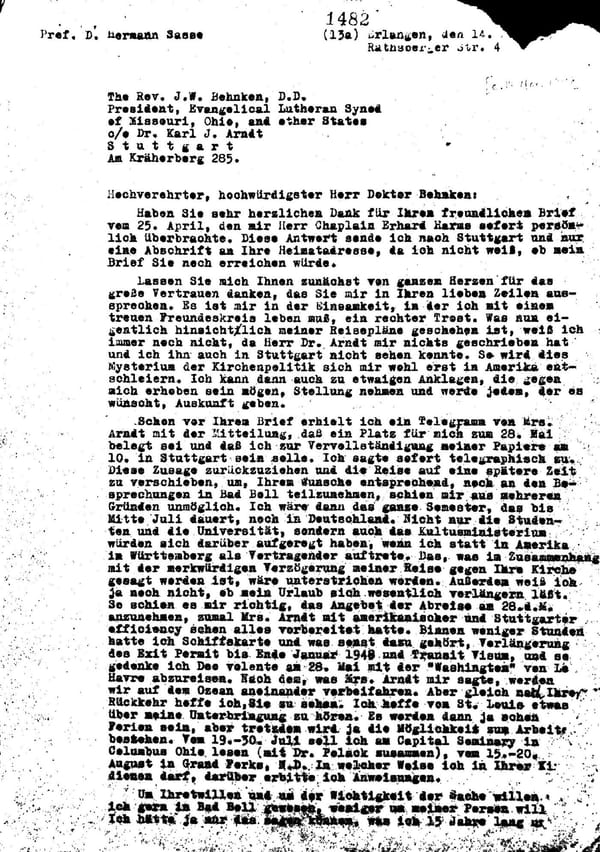
The second year of Bad Boll was fought over before it was held, in the same winter that carried Hermann Sasse’s last letters to Behnken. It began, as things in this story tend to, with Karl Arndt and money.
On October 16, 1948, Arndt proposed to Behnken and Bretscher that the conferences be widened: “After having excluded non-Missourians from Bad Boll last summer it would seem highly desirable to widen the scope of the conferences this summer and to bring men from the United Lutheran and American Lutheran Church as well as from the Lutheran churches of the Continent.” Two weeks later, to Lawrence Meyer, he laid the mechanism bare. Donations to the Emergency Planning Council had “slowed down considerably”; outside funds were available; but the money “would have to be spent before the 30th of June 1949,” and outside funds meant outside Lutherans. He added a reassurance: “I do not believe that orthodox Missourians need fear for the results of the conferences, if we bring in men from the United Lutheran Church, the American Lutheran Church, and the Scandinavian Lutheran Churches, for the initiative will still be in the hands of the Missouri Synod.”
The National Lutheran Council came to Bad Boll in 1949 because a funding deadline required a wider letterhead. The doctrinal argument came after the arithmetic.
Behnken did not like it. On October 26 he told the inner circle that he did “not like the suggestion of making the next Bad Boll meeting a kind of an ‘all-Lutheran’ meeting.” On November 15 he wrote Meyer a confidential letter that is the year’s central document: “I simply cannot help but feel that some sinister forces are at work. . . . I definitely favor another Bad Boll meeting, but this must be strictly a Bad Boll arranged and conducted by the Missouri Synod.” If the widened meeting became a reality, he wrote, “I shall not participate.” Three days later the committee took the money out of the argument with a wire to Arndt: “Committee urges Missouri sponsored Bad Boll July first to thirtieth and herewith accepts full financial responsibility.” Arndt’s reply named what he thought he was fighting: “your committee’s resistance movement against my carefully worked out plan to draw Missouri Synod further out of its isolationism.”
Set the two phrases side by side, strictly a Bad Boll of the Missouri Synod against out of its isolationism, and you have the argument the book’s later chapters are about, rehearsed in a quarrel over a summer program.
The table without Missouri
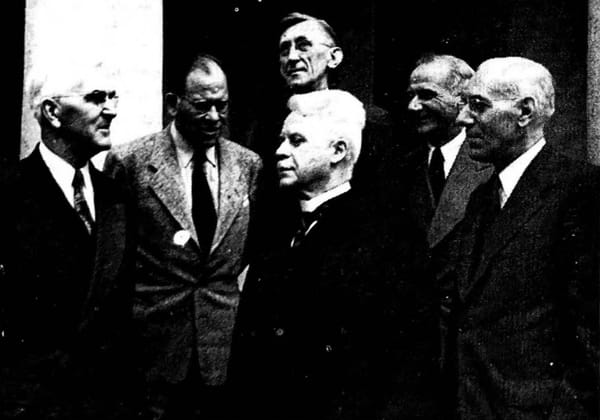
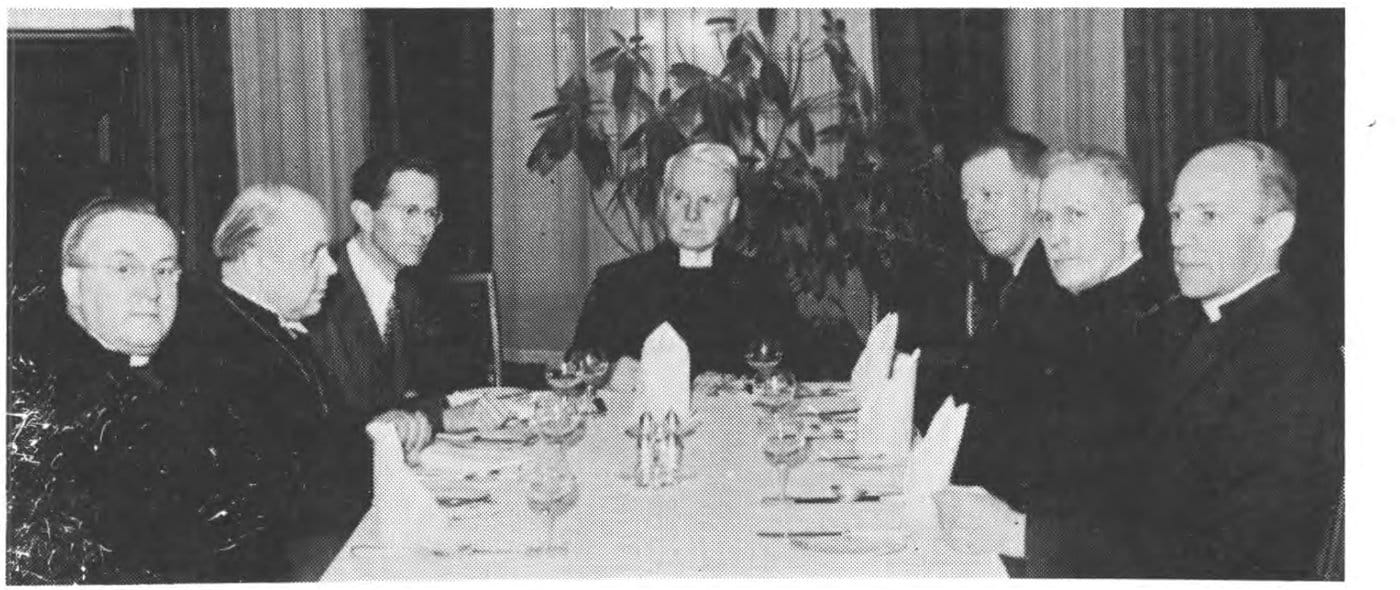
The shape of the summer was settled on January 10, 1949, at the British Officers’ Club in Bielefeld. Around the table sat Michelfelder of the World Council of Churches and Bachmann of the American Military Government, Bishops Lilje of Hanover, Meiser of Bavaria, and Hahn of Saxony for the German churches, Dietrich for the National Lutheran Council at Geneva, and Arndt. Every branch of Lutheranism with an interest in Bad Boll was represented except the one whose enterprise it was. Arndt’s own account is candid: “All the important men of German and American Lutheranism were represented there, except for the Missouri Synod, but although not officially named as a representative, I did the best possible for Missouri at that meeting.”
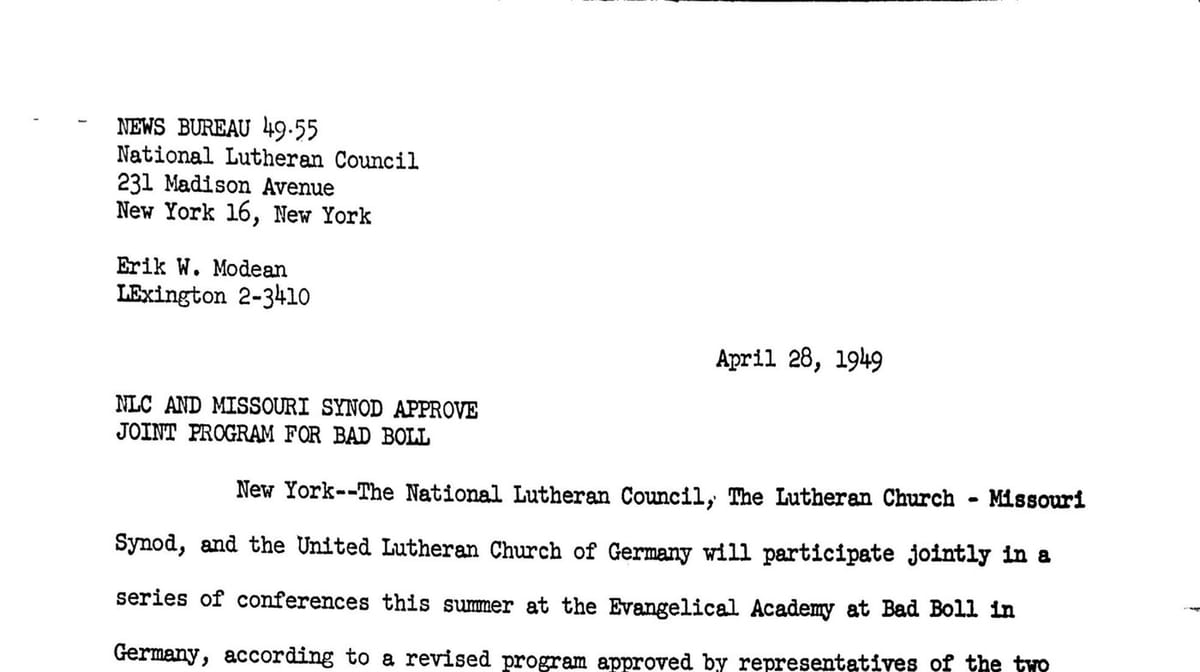
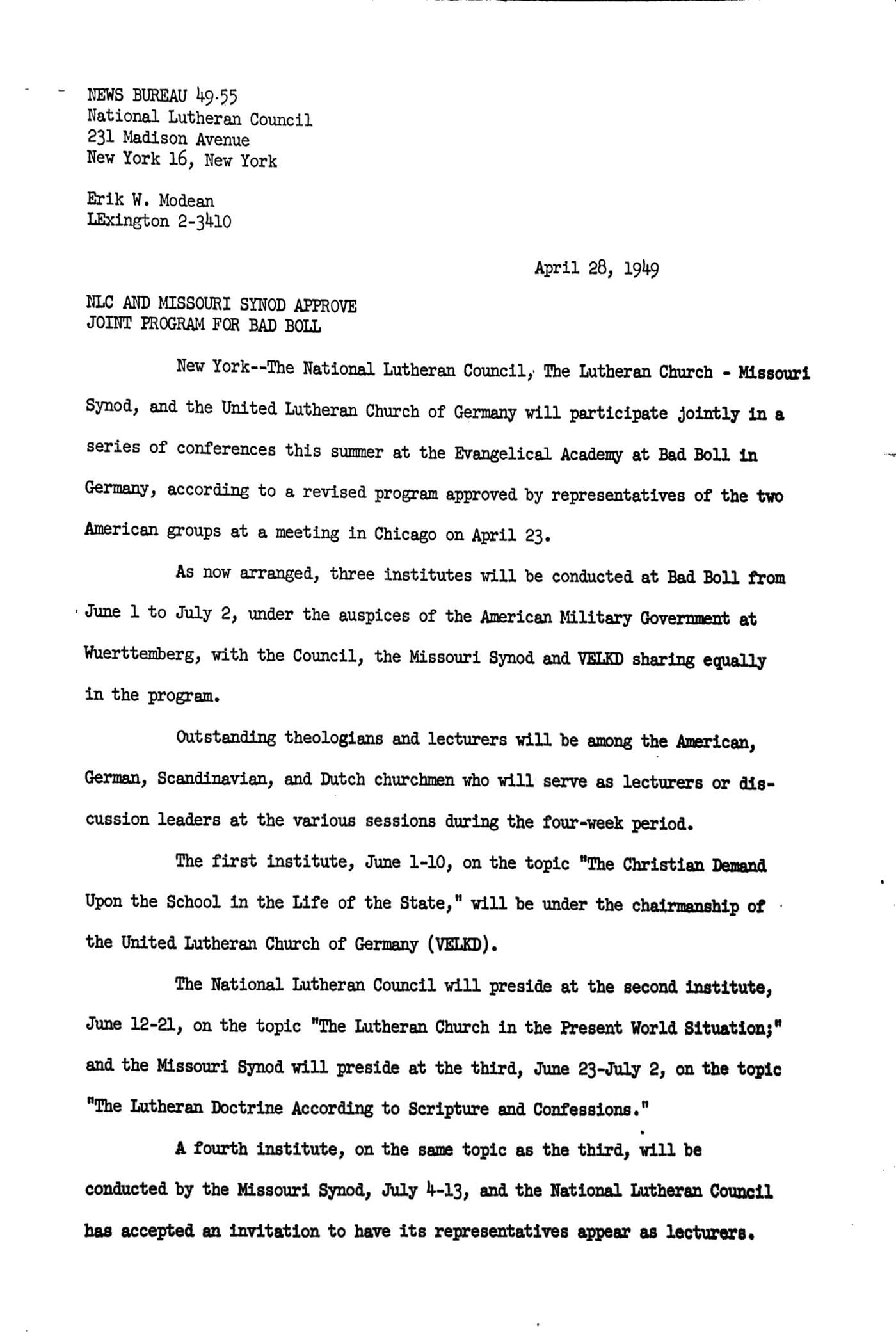
By April the program was fixed and the Council’s press release announced it, all amity: four institutes at Bad Boll, June 1 to July 13. Nothing in it hinted at six months of struggle, one threatened withdrawal, and a financial counter-offensive. Behnken, asked that month by an alarmed correspondent why the Council’s men were being treated as mere observers, gave the most candid sentence in the file: “The idea of the seminars originated with Missouri. That N.L.C. now also is in on this year’s Bad Boll program is the result of some activity which I better not mention by name.”
There was one more winter letter, and it is the quiet one. On January 3, writing to Graebner in support of continuing the seminars, Behnken set down the soberest assessment any Missouri leader had yet made: “I am more and more convinced that we must do everything within our power to arrange such a series of Seminars. . . . I doubt whether we shall ever have full doctrinal agreement and resultant pulpit and altar fellowship.” Five months after the triumph of 1948, the president of the Missouri Synod did not expect the Begegnung, the encounter, to end in fellowship (he had not expected it, he added, for three years), and favored it anyway.
Four institutes
The compromise built four consecutive institutes under three chairmanships. The first, June 1 to 10, belonged to the VELKD, the united church of the German Lutheran territorial churches: a conference on Christian education and the church school, Bishop Meiser presiding. The second, June 12 to 21, belonged to the National Lutheran Council under Julius Bodensieck, on “The Lutheran Church in the Present World Situation.” The third and fourth, June 23 to July 2 and July 4 to 13, were Missouri’s own, on the theme the year is remembered by: “The Way of Salvation According to Scripture and the Lutheran Confessions.” Behnken did not sail in 1949. First Vice-President Herman Harms led the delegation, and wrote Behnken long diary-letters that are the richest first-person record of any Bad Boll summer.
The theological event the fall fight had made possible came in the Council’s own institute, on June 16, when Conrad Bergendoff of Augustana College read on the church and the ecumenical movement. Harms’s letter preserves the room: “It was the worst confusion on the doctrine of the Church that I have heard. He stood alone. Dr. Graebner set things right by calling attention to the fact that John 8:31.32 and Matt. 28:17 demand a clear-cut doctrinal position. The assembly took a definite stand against Dr. Bergendoff. I am glad that the German theologians dissociated us in their minds from this theology presented by NLC.”
No text of Bergendoff’s essay survives in the files; his position is known only as his critics reported it, and the book says so. What is documented beyond dispute is the alignment. The German territorial theologians, the men Missouri’s own right wing suspected of unionism, stood with Missouri against the American ecumenist, on the authority of the Confessions. Behnken had feared the widening would import doctrinal confusion. The widening happened, the confusion arrived on schedule, and the Germans joined Missouri in repelling it. Both sides of the fall argument could claim vindication from the same week.
Harms also recorded the texture behind the September verdict. “The NLC committee is very lax in taking part in the sessions. They are all over, but rarely in the sessions. They have not been heard on the floor.” When the second institute closed: “No one appointed by NLC to prepare a summary. Hence the session closed without a definite statement as to result.” Missouri’s institutes ended with a prepared summary read to the whole conference.
Half past six in the morning
Missouri’s own institutes had a drama of a different kind. At half past six on the morning of June 27, Martin Franzmann came to Harms’s room “all worn out; so completely so that he had to desist from presenting his essay.” Arndt, reporting it to Meyer the next day, suggested the Missouri men were being shaken to their foundations by their first sustained exposure to German scholarship. Harms’s account, written at the time, records exhaustion, not a crisis of faith, and the book takes Harms. Franzmann recovered. His booklet Bad Boll 1949 became the most reflective American account of the year, and its most honest sentence is about the impasse: “the long and earnest debates on the question of the inspiration of Scripture, where we were farthest from a consensus . . . the work was not done in vain — at the very least, questions were raised that will not easily down again.”
The fourth institute is the best documented, because Martin Hein, a Free Church rector, wrote an evaluation the Synod translated and published. J. T. Mueller of Saint Louis read on revelation and Scripture and held the Missouri line. Superintendent Hoffmann of Verden answered that Scripture is “not the Word of God, but its record,” and that verbal inspiration “does not do justice to the human aspect of Scripture”; in his closing statement he granted the distinction between norma normans and norma normata, Scripture as the norming norm and the Confessions as the normed one. The exchange, in Hein’s account, ended without agreement. On the sacraments, “a great tension existed. . . . The question concerning altar fellowship greatly excited the minds.” At the close the Swedish essayist Törnvall said what attendance figures cannot: “I feel like embracing you all; I have learned to love you deeply.” Hein’s first request for the future was the plea the Synod would quote for years: “Come again! Come once more, and help us!”
What a German ear heard
The German public verdict exists too, and Missouri’s own journal carried it. In December the Concordia Theological Monthly translated a report by Frieder Huebner, a young territorial-church pastor on the island of Föhr. Some four hundred German theologians had met fifteen Americans at Bad Boll, he reckoned, and, as Adolf Haentzschel of Valparaiso put it to the conference, the two points of divergence were the inspiration of Scripture and altar fellowship, the same two the Missouri men would write into their minutes. Then he wrote what no American said of the Germans: “we German theologians can no longer ignore the ‘static’ inspiration doctrine of the brethren of the Missouri Synod and with a sort of superiority complex by-pass this teaching.” The polemic against a false Biblicism, he went on, “can become fruitful and accomplish its purpose only if it is based upon an invulnerable doctrine of theopneustia. This is missing in German theology.” Theopneustia, divine inspiration, is the noun formed from the adjective of 2 Timothy 3:16, theopneustos, “God-breathed.” A territorial-church pastor, in a Lutheran church paper, was conceding that the doctrine his colleagues kept pressing Missouri to defend was the one his own theology lacked.
Huebner also preserved Theodore Graebner’s farewell to the conference: “We found among you in Bad Boll the unam sanctam ecclesiam catholicam, communionem sanctorum,” the one holy catholic Church, the communion of saints, in the Creed’s Latin. Coming from a Missouri theologian, Huebner heard it as an acknowledgment “of unity in faith, doctrine, and confession with the Lutheran Provincial and Free Churches of Germany.” The hearing is Huebner’s, not Graebner’s text. But it measures how differently the two sides could hear the same Begegnung: a German ear took an acknowledgment of unity from a farewell, in the very year Missouri’s working maxim, in Hagen Katterfeld’s words as Franzmann quoted them, was “No union without doctrinal unity!”
The exception
Which returns the reader to September 5 and the three words. The one year of shared platform had persuaded the Missouri men that the platform could not be shared. The joint experiment was not repeated; within months the Council and the Synod parted ways over the very question, doctrine or practicality, that had been argued the previous November, and that parting is next week’s post. What 1949 had proven to the men who ran it was both halves of a hard lesson: that the Begegnung worked, since the Germans said so and came back, and that its working depended on exactly the confessional narrowness Arndt had called isolationism.
Anyone who has served on a church committee knows the three-word verdict. It is the sentence that praises the whole and takes one thing out, and it is usually the only sentence anyone remembers afterward. The Missouri Synod spent the next five summers, and in a sense the next twenty-five years, living inside its exception.
Next Thursday: the middle years. In August 1951 the man who ran the German side of the conferences proposed, in writing, that there be no Bad Boll in 1952. It happened anyway, and nothing in the file says how.
Sources and notes: The September 5, 1949, minutes (“‘Bad Boll’ Meeting”) are in the Paul M. Bretscher Collection, Concordia Historical Institute. The winter correspondence is at CHI: Arndt to Behnken and Bretscher, October 16, 1948; Arndt to Lawrence Meyer, November 2 and 20, 1948; Behnken to the inner circle, October 26, 1948; Behnken to Meyer, November 15, 1948; Meyer’s wire to Arndt, November 18, 1948; Behnken to Graebner, January 3, 1949 (misfiled under a February date); Behnken to O. Hoffmann, April 16, 1949. The Bielefeld meeting and its photograph are from Karl J. R. Arndt, “Missouri and World Lutheranism at Bad Boll in 1949,” Concordia Historical Institute Quarterly 54, no. 2 (1981): 54–56, which also reprints the April 28 press release. Harms’s diary-letters to Behnken of June 17, June 20 and 23, and July 1, 1949, and Arndt to Meyer, June 28, 1949, are at CHI. Franzmann is Martin H. Franzmann, Bad Boll 1949 (Saint Louis: LCMS, 1950), 6, 13; Hein is Martin Hein, An Evaluation of Bad Boll 1948 and 1949, trans. J. T. Mueller (Saint Louis: LCMS, 1949), 6–13, 16; Huebner is Frieder Huebner, “Begegnung in Bad Boll,” Concordia Theological Monthly 20, no. 12 (1949): 922–25. The book treats 1949 in chapter 6.
Researched and written by Dr. Albert B. Collver III, from the archives behind the forthcoming book Bad Boll: Missouri at the Crossroads (Concordia Historical Institute). Corrections, recollections, and documents of your own are welcome at info@badbollbook.com.
© 2026 Albert B. Collver III · Thursdays at Bad Boll. Archival documents are reproduced by courtesy of the holding institutions, as credited; the research, text, and annotations are the author’s. Please cite or link rather than republish.