The Proposal to Stop
Disperse comes from a Latin word about sowing: spargere, to strew. From 1950 to 1953 the conferences scattered from a Swabian spa to Bad Harzburg, Berlin, Paris, and Oxford. Midway, the man who ran the German side proposed in writing to skip 1952. It happened anyway, and no document says how.

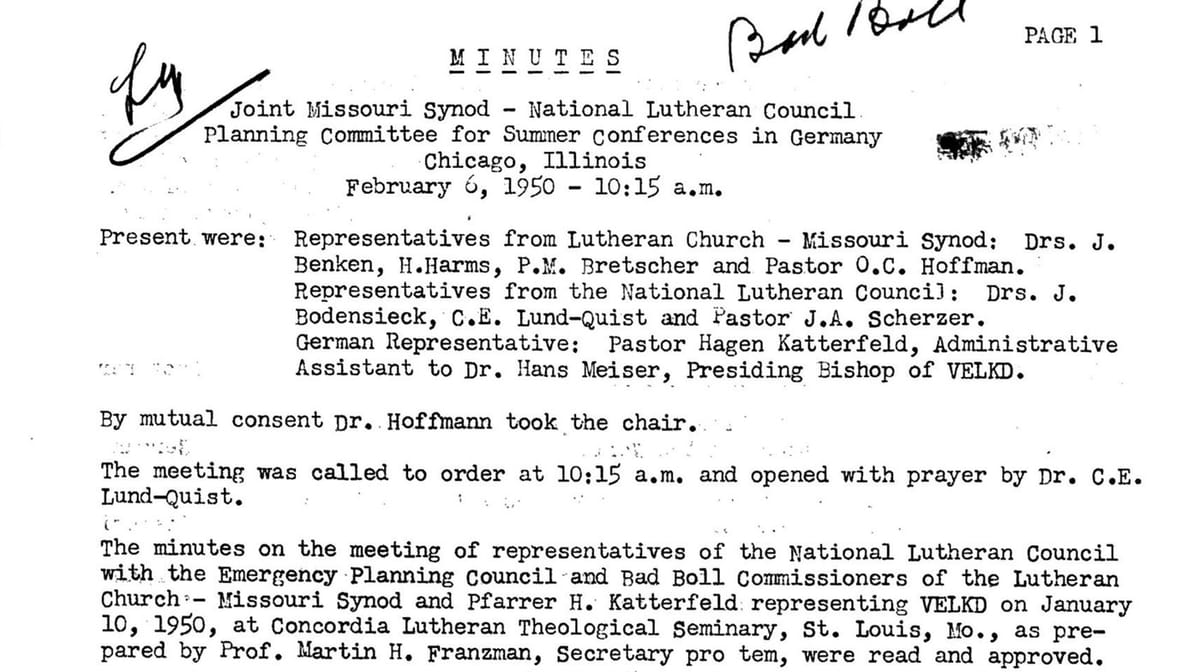
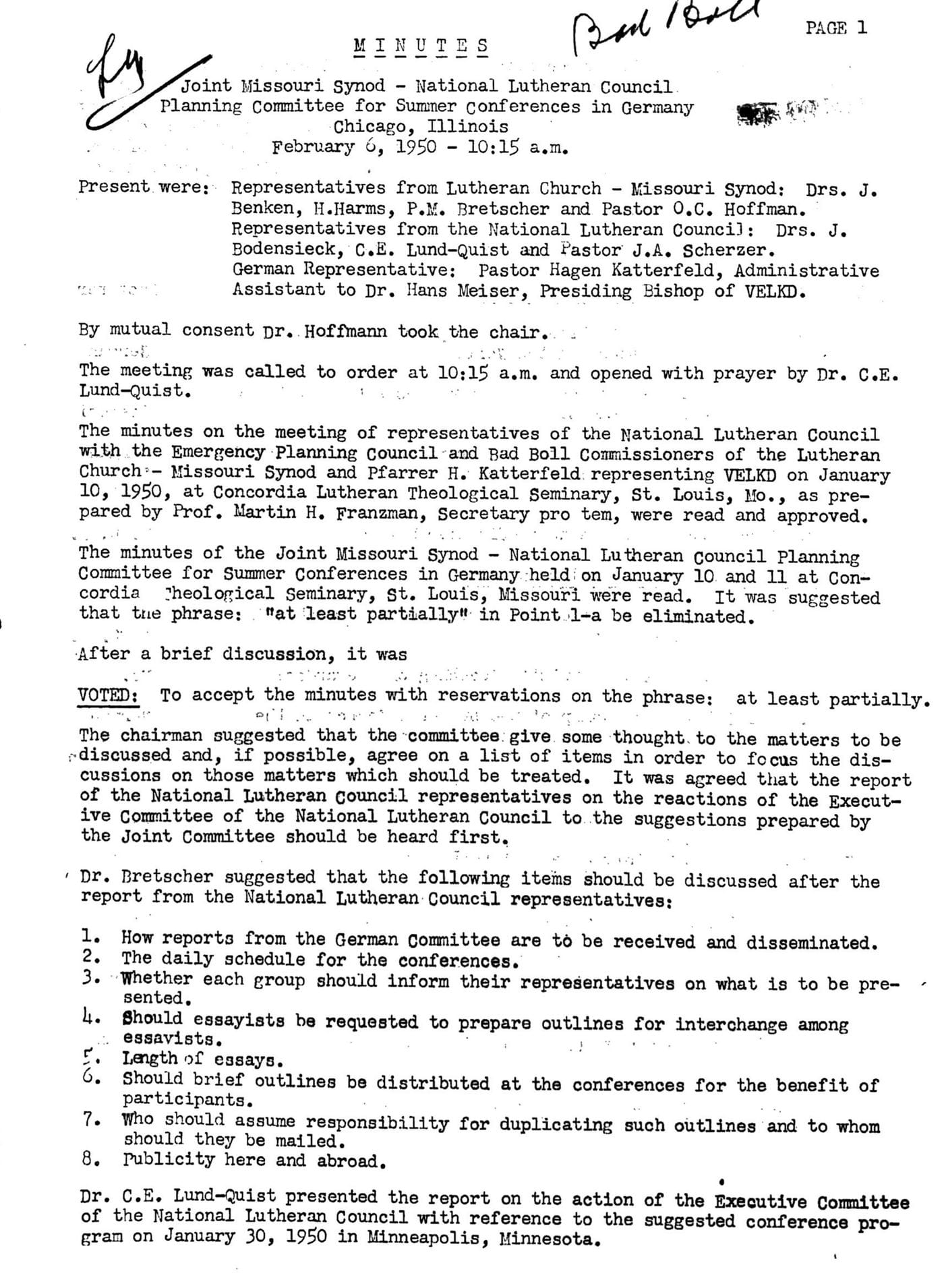
On the morning of February 6, 1950, in Chicago, the joint planning committee of the Missouri Synod and the National Lutheran Council met for the last time. Dr. Lund-Quist opened for the Council with news: its executive committee, meeting in Minneapolis a week before, had rejected the program the two sides had drafted in Saint Louis in January, in toto, entire. Pastor Scherzer presented the Council’s counter-proposal instead, a general theme from Matthew 5:13, “Ye Are the Salt of the Earth,” with subthemes on Christian witness, stewardship, and social responsibility.
The two programs on the table that morning were the two theologies of the whole postwar engagement in miniature: doctrine confessed, or Christianity applied. After lunch Behnken stated the resolution. Since the Saint Louis program had been rejected, “it seems advisable that Missouri would continue the Bad Boll conferences in Germany, provided such conferences are desired by the German church leaders,” with the Council free to hold conferences of its own. Pastor Hagen Katterfeld, sitting for Bishop Meiser and the German committee, “expressed deep regret that no way could be found to hold joint conferences and expressed the hope that the door may be kept open for the resumption of discussions.”
Last week’s post turned on three words in a set of minutes, “N.L.C. an exception.” Five months later the exception had become a separation, and the enterprise walked on alone. The book’s chapter on the four years that followed is one of the two longest in the book, and it is the hardest to summarize, because the conferences stopped being one thing in one place.
Spargere
Disperse comes from a Latin word about sowing. Spargere is to strew or scatter, what a sower’s hand does; dispergere adds dis-, apart, in every direction. The middle years of Bad Boll are the years of dispersal. From 1950 to 1953 the conferences met at Bad Harzburg in the Harz mountains, at Neuendettelsau, at Berlin-Spandau, at Heiligenstein in Alsace and in Paris, at a conference centre near Leicester and at an Oxford college, and at Bad Boll itself. The book says dispersal reads two ways, as demand outrunning design or as footing under strain, and it declines to choose. The reader may keep the sower in mind as one more way to read it.
The thin year
1950 is the thinnest year in the file, and the thinness has a cause the book names. Paul Bretscher, the enterprise’s most systematic record-keeper, missed 1950, the only summer of the series he missed, and the 1955 thesis on which all later accounts lean was built, for that year, on the files of Lewis Spitz instead. The book has not obtained those files. So the absence of a record is not the absence of the thing; readers of this series have met that principle before, and it governs here.
What is documented is enough. The centerpiece was Bad Harzburg, July 31 to August 7, opened on the Monday evening with a service in the Luther Church at which Vice-President Harms preached on the year’s theme, “Christ Loved the Church.” About a hundred men attended. The differences that emerged were the familiar ones, among the Europeans as much as between them and Missouri: the ministry, the rights of the local congregation, joint Communion between Lutherans and Reformed. On the free Sunday the delegation drove to Gross-Oesingen to visit the Free Church pro-seminary, and Harms preached to his boyhood congregation.
The year’s quietest experiment was its most consequential. From September 4 to 6, 1950, a conference met at Wistow, near Leicester, the first extension of the enterprise across the Channel, so little noticed that it appears in neither of the standard year-by-year accounts. Its survival in the record hangs on one cover letter. E. George Pearce, the London pastor who organized it, forwarded the reactions of the attending pastors, several of them Latvian, Estonian, and Polish refugee clergy, to Lawrence Meyer that November: “Perhaps the impressions contained will help to determine whether or not a repeat performance is justified.” The pastors preferred the purely theological format to a practical one, the Wistow congregation voting, in effect, with the Missouri side of the February divorce. The repeat came a year later at St. John’s College, Oxford, where thirty-seven pastors from eight Lutheran groups, “English, German, Estonian, Hungarian, Latvian, Polish, Norwegian, Swedish,” met the Missouri men from September 4 to 6, 1951. Two conferences, two venues, one year apart, on identical calendar dates. The records make them easy to confuse; the book treats them separately.
The interview
With 1951 the record thickens, and it thickens around two letters Bretscher wrote Lawrence Meyer, one from Stuttgart on August 5 and one from the Frankfurter Hof on August 16, as the two Bad Boll conferences of that summer closed, with a third still ahead at Berlin-Spandau. He numbered his impressions. On one side, allies: “The Free Church men took a healthy interest in the discussions and helped our cause.” On the other, absences: “There were no outstanding university professors on the program,” and he listed the missing, Schlink, Köberle, Thielicke, Elert, Hermelink, von Campenhausen, the first shelf of the German faculties, in the typescript’s own uncertain spellings.
The same letter preserves the hour that gives this post its title. On the last day of the second conference Bretscher interviewed Pastor Katterfeld, whose office carried the German side of the arrangements, and set the exchange down as question and answer. Three of the four answers are as warm as anything a German churchman said in these years. Katterfeld had “never heard an adverse criticism of these conferences by a member of the LWF.” “We have loved the Missouri Synod and we shall continue to love it. We need the Missouri Synod to help us in our spiritual distress.” Asked whether the Lord was blessing the work: “Decidedly!” Then the fourth question. Should the conferences be continued?
They should if possible, be continued. Because of immense amount of work, however, which our office now has in connection with the meeting in Hannover next July, I simply will not be able to handle the conference next year. But if some other agency, like the Free Churches, could take it over next year, we would have no objection. It may be good however simply to discontinue the conferences for a year and continue them in 1953.
That is the plainest statement of strain in the whole middle-years file, and it is worth being exact about what kind of strain it is. It is a shortage of hands, not a loss of conviction: one office, one staff, and the Lutheran World Federation’s Hanover assembly landing on the same desk. The proposal was not followed. Two conferences met at Berlin-Spandau in 1952, in the very weeks before Hanover opened. Who took the work off Katterfeld’s desk the record does show, almost in passing: Harms noted in 1952 that Zimmermann’s Berlin office “is responsible for arranging our meetings.” When and how that was decided, no document read for the book records, and the book says so rather than smoothing it over. The most crowded season of the entire enterprise was the season that, eleven months earlier, the man who ran its German side had proposed to skip.
Spandau, and the trampling of feet
The record does show who wanted it held. Dr. Walter Zimmermann, president of the Lutheran office in Berlin and Bishop Meiser’s representative in the East, had “insisted at the bishops’ conference that these ‘Bad Boll’ conferences be held also this year.” The continuation required advocacy at the level of the bishops, not a renewal of dates.
The conference that opened at the Johannesstift in Spandau on July 2, 1952, nearly did not have its audience. New travel regulations had just been imposed in the East, “which caused fear that the men would not be allowed to come,” Harms wrote. “It was not so bad after all. Some eighty were present.” On the second day all devotions and the chairmanship were deliberately kept in German hands, “so that the pastors might not be placed into embarrassing positions when questioned concerning the meeting” by the authorities of the zone they would go home to. When Harms’s report reached Saint Louis, Behnken circulated it with a warning: “Some of it cannot be quoted lest the poor ‘Pfarrer’” (the German parish pastor) “in the Eastern Zone may have to suffer on account of it.” A president treating a conference report as a danger to the men it described locates the strain of these years more exactly than any argument.
The theology, by the American accounts, was the strongest yet. Bretscher recorded the Formula of Concord “frequently quoted with approval,” a marked change from three and four years before. What the Germans increasingly said to the Americans was not an argument but an appeal: “We share your position but we are alone and lonesome.” Missouri gave each Eastern pastor twenty-five marks for his family. And when Zimmermann told the assembled pastors that he had pressed the bishops to hold the conferences again, the American record notes their consent: “the trampling of the feet was almost thunderous.”
From Spandau the delegation went on to Hanover, where Missouri sat as “official visitors” at the Federation it would not join, and then to Uelzen. That summer has a post of its own in December.
The conference the uprising cancelled
The 1953 itinerary was the most dispersed yet, and it lost a limb in transit. Six commissioners left New York by air on June 29. Half flew to London for the England leg. The other half reached Paris on June 30, where President Kreiss of the Free Church in France chaired five sessions at the Church of Our Redemption, Free Church brethren of France, Alsace, and Belgium meeting with some twenty pastors of the other French Lutheran churches, over essays on Baptism, the Incarnation, Close Communion, and “The Word in the Word,” several translated into French in advance.
The next scheduled meeting was Berlin-Spandau, July 6 to 14. It did not happen, and the two available sources speak very differently about why. The contemporary report says only that the Berlin meeting “had to be canceled, much to our regret, because of circumstances beyond our control.” The naming came two years later, from Spalteholz’s thesis: the Berlin conference “was cancelled because of inter-zone tensions occasioned by the June workers riot in East Germany,” the rising of June 17, 1953, nineteen days before the opening day. The conference the uprising cancelled was the one Zimmermann had fought at the bishops’ conference to preserve the year before. Readers of the first post in this series will remember that a seminarian from Coal Valley, Illinois, named Edward Schroeder was at Bad Boll that summer and “was a guest of the theological faculty in Berlin shortly after the June 17 revolution.” His hometown paper is the only source read for the book that puts a Missouri man in Berlin in the aftermath.
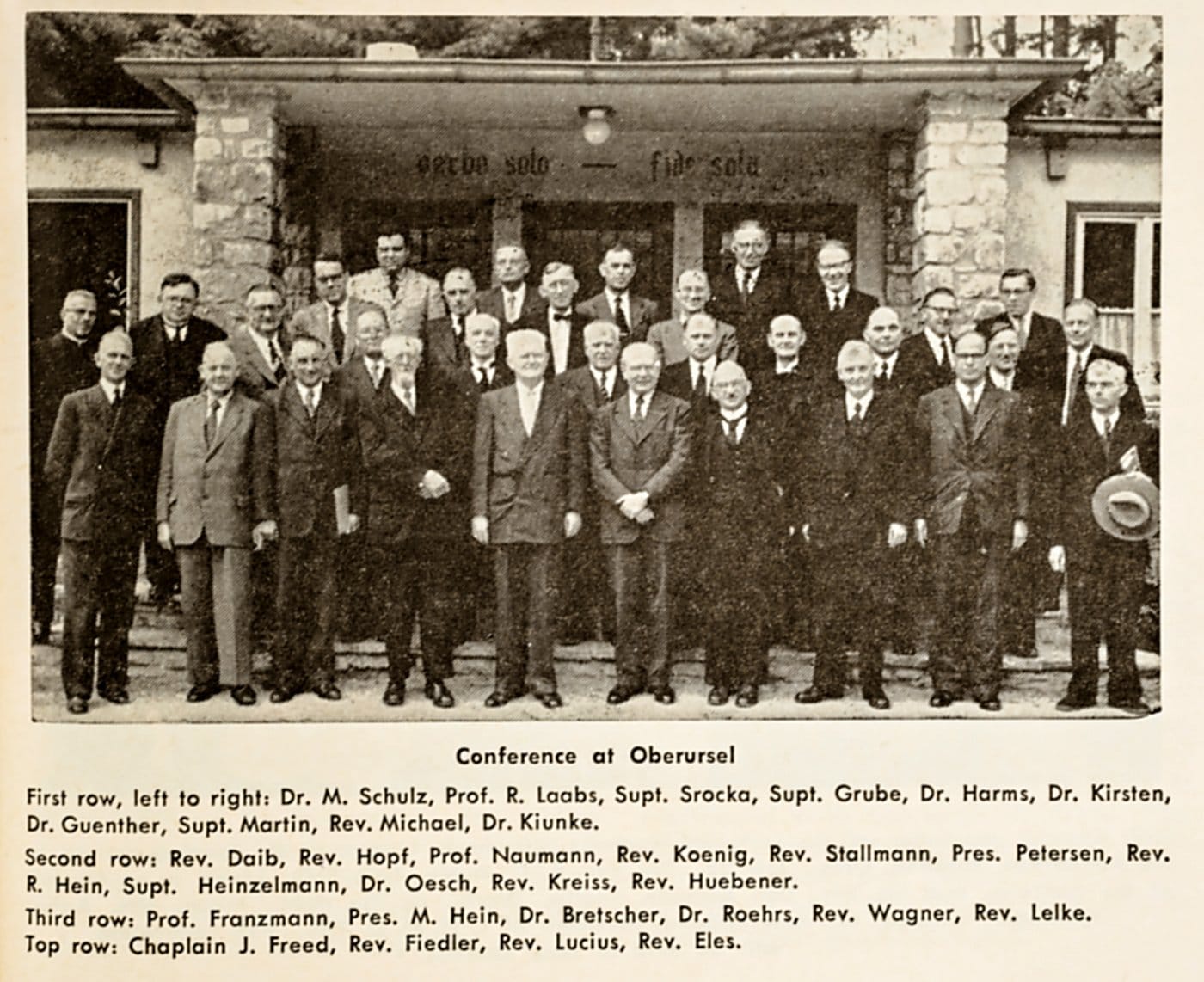
What remained of 1953 gathered at Bad Boll itself: two conferences, July 15 to 22 and July 24 to 30, about seventy at each, under the title “The Church as Viewed by Its Living Lord” and a subtitle that made the whole program a confession in the first person, “The Confession of All Believers, Jesus Christ Is My Lord.” On the last theme, “My Lord who shall deliver me from every evil work,” Pastor Willkomm of the Berlin Free Church read on Jesus the Judge of the world.
The ledger
Four years, then, and a ledger. On the side of reach: a first conference in England answered by a second at Oxford, and a third year’s leg; a first conference in France answered by five sessions in Paris; attendance between seventy and a hundred at the German sessions, with thirty-seven at Oxford. On the side of strain: an organizer proposing to suspend a year for want of hands; a church official pressing the bishops to hold the conferences again; delegates whose repeated plea was that the meetings “might not cease”; a Berlin conference lost outright to the aftermath of a rising. The strain, the book notes, does not sit on the American side, which in 1952 alone staffed a conference, an assembly delegation, and Uelzen inside six weeks. It sits on the German side, and it is administrative and political before it is theological.
Whether that was the beginning of an ending, or simply the weather in which a sturdy thing kept growing, the sources of these four years do not say, and the book has promised not to say for them. What they do say, in their different accents, is come again, might not cease, we are alone and lonesome: the thing being scattered was wanted in more places than it could be. Churches still face that arithmetic, and still call it by all three of its names: opportunity, strain, and suspicion.
Next Thursday, 1954: the fullest circuit and the last full year, six conferences from London to Gothenburg, and the German objection to a “paper Pope.”
Sources and notes: The Chicago minutes of February 6, 1950, and the Saint Louis minutes of January 10, 1950, are at Concordia Historical Institute. Bad Harzburg and the 1950 planning follow Lewis W. Spitz’s report and the Lutheran Witness of April 1950; Wistow rests on E. George Pearce to Lawrence Meyer, November 1950, at CHI, and Oxford on Pearce’s report in the Lutheran Witness. Bretscher’s two letters to Lawrence Meyer of August 5 and 16, 1951, with the Katterfeld interview, are at CHI, as are Harms’s and Bretscher’s reports on Spandau, July 1952, and Behnken’s covering note. Spalteholz’s account of the Berlin cancellation is Hans Spalteholz, “The Bad Boll Enterprise, 1948–1954” (B.D. thesis, Concordia Seminary, 1955), which also records that its 1950 sources were Spitz’s files rather than Bretscher’s. The Schroeder clipping is “Coal Valley Man Tours 10,000 Miles in Europe During Year as Student,” The Dispatch (Moline, Ill.), August 14, 1953. The 1953 Paris and Bad Boll sessions follow Paul Koenig’s report in the Lutheran Witness of September 15, 1953. The book treats 1950–1953 in chapter 7.
Researched and written by Dr. Albert B. Collver III, from the archives behind the forthcoming book Bad Boll: Missouri at the Crossroads (Concordia Historical Institute). Corrections, recollections, and documents of your own are welcome at info@badbollbook.com.
© 2026 Albert B. Collver III · Thursdays at Bad Boll. Archival documents are reproduced by courtesy of the holding institutions, as credited; the research, text, and annotations are the author’s. Please cite or link rather than republish.