The Telegram and the $1.9 Million
Relief is a Latin word about weight: relevare, to lift again. Before the Missouri Synod sent Germany a single theologian, it sent $1.9 million worth of milk, clothing, and books — and a telegram its editors printed exactly as the wire delivered it.

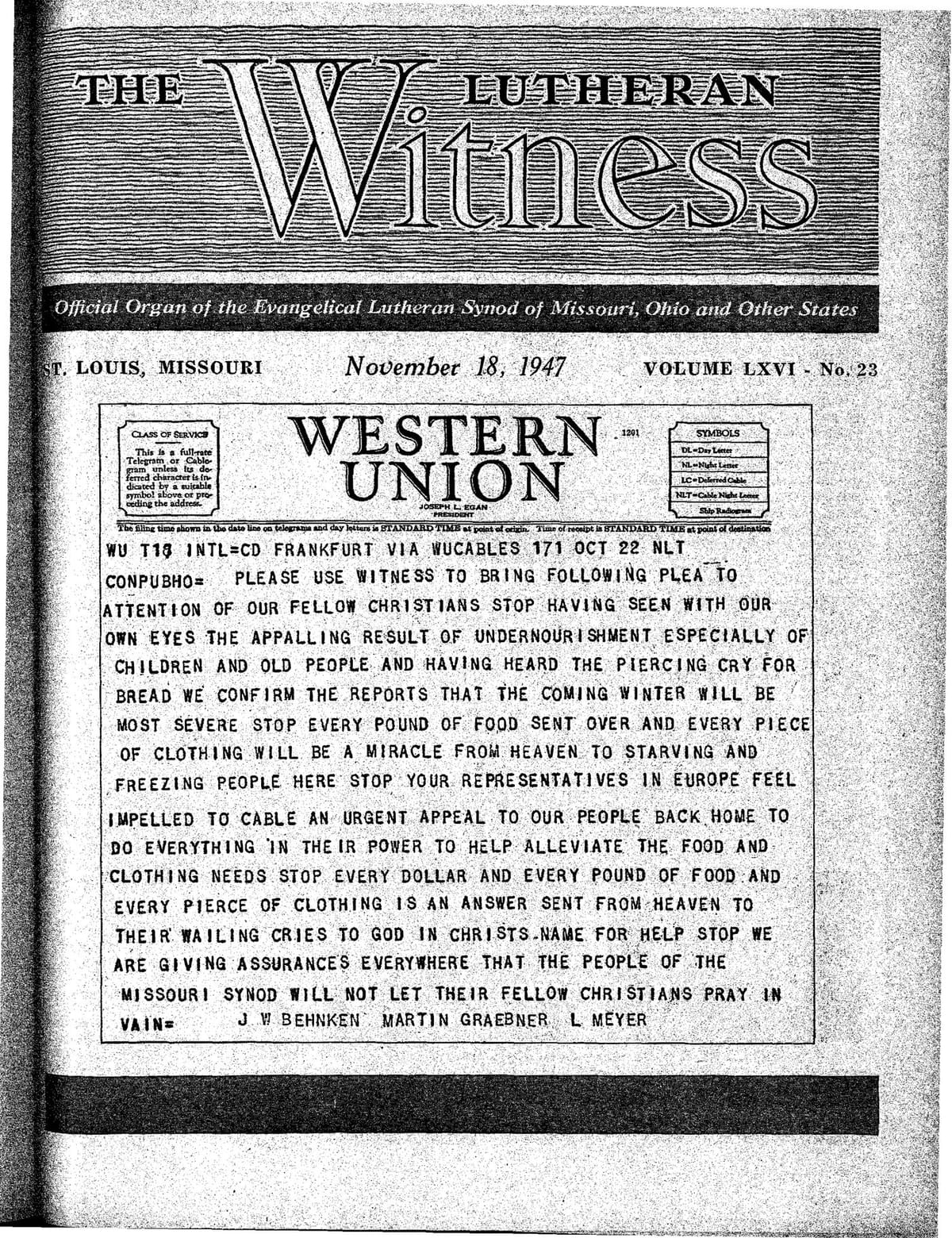
On November 18, 1947, the Lutheran Witness gave its cover to a piece of office stationery. Not a photograph, not an engraving of a church: a Western Union night-letter blank, symbols key and all, exactly as the cable had arrived from Frankfurt on October 22 over the names of three men then traveling through the ruins — President John W. Behnken, Dr. Martin Graebner, and Dr. Lawrence Meyer, the executive secretary the reader met last week. The text was set in the telegraph's own capitals:
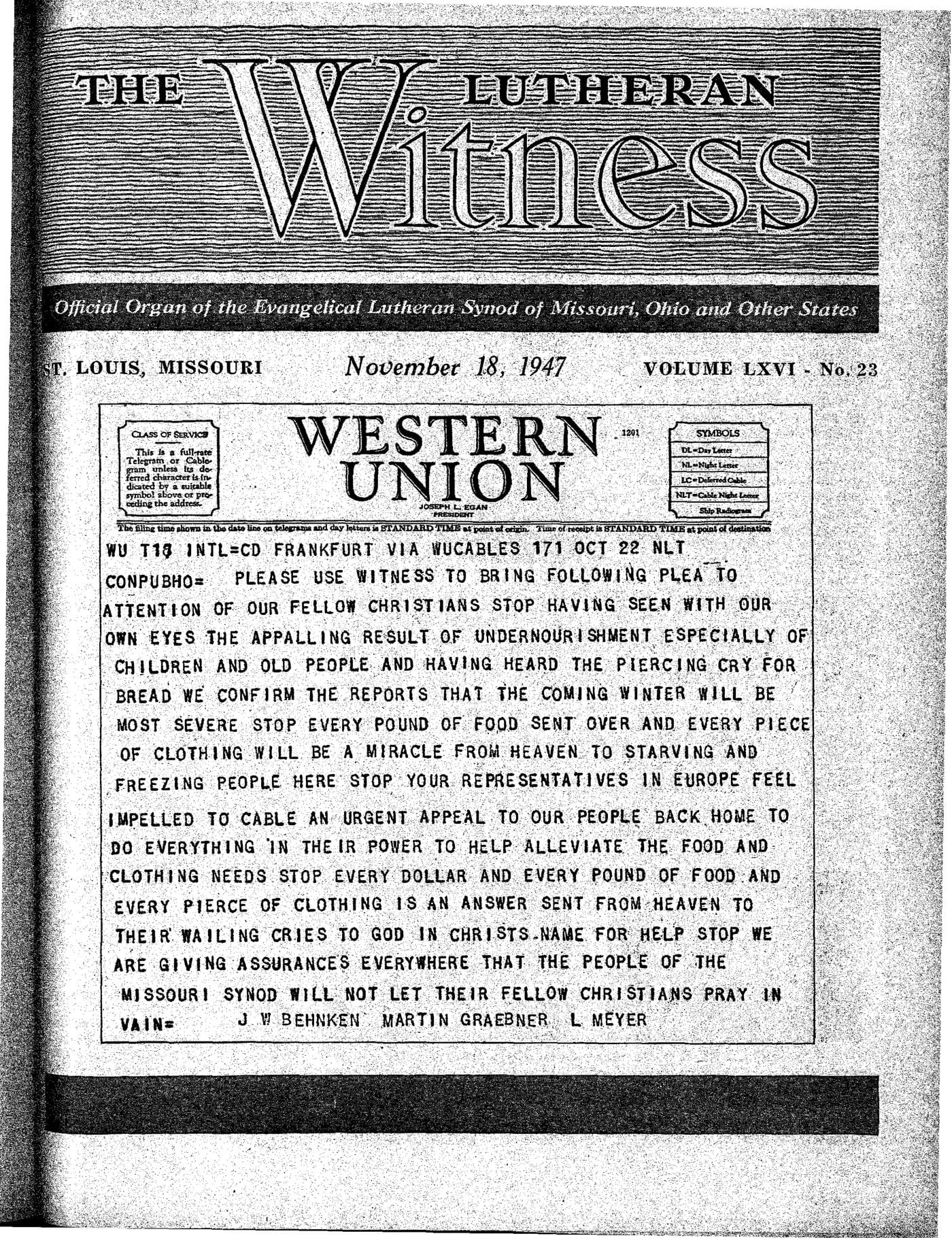
EVERY POUND OF FOOD SENT OVER AND EVERY PIECE OF CLOTHING WILL BE A MIRACLE FROM HEAVEN TO STARVING AND FREEZING PEOPLE HERE STOP YOUR REPRESENTATIVES IN EUROPE FEEL IMPELLED TO CABLE AN URGENT APPEAL TO OUR PEOPLE BACK HOME TO DO EVERYTHING IN THEIR POWER TO HELP ALLEVIATE THE FOOD AND CLOTHING NEEDS STOP EVERY DOLLAR AND EVERY POUND OF FOOD AND EVERY PIERCE OF CLOTHING IS AN ANSWER SENT FROM HEAVEN TO THEIR WAILING CRIES TO GOD IN CHRISTS NAME FOR HELP STOP WE ARE GIVING ASSURANCES EVERYWHERE THAT THE PEOPLE OF THE MISSOURI SYNOD WILL NOT LET THEIR FELLOW CHRISTIANS PRAY IN VAIN
The wire spells piece correctly the first time through. On the second pass — a few lines after the operator had tapped out "THE PIERCING CRY FOR BREAD" — it comes through as a PIERCE of clothing, and the editors let it stand. That was the point of printing the blank itself: not prose about urgency but the artifact of it, wired from the ruins to several hundred thousand American households, slip of the key and all.
Relevare
Last week's word, emergency, was about water — emergere, to rise up out of it. This week's word is about weight. Relief descends, through the French relever, from the Latin relevare: re-, again, and levare, to lift — the verb that hides inside elevate and lever, built on levis, light. To relieve someone is not, in the first instance, to feel for him. It is to get under his burden and raise it. Sculptors still use the word in its bodily sense: a relief is the figure that stands up out of the flat stone.
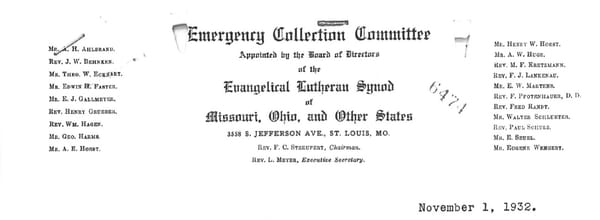
The two words belong together, and in 1945 the Missouri Synod put them together. The emergency machinery described last week — the committee of 1932, the wartime council of 1942 — did not dissolve when the war ended. It turned toward Europe and began to lift.
The ledger
The numbers climbed the way flood water recedes, month by month. By June 1946 the Emergency Planning Council's itemized statement stood at $912,118.49. By December it had passed a million and a half. The audited figure as of December 31, 1946 — one year of relief — was $1,904,360.22, something over thirty-two million in today's dollars, and the spending did not stop at the year's end.
Behind the total stood programs of almost domestic concreteness. The Saint Louis relief office shipped more than sixty thousand eleven-pound food packages. Congregations gathered clothing by the ton — some seven hundred fifty tons in bulk, with thousands of family parcels besides. More than eight thousand European families were "adopted" by American congregations. A child-feeding program ran kitchens in Finland, Poland, Czechoslovakia, Austria, Hungary, and the Russian Zone of Germany; seven dollars kept one child through the winter, and some forty-six thousand children were so kept.
And because this was the Missouri Synod, the crates held books. Ten thousand copies of Pieper's Christliche Dogmatik, ten thousand of Walther's Law and Gospel, one hundred forty thousand Small Catechisms printed in Bavaria for German distribution. "There is many a bombed-out pastor in Europe," Meyer reported, "whose complete library consists of one new volume of Dr. Pieper's Dogmatics, which he received as a Christmas gift from you." A German pastor's library, rebuilt beginning with Pieper — the aims of the relief program could hardly be put more concretely than that.
What the lifters saw
The men who carried the money went and looked at what it was lifting. In the fall of 1945 Behnken and Meyer entered Germany themselves. "Erstwhile proud Berlin is a mass of ruins," their report ran. At the Zehlendorf seminary, a few blocks inside the Russian sector, its president, Dr. Willkomm, told his visitors plainly: Meine Frau und ich werden schwerlich den Winter durchleben — my wife and I will hardly survive the winter.
On that same journey they handed Bishop Meiser of Bavaria five thousand dollars "to further the cause of Lutheranism in Germany," and pledged one hundred thousand to the Hilfswerk, the relief agency of the German Protestant churches, whose director, Dr. Eugen Gerstenmaier, had come to the work by way of a Nazi prison and did not deal in understatement: "I would be a dumb coward, a dumb dog, if I did not fight for Lutheranism. The Reformed will triumph only over my dead body." And at Erlangen they met a professor named Hermann Sasse, whose parting word was quieter and, in retrospect, heavier. By February 1946 it was in print in the Lutheran Witness for the whole Synod to read: "If American Lutheranism fails Germany, then Lutheranism in Germany is dead."
The reader should hold all three voices. Each will return in this series, and no two of them wanted the same thing.
Two years of this — the packages, the kitchens, the visits, the tonnage — changed what the word Missouri meant in a German churchman's mouth. The Germans had thought of the Synod, when they thought of it at all, as a curiosity "steeped in traditionalism, dead orthodoxy, and obscurantism." What they saw instead was the church body that had fed their children and restocked their libraries and asked, so far as they could see, nothing in return. Mercy was the whole of the errand; standing was its unlooked-for wage.
"Bad Boll, near Munich"
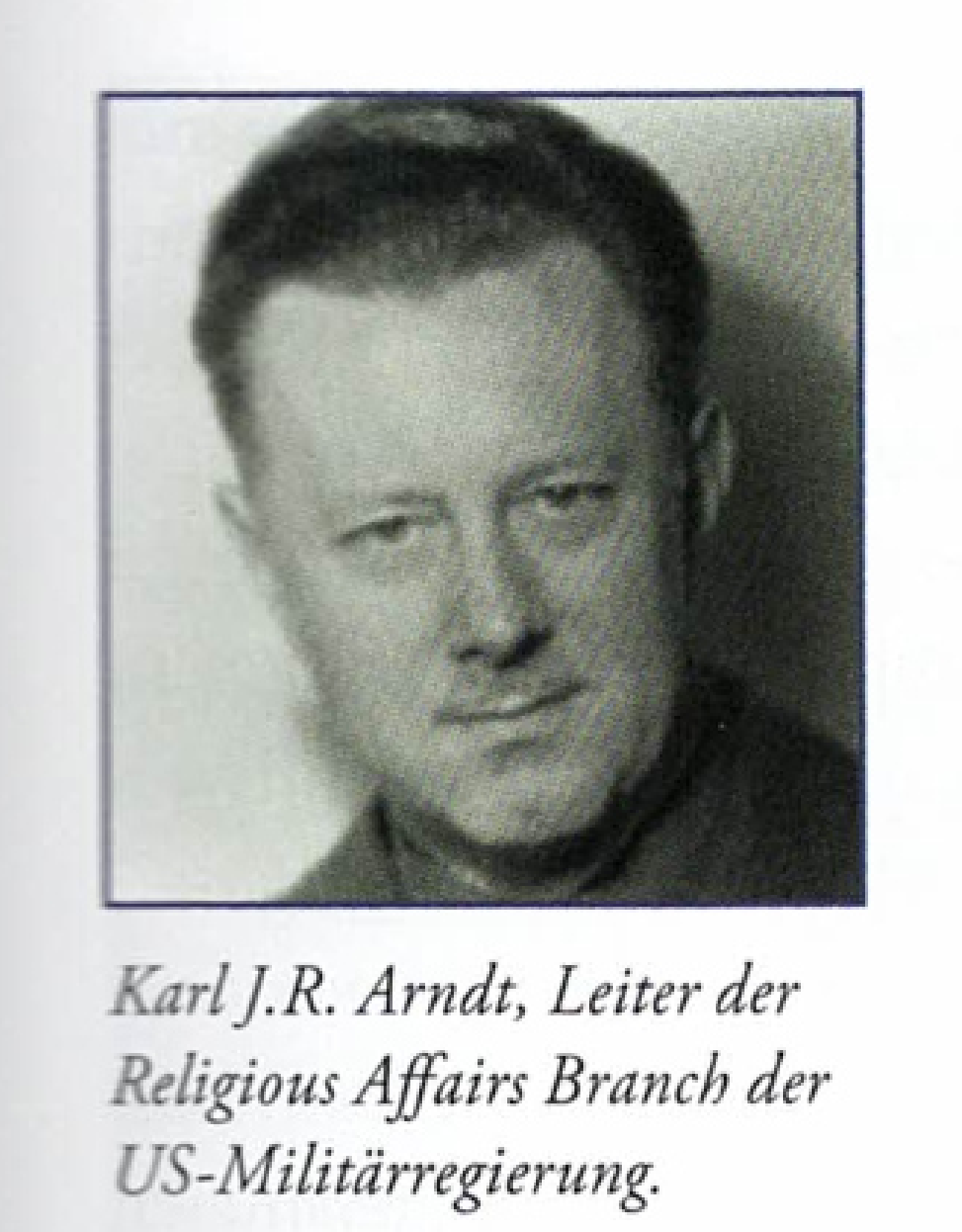
The fall of 1947 brought the climactic journey — Behnken and Meyer sailed on October 2 aboard the Mauretania — and with it the telegram. But the same trip produced a smaller notice that repays more attention than it got. At Bad Soden near Frankfurt, the Synod's army chaplains and relief workers in Europe held what their chronicler, Chaplain Hugo K. List, writing in the Witness of December 16, called a centennial convention on German soil — the Synod turned one hundred that year. Behnken preached on Isaiah 54:1–2, sounding, List wrote, "the keynote for a second century of progress." Dr. Karl Arndt, a Missouri Synod layman serving as chief of a Military Government religious-affairs branch, briefed the gathering on the struggle inside the German churches. And Lawrence Meyer, presenting the Synod's plans, disclosed a new one:
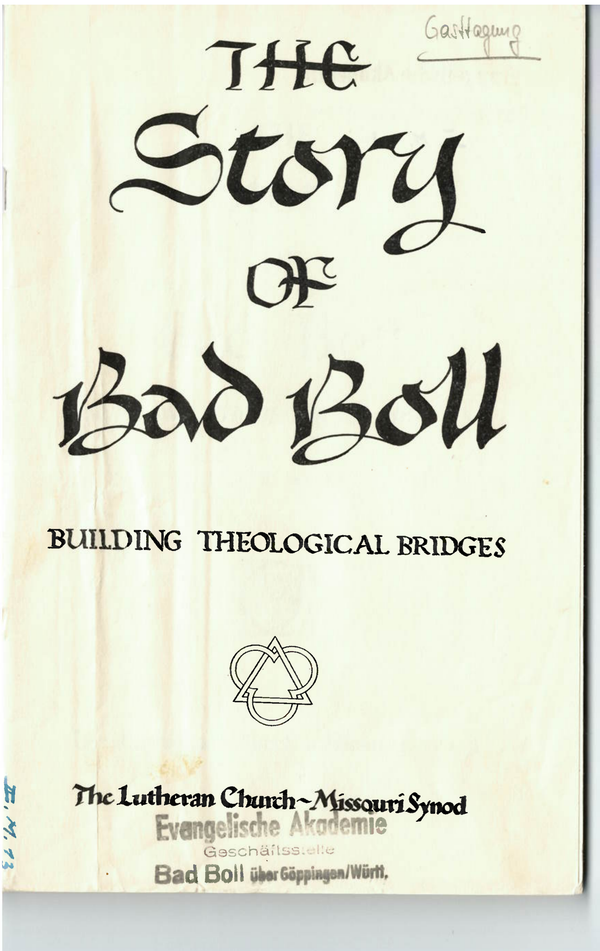
A program of seminars is to be instituted at Bad Boll, near Munich, where German churchmen will be invited to study doctrinal direction and the pastoral method of our Church in order to clarify and bring unity into their own desires with respect to the future of the Church in Germany.
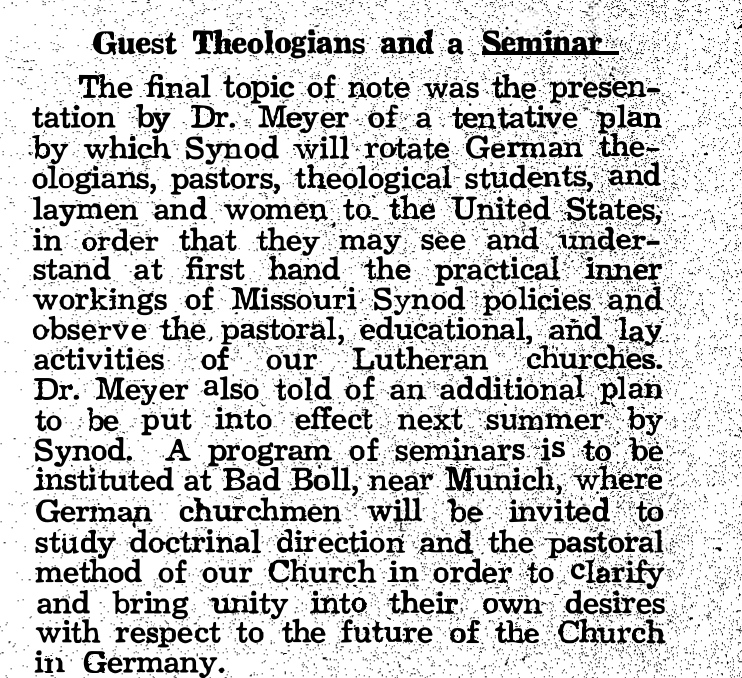
That sentence is the first public notice of Bad Boll, and nearly everything about it rewards a second reading. It was announced not to a convention but to an audience of army chaplains, with the chief of a Military Government religious-affairs office on the same program — a fair portrait, in miniature, of the alliance that would produce the conferences. And its geography is wrong. Bad Boll lies in Württemberg, near Göppingen, some two hundred kilometers west of Munich. The Synod's first published sentence about the place misplaced it by a province — a reminder of how new all this was, to the men proposing it most of all.
Meyer reached home a few days before Christmas 1947, having logged some sixty thousand miles over four wartime and postwar journeys. His retrospective in the Witness made the claim plainly: "The Lutheran leaders of Germany know and respect the Missouri Synod. Not all of them agree at all times with our doctrinal position. But they all lean on the Missouri Synod for spiritual help." Whether the leaning was as universal, or as durable, as Meyer believed in the flush of that December is a question this series will spend the autumn testing.
For now, stay with the word. Any congregation that has ever filled a food pantry or a disaster trailer knows the grammar of relevare: you lift the burden first, and whatever conversation follows is a conversation between people who have stood close enough to share weight. By the end of 1947 the Missouri Synod had earned such a conversation with the churches of Germany, and had, at a chaplains' gathering near Frankfurt, named the place where it intended to hold it. What it could not supply from Saint Louis was the vocabulary. The Germans, when they took up the plan that winter, did not reach for the English word conference at all. The word they used is next Thursday's — and it does not mean what Missouri thought it was planning.
Sources and notes: This post walks the relief documents of chapter 2 of the book. The telegram is John W. Behnken, Martin Graebner, and L. Meyer, “Plea,” Lutheran Witness 66, no. 23 (November 18, 1947), cover; the misprint is the cover’s own. The relief figures and the book shipments are Lawrence Meyer, “Missouri Synod World Relief in 1946,” Lutheran Witness 66 (February 11, 1947), which prints the itemized statement of $1,904,360.22 as of December 31, 1946; the 2026-dollar equivalents follow the book’s Introduction. The 1945 journey, the Berlin sentence, and Dr. Willkomm’s words are “Shall Lutheranism in Germany Be Saved?” Lutheran Witness 64 (1945); the Meiser and Hilfswerk gifts, Gerstenmaier’s vow, and Sasse’s warning are J. Behnken and L. Meyer, “Europe Cries, ‘Help!’” Lutheran Witness 65 (1946); “steeped in traditionalism, dead orthodoxy, and obscurantism” is F. E. Mayer, The Story of Bad Boll (Concordia Publishing House, 1949). The Bad Soden gathering and Lawrence Meyer’s announcement of the seminars are Hugo K. List, “Centennial Convention on German Soil,” Lutheran Witness 66 (December 16, 1947), 429; Bad Boll’s actual geography is the book’s Introduction. Meyer’s homecoming retrospective is “Return from Europe: Retrospect and Prospect,” Lutheran Witness 67 (1948). The book carries the full apparatus in chapter 2.
Researched and written by Dr. Albert B. Collver III, from the archives behind the forthcoming book Bad Boll: Missouri at the Crossroads (Concordia Historical Institute). Corrections, recollections, and documents of your own are welcome at info@badbollbook.com.
© 2026 Albert B. Collver III · Thursdays at Bad Boll. Archival documents are reproduced by courtesy of the holding institutions, as credited; the research, text, and annotations are the author’s. Please cite or link rather than republish.