The Shining Star of Materialism
He was born in Minnesota, raised in China, trained at a St. Louis seminary, and spent his life writing the history of Württembergers who left. Then he came back with an American army.

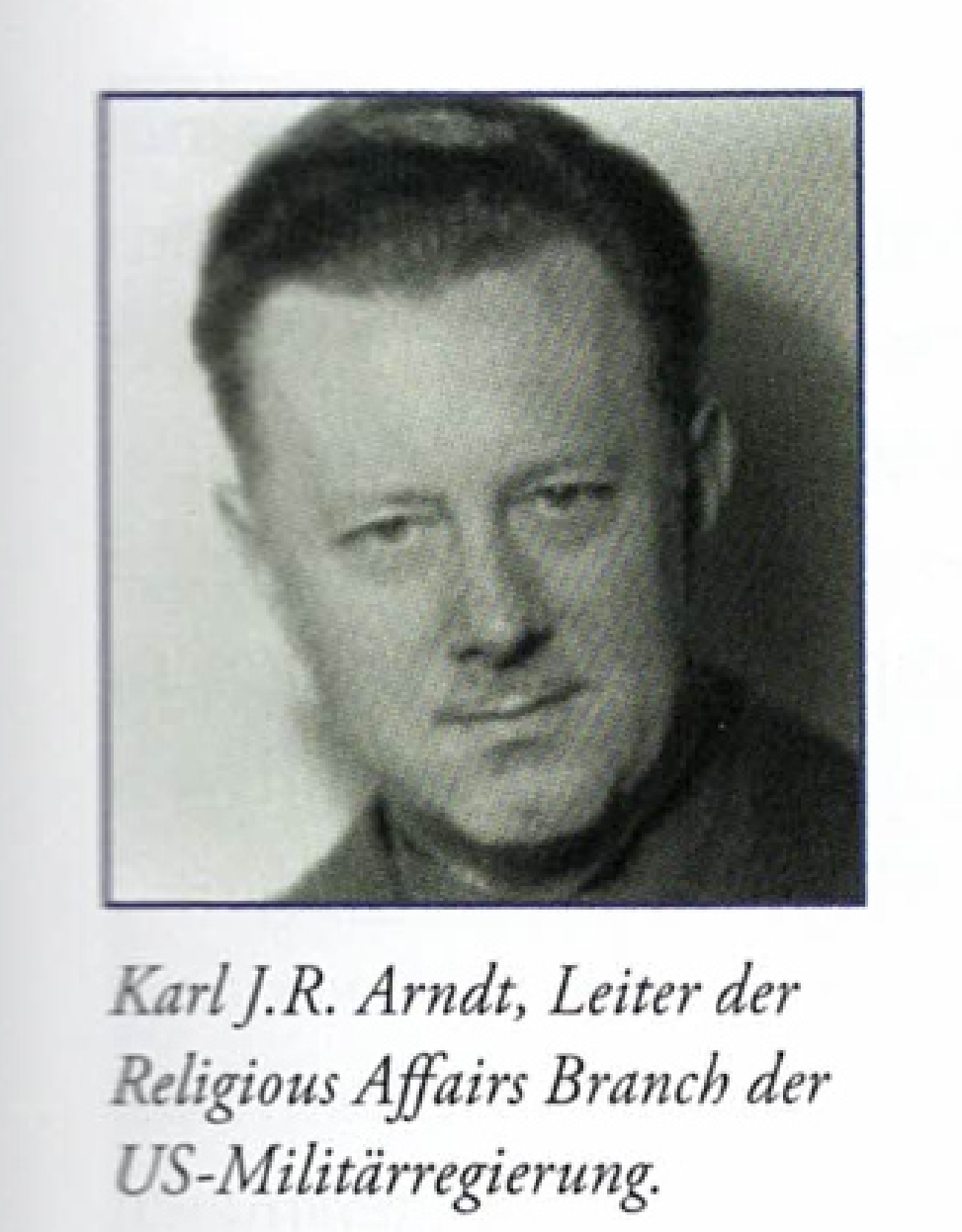
In the photograph he is about forty-five, in a dark jacket, looking a little past the camera. It is the only likeness of him I have, and it reached me last week from a reader in Württemberg.
The caption identifies him by his office. It leaves out the rest, which is the interesting part.
A Missouri boy in China
Karl John Richard Arndt was born in St. Paul, Minnesota, in 1903.
From 1913 to 1919 he lived in China. His father had gone out as the founder and first missionary of the Missouri Synod's mission there; the family went with him — the wife and four of the seven children made the crossing — and the boy learned Mandarin the way children learn things, by being ten years old in a place. He translated English into Mandarin as an exercise, and his father corrected his texts.
He hated it. In later life he called those six years his Babylonian Captivity, and he was rescued from them, at fifteen, by a British-American tobacco company freighter that happened to be lying off the Bund at Hankow and was sailing directly for Seattle. He left on the second of July, 1919. According to his father, he did not shed a tear.
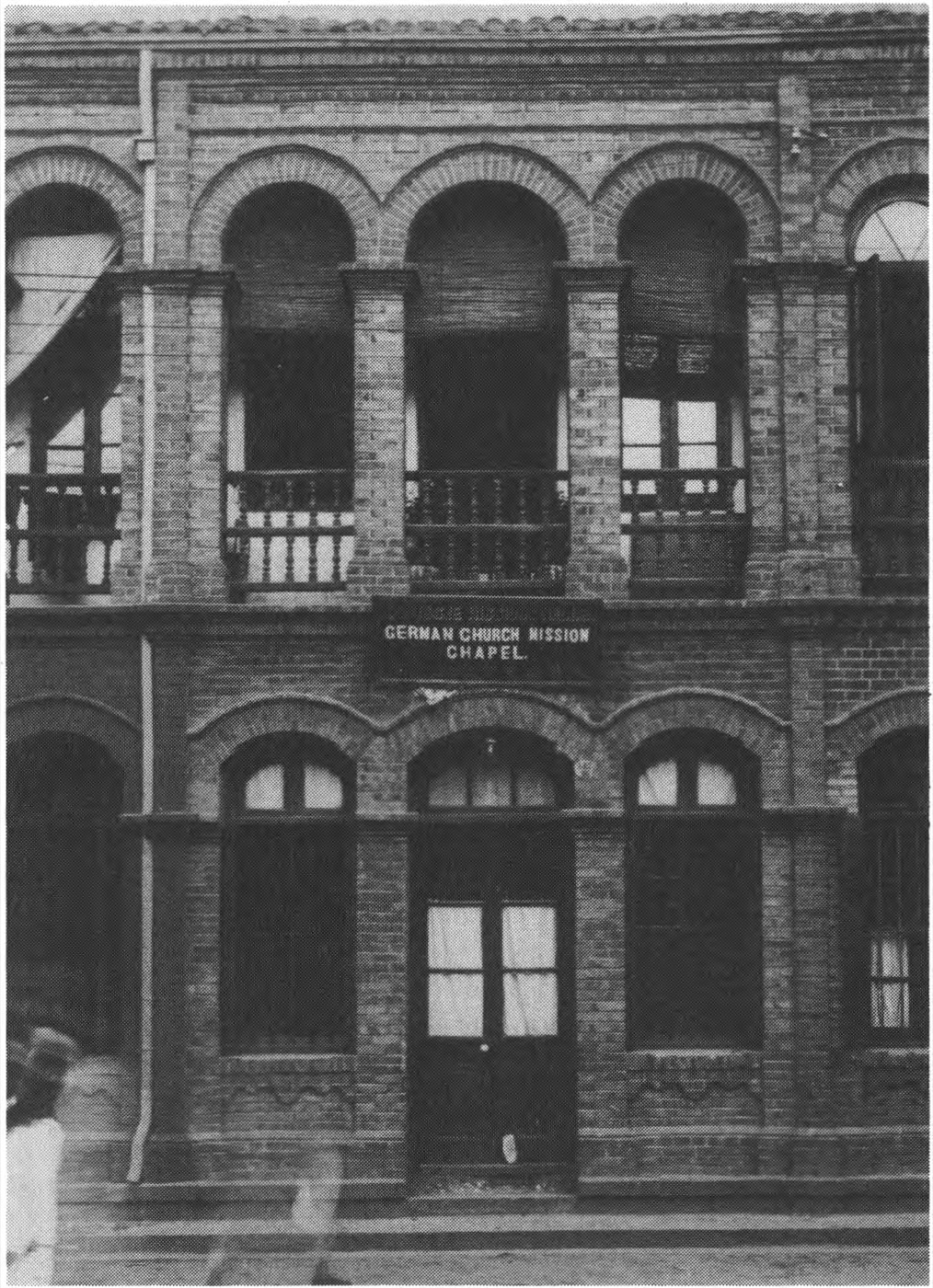
The father has a story of his own, and it bears on this one. Eduard Louis Arndt was born in Pomerania in 1864 and trained at Fort Wayne and St. Louis. He spent twelve years in a Saginaw pulpit, and then thirteen as the first professor of science at Concordia College in St. Paul — which is why Karl was born there. In 1910 the college relieved him of his classes, and how that happened is worth a section of its own. He did not expect a favorable hearing from the mission boards afterward, so he did not ask for one: in 1912 he founded a mission society, had it commission him, and sailed; the Synod adopted the field as its own in 1917, five years after the fact. He went back to America once, on furlough, in 1921 and 1922. He died at Hankow in 1929.
How he lost his position
The received version is a discipline case, and it is nearly right. What it has backwards is who was accused.
Arndt recommended that three students not be promoted, on their test scores. One of the three was Martin Pfotenhauer, whose father Friedrich was then the Synod's first vice-president and had run the Minnesota and Dakota District — the district the college stands in — for seventeen years; he would be president of the Synod within the year. More trouble followed in the same school year, this time over a student named Karl von Schenk, whose father had helped found the college. The faculty did not support him. In February 1910 he was relieved of his classes.
The ground given was not that he had disciplined the sons of prominent men. It was that he could not keep discipline at all. His son put the phrase in quotation marks when he came to write the mission's history half a century later: his father was "in midyear relieved of his teaching and forced to resign his divine call because 'he could not keep discipline' in his classes."
The matter went to the Synod convention of 1911, which appointed a committee of five — two men for the Synod, two for Arndt, one chosen by both sides — and the appeal ended the way such appeals end. "This matter was settled in that Prof. Arndt submitted his resignation." The convention voted him an allowance and recommended that he be helped back into a pastorate, "in which he earlier proved himself so well."
His son's verdict on the file, in 1963: "The published synodical record made a scapegoat of Professor Arndt."
He waited six months for a call to come through the Synod's own channels. None came. Then he printed the first of his Missionsbriefe.
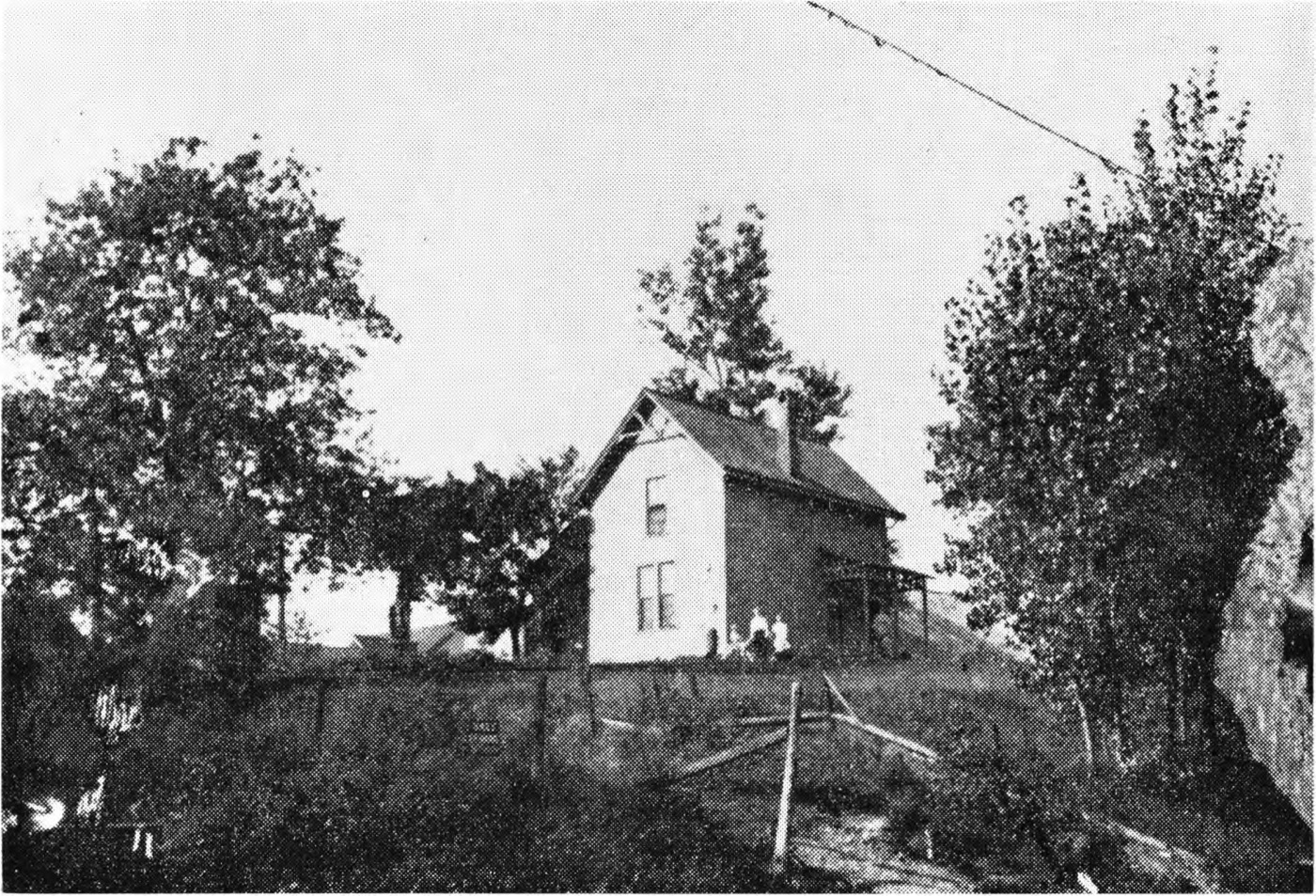
Two photographs survive from the house at 604 Rondo Street, where the family went from their campus home — no indoor plumbing, twelve dollars a month, and eighteen years of living at that level ahead of them. Arndt marked both prints in his own clear hand: exile. One is the house. The other is the view from it back toward Concordia College, and on that one he wrote Looking backward, and marked the college itself on the photograph, so that nobody could mistake what he meant.
Karl, meanwhile, came home to the Synod's own schools — St. John's College at Winfield, Kansas, and then Concordia Seminary in St. Louis. That is the same faculty which would later supply the American essayists at Bad Boll, in the same building that stands near the centre of this book.
He did not become a pastor.
That sentence deserves its own line, because a good deal follows from it. He took the degree and went into a university German department instead — and it amused him in later life to point out that he had never taken a bachelor's degree at all. He went on to a master's at Washington University in St. Louis and a doctorate at Johns Hopkins without one. The seminary took him nine years to finish, because he kept leaving it: two years, then the year 1924–25 as purser for the United States Mississippi River Survey Service on a ship running between St. Louis and New Orleans, then a spell teaching German and Greek at Concordia College in Edmonton, and a degree at last in 1927. Then Johns Hopkins, and the doctorate in 1933. He taught ten years at Louisiana State University — where, in an abandoned building, he found the manuscripts that made his name — and from 1950 at Clark University in Worcester, Massachusetts, where he ran the German department for nineteen years and stayed until the year he died. He remained a layman for the whole of his life. When the Missouri Synod later needed a man inside the American occupation of Germany, the man it had was not a clergyman at all. He was a professor of German literature who happened to have been through its seminary.
Four families wide
One more thing happened at Hankow, and it is the reason this section took a week longer than it should have.
The mission did not end when the boy left it. Six years after Karl came home, in that same river city, a New Zealander named Christian Nagel and his Australian wife, Mathilda, who had gone out to the same small mission — four families at Hankow, by the count of the 1921 directory — had a second son. They named him Norman. When the fighting reached the city the next year, the Nagels took their two boys out to Australia, and the father spent the rest of his working life in three country parishes: Netherby in Victoria, then Palmer and Booleroo Centre in South Australia.
The elder Arndt would not go. He stayed through the same uprising the Nagels fled — by the second week of April 1927, one of his own missionaries wrote, every one of them had left for Shanghai except him — and he died at Hankow two years later.
In 1981 his youngest son went back to look for the grave. He found the German church where the funeral had been held, locked, with a floor-to-ceiling painting of Mao at the altar, and the churchyard around it turned to a brickyard whose flooring was old headstones, still legible: Hier ruht in Gott. At the international cemetery an old woman led him out through weeds and young trees, stopped, and pointed at a single stone lying on its face. "This is it," she said. "All stones have been dug under. Only this one remains." He had his wish to be buried in Chinese soil, his son wrote, but today no one knows where he was laid to rest.
The boy born at Hankow in 1925 was Norman Nagel. On the last Tuesday of June 1954, the Bad Boll commissioners reached London and telephoned him for the details of the conference program. Forty-four years after that, he was my Doktorvater — my doctoral father, the term the German universities use and the Americans never found a word for.
I do not want to make more of this than it will bear. Karl Arndt never met the Nagels; he had been gone from China six years when Norman was born, and there is no letter in any file I have read in which either man names the other. What the record will bear is this. The mission was four families wide, and everyone in it knew whose mission it was.
The other man from Hankow
There is a second name in this, and I was slow to see it.
In 1917 a newly graduated seminarian named Lawrence Meyer had two written offers in front of him. One was from Western Electric at four hundred dollars a month, which was a great deal of money in 1917. The other was a call from the Board of Assignments to go out to China as one of the Synod's first missionaries there — to the mission Arndt had founded in his exile. His biographer says the dilemma posed him no problems. He sailed from San Francisco that November with a bride of nine days, and the next year he was made president of the mission's seminary at Hankow, which he ran until tuberculosis sent him home in 1925 with about six months to live.
He did not die. He recovered, and became the executive director of the Emergency Planning Council — the American who ran the Bad Boll planning from St. Louis, the man to whom Karl Arndt addressed his letters and his cables.
The two of them had met before. Karl's brother, writing his obituary in 1992, records that Missouri's part in the enterprise owed itself to "the leadership shown by two men, former China missionary Dr. Lawrence B. Meyer and Dr. Karl Arndt, who had met briefly in China in 1919" — which was the year the boy went home on the tobacco freighter.
So when those two arranged a conference in a Swabian spa town thirty years later, they were not strangers who happened to land in the same file. They had met in the mission Karl's father founded after the church dismissed him, in the last year Karl was made to live there.
Separatist
The word is se-parare: to prepare apart, to make ready by setting aside. It is not originally a word of insult. It became one in Württemberg in the seventeenth and eighteenth centuries, applied to Pietists who would not be contained inside the territorial church — who held their own meetings, kept their own discipline, and in the end would not have the parish system at all.
The most consequential of them was a linen weaver.
Johann Georg Rapp was born at Iptingen, near Maulbronn, on the first of November 1757. By the middle 1780s he had a following; by the end of the century the Duchy was answering him with fines and prohibitive taxes; in 1803 he sailed for Philadelphia with his son and two companions, and within two years some six hundred of his people had followed him into a settlement in Pennsylvania they called Harmony. They went on to Indiana and back to Pennsylvania again. They held their goods in common, and in time they stopped marrying, and in time there were none of them left.
Karl Arndt made himself their historian. He spent decades on it — volume after volume of documents, assembled and edited and printed — and the collection he built in the doing of it is now in the Pennsylvania State Archives and at Old Economy Village. Among American scholars, that is what his name means. Not the occupation. The Rappites.
He had begun on them before the war.
Here is a small thing, and I have no idea what to do with it. Iptingen belongs to Wiernsheim, in the Enzkreis. The reader who sent me the photograph lives in the same district, about twenty kilometres off, on the other side of Pforzheim. A man in that country wrote to St. Louis last week about a book; two hundred and twenty years ago a man from that country sailed to Pennsylvania because the territorial church would not have him; and the American who studied the second was sent, in 1945, to sit in Stuttgart and decide what the territorial church could and could not do.
The man in Stuttgart
He went over in 1945 and took charge of religious affairs for Württemberg-Baden. He held the post until he left Germany, in 1949 or in 1950 — the sources differ by a year, which is probably the distance between giving up an office and giving up a country.
Hermann Ehmer, whose history of the Württemberg church appeared last year, calls him the man decisive for church affairs in the American Military Government, and adds a clause I keep turning over: that he met the church leadership throughout with sympathy, and was their point of contact in every question.
Ehmer also names what he thinks the most enduring thing the Americans did. Not a policy, not an order. The invitation of individual Germans to go and look at America — study journeys, arranged one man at a time, for people whose horizon had been closed for twelve years. One Württemberg pastor used his to meet emigrants from his own congregation.
So the shape of it is this. A man spent his scholarly life on the Württembergers who left because the state church would not have them, and then spent five years as the American the state church had to deal with — and met it, on the German account, with sympathy throughout.
What that sympathy cost, and who paid, is a matter for the first of October.
The shining star of materialism
Arndt left Germany about 1950 and came back in later years to visit.
On those visits, Ehmer records, he thought he had to register a decline of religion and piety in the country as against the immediate post-war years, because over it there had meanwhile risen — the phrase is Arndt's own, in English, sitting inside the German page — "the shining star of materialism."
He meant the Mercedes star on the tower of the Stuttgart railway station.
It went up in 1952. Workmen cleared rubble from three hundred and sixty-five steps and carried the scaffolding and the oxygen bottles and the star itself up the tower on foot, and it was lit for the first time on the twenty-third of June — four years to the day after the first conference opened at Bad Boll. That is a coincidence and nothing more, and I mention it only because it is the kind of thing that makes a man sit still for a moment.
Note the chronology, which is the whole point. Arndt did not watch that star go up. He was gone before it was lit. He had known the tower when it was a burnt shell above a wrecked city, in the years when the Americans were feeding the country and the churches were counting their dead; and he came back to find that the skyline had acquired a star, and read it as a verdict.
It is an unfair remark and an unforgettable one. The country he was judging had been fed, in part, by his own church body, and got rich afterward, and the getting rich is not obviously a sin. But he had spent his life among people who gave up a country for the sake of what they believed, and he had spent five years among people who had lost one, and he knew what a star on a tower meant when it was turning.
As I write, it is not there. The star came down from the Bonatz tower in March 2021 for the rebuilding of the station, and it has been kept at the company's museum since; it is due back in 2027. For a few years the tower Arndt knew is bare again, the way it was when he knew it.
I do not intend anything by that. The star is coming back.
Next Thursday, the house itself: what a Bad is, why three hundred theologians went to a spa town to reconsider the Augsburg Confession, and who built the academy that took them in.
Sources and notes: The photograph, the sympathy clause, the study journeys, and the “shining star of materialism” remark are Hermann Ehmer, Württembergische Kirchengeschichte: Von der Christianisierung bis zur Gegenwart (Stuttgart: Calwer Verlag, 2025), 698–99, sent by the reader introduced last week. The life — St. Paul in 1903, China 1913–19, Winfield and the St. Louis seminary, the missing bachelor’s degree, the river survey, Edmonton, Louisiana State, and Clark — follows Mortimer H. Appley’s memorial for Arndt in the Proceedings of the American Antiquarian Society, corrected and much enlarged from his brother’s: Edward J. Arndt, “Karl J. R. Arndt: Lutheran German-American Scholar — A Nachruf,” Concordia Historical Institute Quarterly 65, no. 2 (Summer 1992): 47–52, which supplies the “Babylonian Captivity,” the tobacco freighter of 2 July 1919, the single Mississippi post of 1924–25, and the meeting with Lawrence Meyer in China in 1919. Rapp and the Harmony Society are the subject of Arndt’s own documentary volumes; the collection he assembled is held by the Pennsylvania State Archives and Old Economy Village. The star’s installation — the three hundred and sixty-five steps cleared of rubble, the equipment carried up on foot, the first lighting on 23 June 1952 — follows the Stuttgart press accounts gathered in the Stuttgarter Nachrichten’s Stuttgart-Album series on the Bahnhofsturm, which also record its removal in March 2021 and its expected return in 2027. The first Bad Boll seminar opened on 23 June 1948 — chapter 4 of the book. Arndt’s Stuttgart years, and what his sympathy meant for Missouri, are chapter 3’s — and the first of October’s. The photograph of the Arndt marker at Worcester Rural Cemetery is by Merry Hill, via Find a Grave (memorial 126867259), where Arndt’s memorial stands linked to his father’s. The Mandarin exercises, the four of seven children, and the second marriage are Appley’s; the father’s life — Pomerania 1864, the Saginaw pulpit, the St. Paul professorship, the mission society of 1912, the Synod’s adoption of the field in 1917, and his death at Hankow in 1929 — follows the biographical note to the Edward Louis Arndt Papers at the Concordia Historical Institute. The loss of the professorship is told from the synodical record by his son: Karl J. R. Arndt, “The Birth of Our China Mission (1912–62),” Concordia Historical Institute Quarterly 35 (January 1963): 113–27, quoting the Synodal-Bericht of 1911 for the committee, the resignation, and the allowance, and printing the two photographs Arndt marked exile. Lawrence Meyer’s call, the Hankow seminary, and his illness are Herman W. Gockel, “Lorry Meyer, the Memorable Maverick Who Lifted Missouri into the 20th Century,” ibid. 54, no. 2 (Summer 1981): 63–73. April 1927 at Hankow is Frieda Oehlschlaeger Thode’s eyewitness account, “The Rev. E. L. Arndt,” ibid.; the search for the grave is Edward J. Arndt, “The Search for My Father’s Grave,” ibid. 55, no. 3 (Fall 1982): 101–6. Photographs are reproduced by permission of the Concordia Historical Institute.
Researched and written by Dr. Albert B. Collver III, from the archives behind the forthcoming book Bad Boll: Missouri at the Crossroads (Concordia Historical Institute). Corrections, recollections, and documents of your own are welcome at info@badbollbook.com.
© 2026 Albert B. Collver III · Thursdays at Bad Boll. Archival documents are reproduced by courtesy of the holding institutions, as credited; the research, text, and annotations are the author’s. Please cite or link rather than republish.