Emergency
Emergency is a Latin word about water: what is emergent is what rises up out of it. The machine that carried the Missouri Synod to Germany first broke the surface in 1932, on a letterhead, formed to save the Synod from its own debts.

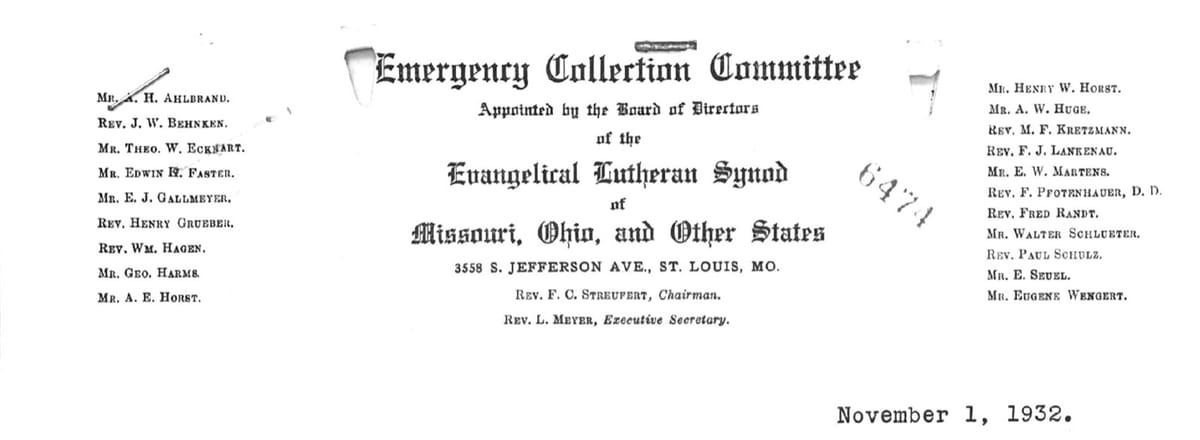
On the first of November, 1932, every pastor of the Missouri Synod received a letter on stationery none of them had seen before. Across the top, in blackletter: Emergency Collection Committee, and beneath it, in smaller type, Appointed by the Board of Directors of the Evangelical Lutheran Synod of Missouri, Ohio, and Other States. Down both margins ran two columns of names, pastors and laymen together, in the manner of letterheads of that era. The chairman was Rev. F. C. Streufert. The executive secretary was a returned China missionary named Lawrence Meyer, and this series will not be done with him for some time.
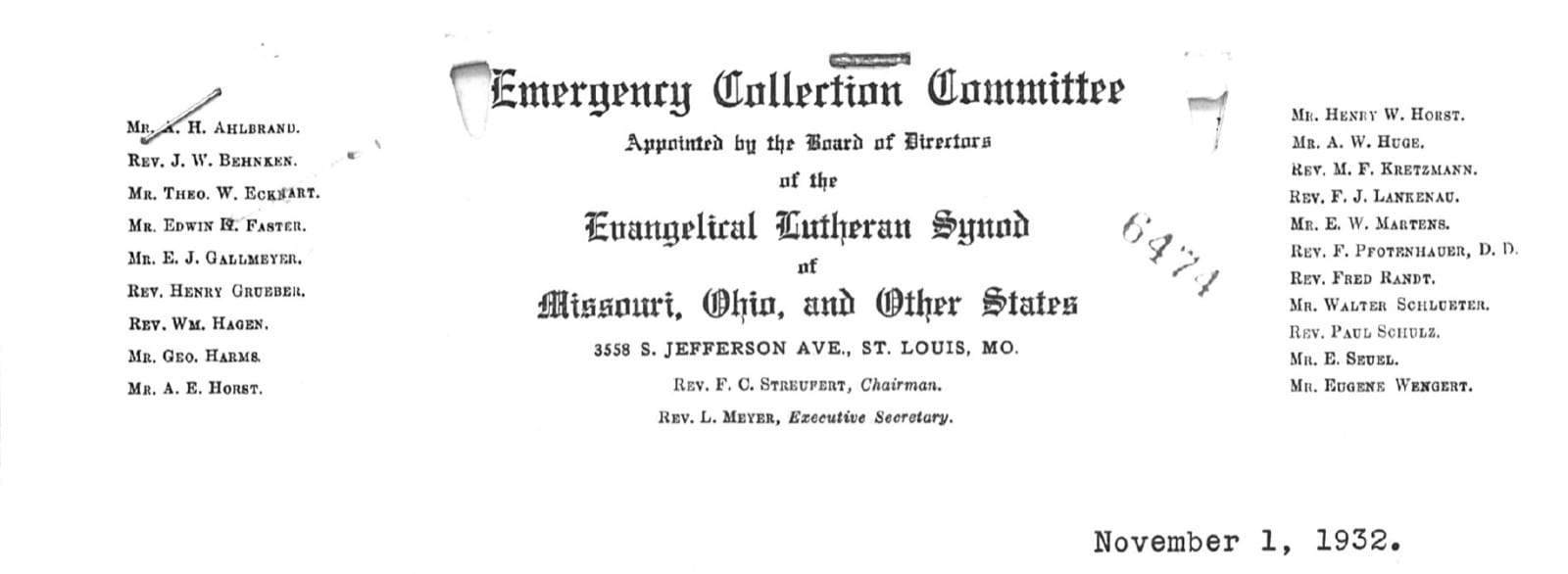
Here is the odd thing about that letterhead, and the reason the series proper begins with it. Search the Proceedings of the Synod's 1932 convention for the phrase "Emergency Collection Committee" and you will not find it. The convention, meeting that June in the deepest year of the Depression, adopted the collection itself — "the entire procedure … under the supervision of Synod's officers and its Board of Directors, to be adopted at their discretion." No resolution calls a committee into being. It simply appears five months later, already at work, on its own stationery.
The committee has no birth certificate. It enters the record already doing its job. Hold that thought for sixteen years; it is the habit this book is about.
Emergere
Emergency is a Latin word about water. It descends from emergere — e-, out, and mergere, to plunge, the verb that also gives English submerge and, more peaceably, merge. We now use the word for the flood itself, the moment of drowning. The Latin looks the other way. It names not the going under but the coming up: what is emergent is what rises out of deep water and breaks the surface.
In 1932 the Missouri Synod was going under. Its books showed a deficit of one million dollars — about twenty-four million in today's money — and behind the deficit stood bank loans it could not cover. The convention adopted a slogan, "A Nickel a Week for Synod's Deficit." Schoolchildren were asked for two cents, and every teacher in the Synod's schools was sent a copy of Theodore Graebner's The Story of Our Church in America, so the children would know what their pennies were saving. The Synod also had more pastors than pulpits: a memorandum of Meyer's from that July asks, "How can we use the 110 surplus candidates and the 150 'stay-at-homes' from St. Louis in the Emergency Collection?" — a sentence in which an emergency becomes, in the same breath, an employment program.
President Frederick Pfotenhauer, in office since 1911, wrote to the pastors on October 9. He did not soften it: "our debts will paralyze Synod at the beginning of the new year, and we shall be forced to curtail Synod's work along the entire front." He knew exactly what his readers had in their ears, and listed it for them — their own financial distress, debts in the congregation's treasury, "the dirge about hard times from all quarters ringing in your ears." And he turned the appeal where a pastor of his generation would turn it: to keep silent, he wrote, would be "robbing some of your members of the opportunity to become rich in good works."
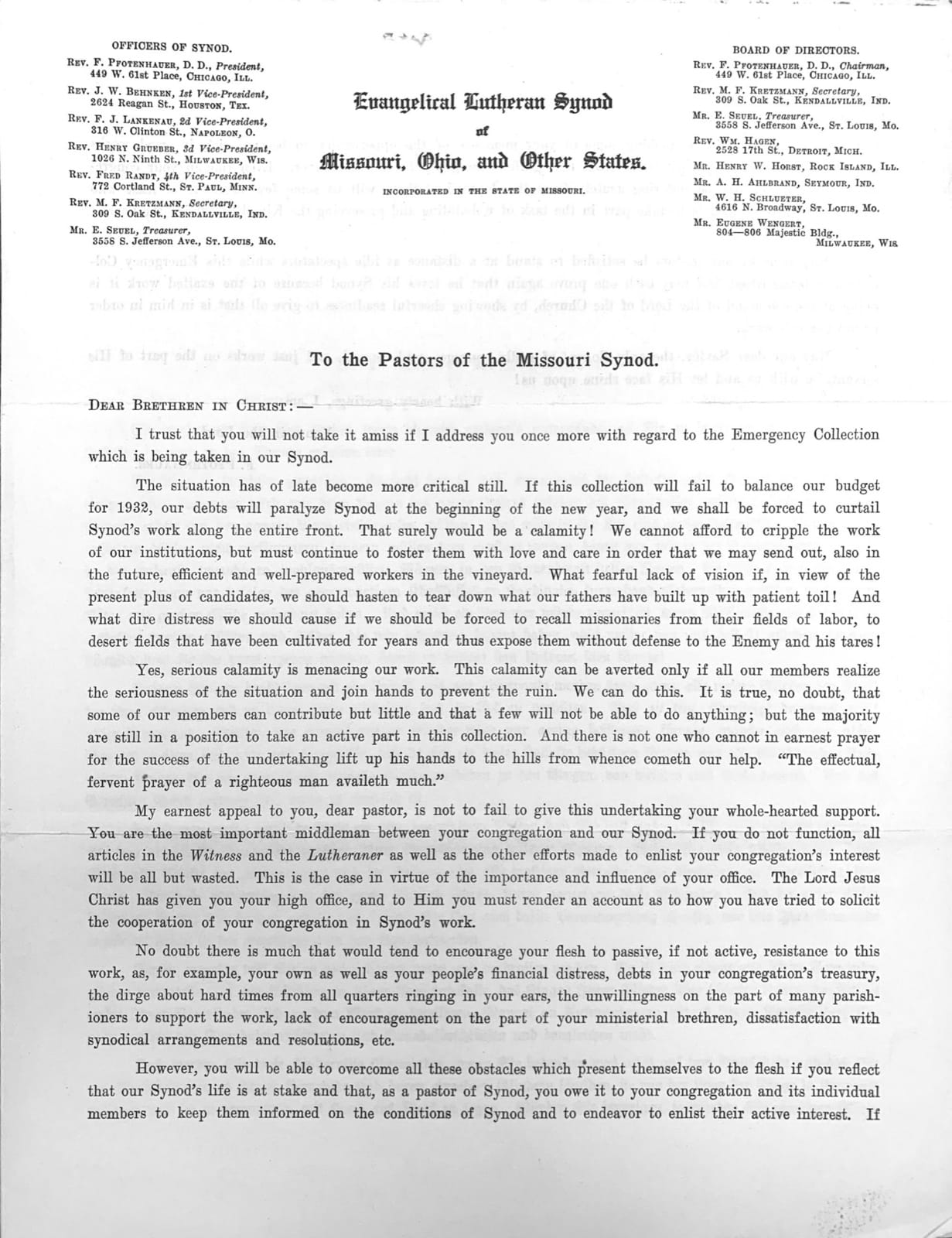
Then came the letter of November 1, on the new letterhead, over Meyer's signature. It reasons from Luke 14:28 — the man who would build a tower first sits down and counts the cost — and its tower is the 1933 budget, already cut by more than a fifth, with synodical salaries down twenty-five percent. The arithmetic is the humblest in this book: "If our 750,000 communicant members can be induced to give regularly, — even though the majority may give only one cent a day for Synod, — we shall not contract a debt during 1933."
The Synod did not default. The committee, its task completed, dissolved. That is what emergency machinery is supposed to do.
The man who did not die
A word about the executive secretary, because the reader will not otherwise know what the Synod had in him.
Lawrence Meyer left the Saint Louis seminary in 1917 holding two written offers: one from Western Electric at four hundred dollars a month, and one from the Board of Assignments to go to China as one of the Synod's first missionaries there. He took the call. He sailed from San Francisco that November with a bride of nine days, was made president of the Synod's seminary at Hankow in 1918, and ran it until 1925, when tuberculosis sent him home with about six months to live.
He did not die of it. In 1927 Pfotenhauer appointed him the Synod's publicity director, and five years after that he was the man signing the emergency letterhead. The Synod had, in other words, exactly one executive who had crossed an ocean for it, built an institution on the far side, and come back. It would have reason to remember where it had put him.
Everybody's concern in general
Ten years passed, and a larger emergency arrived. In June 1942, six months after Pearl Harbor, the Synod's president — now J. W. Behnken, whose own name stands in the margin of the 1932 letterhead — appointed the National Advisory Emergency Planning Council. No convention created this body either. The Council's later report to the 1947 convention explained the founding with disarming candor: the war had produced situations that "were everybody's concern in general, but nobody's business in particular."
Theodore Graebner announced it on the front page of the Lutheran Witness of March 2, 1943: "Our readers must get accustomed to the name of another synodical Board." He did not understate the assignment: "missions principally, but also education, publicity, charity, our relation to other churches, especially to other Lutheran bodies, our relation to the State, to foreign governments — the thing is global in its aspects."
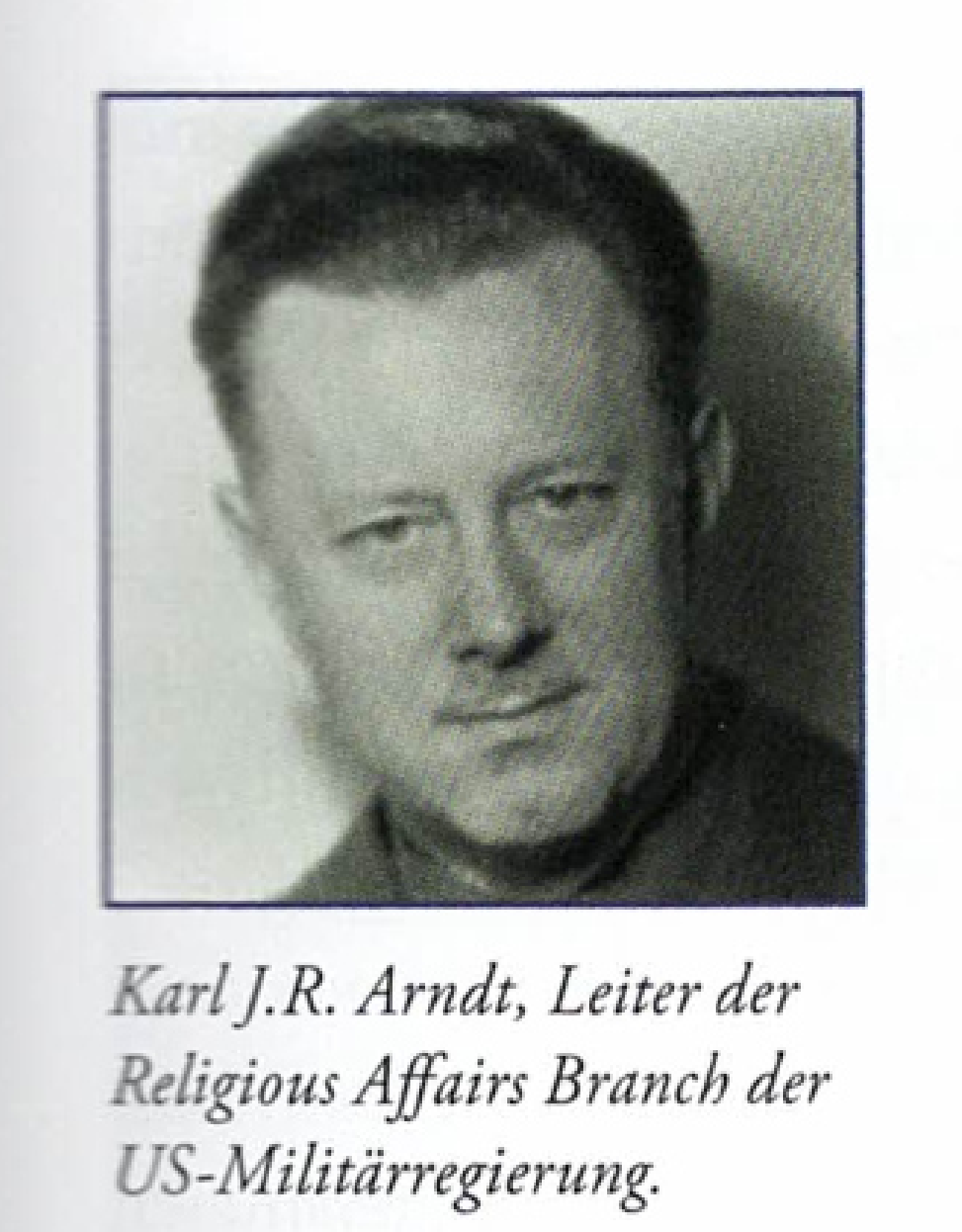
Its chairman was Louis J. Sieck, president of Concordia Seminary in Saint Louis. Its executive director was Lawrence Meyer. The records of the 1932 committee and the wartime Council sit today in the same file box at Concordia Historical Institute — Meyer's own files — which is as close as an archive ever comes to telling you what a man thought: that the one had been the rehearsal for the other.
The Council was, by its name, advisory. Its own budget request of 1945 kept a straight face for exactly one sentence, conceding that it "has at all times been keenly conscious of its purely advisory competency" — except, the request goes on, for the prisoner-of-war ministry and the "unprecedented relief work in Europe," where it had exercised "executive self-direction." The two exceptions it named were the two largest things it did.
What surfaced
By the end of the war, this improvised council — never authorized by a convention, answerable to a president, run by the returned missionary — was the one part of the Missouri Synod that knew how to move money, goods, and men across an ocean. When the question of Germany rose in 1945, there was no need to build the machinery. The machinery had been built twice, tested twice, and was still warm.
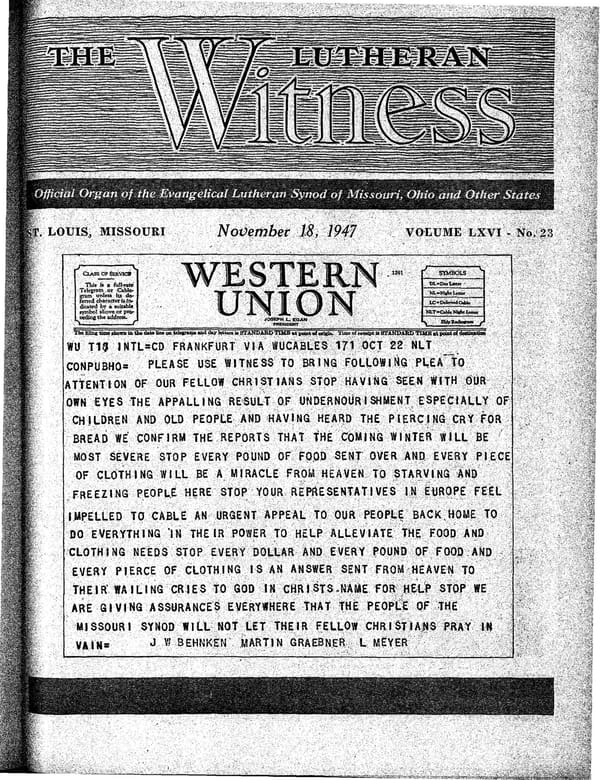
What it did when the war ended — the journey, the relief millions, and the first public notice of a "Centennial Convention on German Soil" — is next Thursday's document.
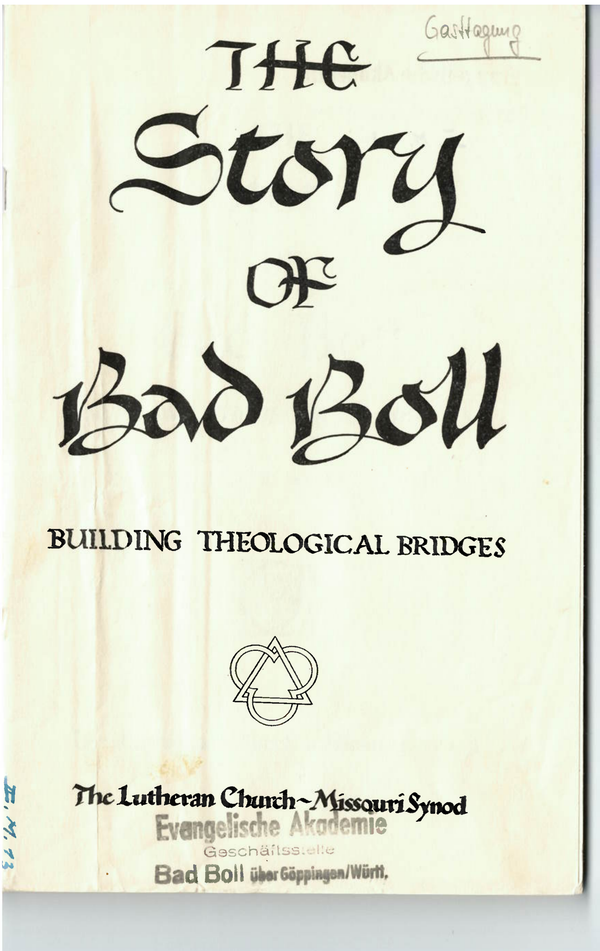
For now, stay with the word. Every church body knows this story's shape, and so does every congregation that has ever weathered a bad year: the crisis outruns the structure, somebody improvises, and the improvisation works. Emergency promises, in its very grammar, that the flood recedes. It makes no promise at all about what has broken the surface in the meantime — and what has come up, dripping and useful, rarely consents to go back down. The Missouri Synod's emergencies produced a committee, then a council, then a habit. In 1948 the habit went to a spa town in Württemberg, and the rest of this series is what became of it.
Sources and notes: This post walks the opening documents of chapter 1 of the book. The Emergency Collection Committee letterhead of November 1, 1932, and President Pfotenhauer’s appeal to the pastors of October 9, 1932, are from the files of Lawrence Meyer at Concordia Historical Institute and appear by its courtesy. The 1932 convention’s authorization of the collection is in the Proceedings of that year, 207–8; the surplus-candidates memorandum is Lawrence Meyer’s “Suggestions at Random” of July 21, 1932; the tower arithmetic is from his “Survey and Appeal” of November 1, 1932. The Emergency Planning Council’s appointment in June 1942 is fixed by its budget request to the Fiscal Conference of 1945, which also concedes the two exceptions to its advisory competency; “everybody’s concern in general, but nobody’s business in particular” is from the Council’s report in the 1947 Proceedings; Theodore Graebner’s announcement is “Emergency Planning Council Under Way,” Lutheran Witness, March 2, 1943. Lawrence Meyer’s China years and the two offers of 1917 follow Herman W. Gockel, “Lorry Meyer, the Memorable Maverick,” Concordia Historical Institute Quarterly 54, no. 2 (1981). The book carries the full apparatus in chapter 1.
Researched and written by Dr. Albert B. Collver III, from the archives behind the forthcoming book Bad Boll: Missouri at the Crossroads (Concordia Historical Institute). Corrections, recollections, and documents of your own are welcome at info@badbollbook.com.
© 2026 Albert B. Collver III · Thursdays at Bad Boll. Archival documents are reproduced by courtesy of the holding institutions, as credited; the research, text, and annotations are the author’s. Please cite or link rather than republish.