Begegnung
Conference is a Latin word about carrying: conferre, to bring things together. The documents that planned Bad Boll kept reaching for a different word — one with "against" hidden inside it — and the difference tells much about what the enterprise thought it was for.

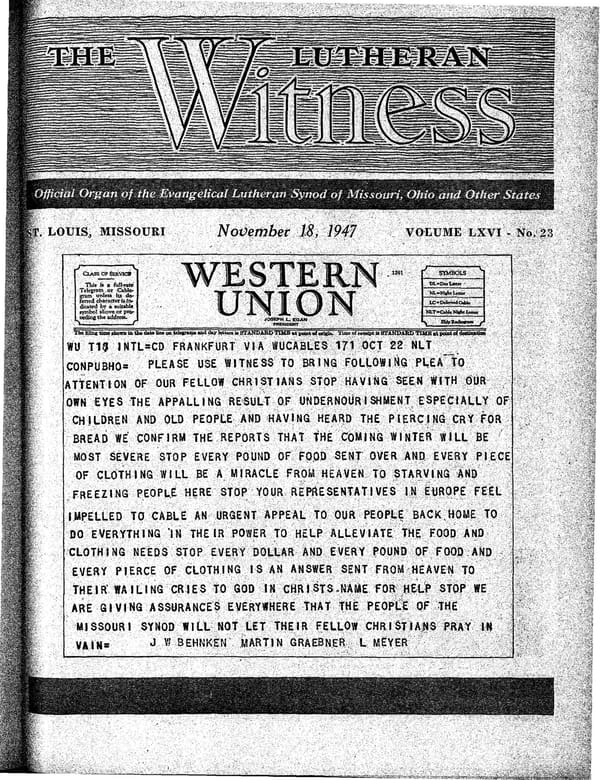
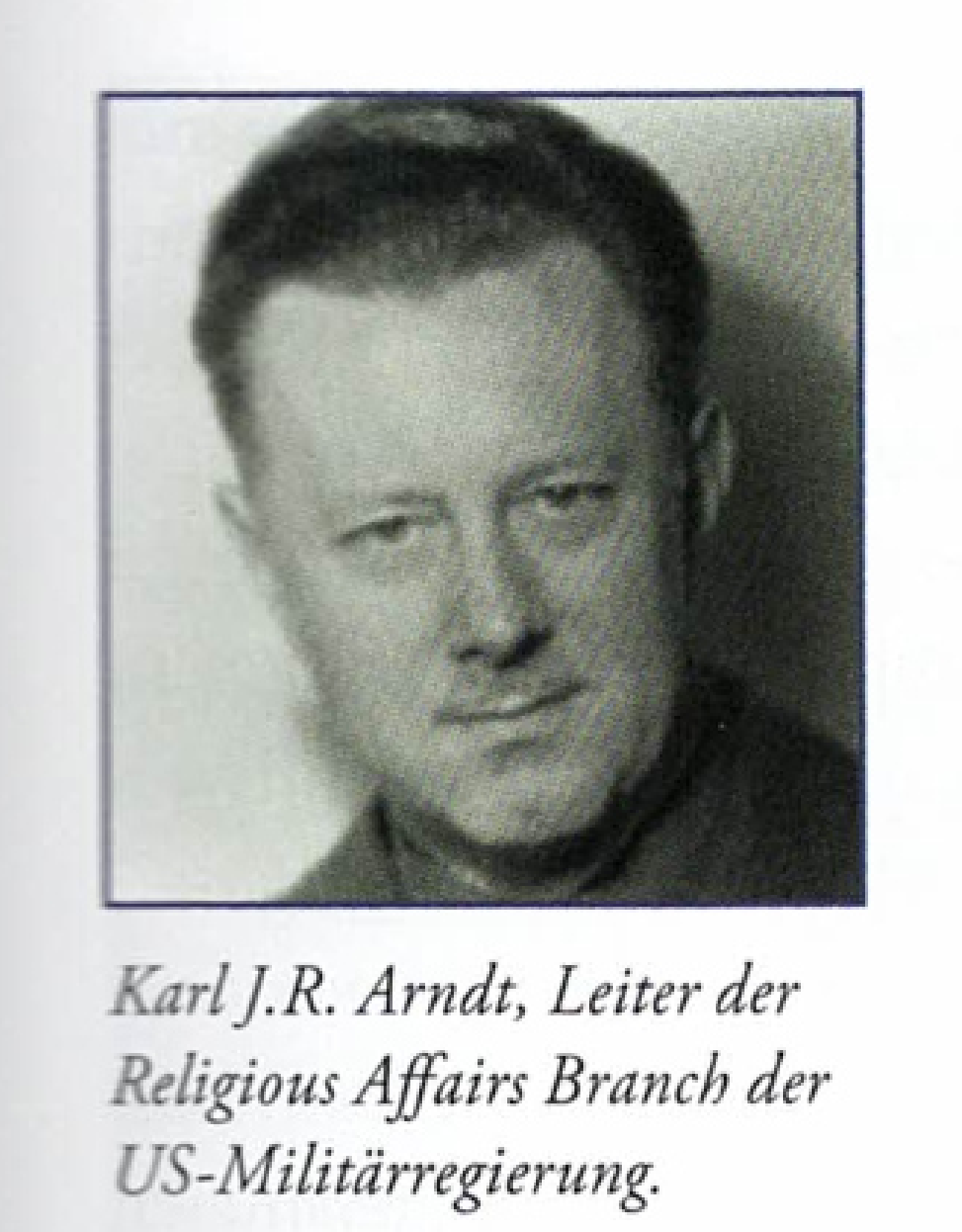
On Wednesday, December 3, 1947 — fifteen days after the telegram of last week's post ran on the cover of the Lutheran Witness — a company gathered in a private house at 285 Am Kräherwald, Stuttgart. The house belonged to Dr. Karl Arndt, Chief of the Religious Affairs Branch of the Military Government for Württemberg-Baden and a Missouri Synod layman, and the guest list deserves to be read slowly: everything this series has described so far was in that living room. Bishop Theophil Wurm of Württemberg. Bishop Hans Meiser of Bavaria. Bishop Julius Bender of Baden. Präses — president — P. H. Petersen of the Evangelisch-Lutherische Freikirche. Pastor Martin Hein, Bezirkspräses — district president — at Gross Oesingen. Dr. Eberhard Müller, director of the Evangelische Akademie at Bad Boll, whose institution would house the conferences. Dr. Eugen Gerstenmaier of the Hilfswerk, the relief agency the reader met two weeks ago. Dr. Lawrence Meyer of the Emergency Planning Council. A Dr. Graebner of the Missouri Synod, who presided — hold that indefinite article; we will come back to it. And Mrs. Rosine Arndt, the Emergency Planning Council's own representative in Stuttgart, whose labors run quietly through the whole file. The territorial churches, the Free Church, the American Synod, the German relief agency, and the American occupation, at one table. Präses Petersen opened with prayer.
What they planned that day, Missouri's English would soon be calling a conference, and the word is not wrong so much as it is American. Conference is built on the Latin conferre — com-, together, and ferre, to carry: a conference is a place where things are brought and laid on the table. It is the vocabulary of committees, and the Missouri Synod of 1947 was a church of committees.
Gegen
The German record keeps reaching for a different word, and the reader need not take my word for it. When the official invitation went to print the following April — a German-language form over President Behnken's own signature, of which more below — its first sentence announced eine Tagung, die der bruederlichen Begegnung zwischen deutschen und amerikanischen Theologen dienen moechte: a meeting that is meant to serve the brotherly Begegnung — the encounter — between German and American theologians. Note the grammar. The Tagung, the meeting itself, with its sessions and its program, is only the servant; the Begegnung is what the meeting is for. And the form closes the same way: In der Hoffnung, Ihnen in Bad Boll persoenlich zu begegnen — in the hope of encountering you personally at Bad Boll. Herman Gockel later glossed the noun for American readers: the theologians came "for a Begegnung, that is, a 'meeting of minds.'"
The word is usually translated encounter, and its inside is worth a look. At its root sits gegen — against, or toward; German uses one word for both. To begegnen someone is to come up against him on the road: not to convene him, not to summon him, but to find him coming the other way. English encounter is built the same — Latin in contra, "in front of, against" — which is why the English word has never fully decided whether an encounter is a meeting or a skirmish.
That is the honest word for what was planned at Stuttgart. A conference carries agendas toward a decision. A Begegnung is what happens when two parties who have been walking toward each other for a long time — one carrying food parcels and Pieper's Dogmatik, the other carrying the wreckage of a state church — finally stand face to face on the road and discover what, besides the road, they have in common. The word promises presence; it promises nothing about agreement. No one at Bad Boll ever had to take back the word Begegnung.
The two sentences
The character of the whole enterprise was set in that day's discussion, and it can be given in two sentences from Arndt's record of it. Bishop Meiser "pleaded that we guard against propaganda as our object, namely that Missouri should desire to propagate its doctrine." And in the same discussion, Gerstenmaier conceded the standing that had put Missouri at the table at all: the Missouri Synod had been "the least corruptible guardian of a perhaps too strict Lutheran heritage."
Read them together. The Synod's strictness was the credential; the Synod's ambition was the worry. Missouri was being invited in for exactly the quality it was being watched for. Anyone who has ever been welcomed somewhere because of a reputation, and eyed for it, in the same conversation, knows the room's temperature precisely.
The company reached consensus on the form the enterprise would take: a reconsideration of the Augsburg Confession, article by article, each topic treated by a Referent and a Co-referent — a presenter and a co-presenter — one American and one German. And when the program came back for adoption at a second Stuttgart meeting on January 8, there was one revealing skirmish. The Free Church men wanted the discussions to open with Verbalinspiration — verbal inspiration, the doctrine of Scripture — first. Gerstenmaier and Arndt had decided against it: they "might as well not have a meeting" if it began there, "especially since the Augsburg Confession does not use that approach itself." Their view prevailed, and the question went to the bottom of the pile. It did not stay there; the series will meet it again in December, standing alone at the head of a program under a title with no committee softness left in it.
Which Graebner?
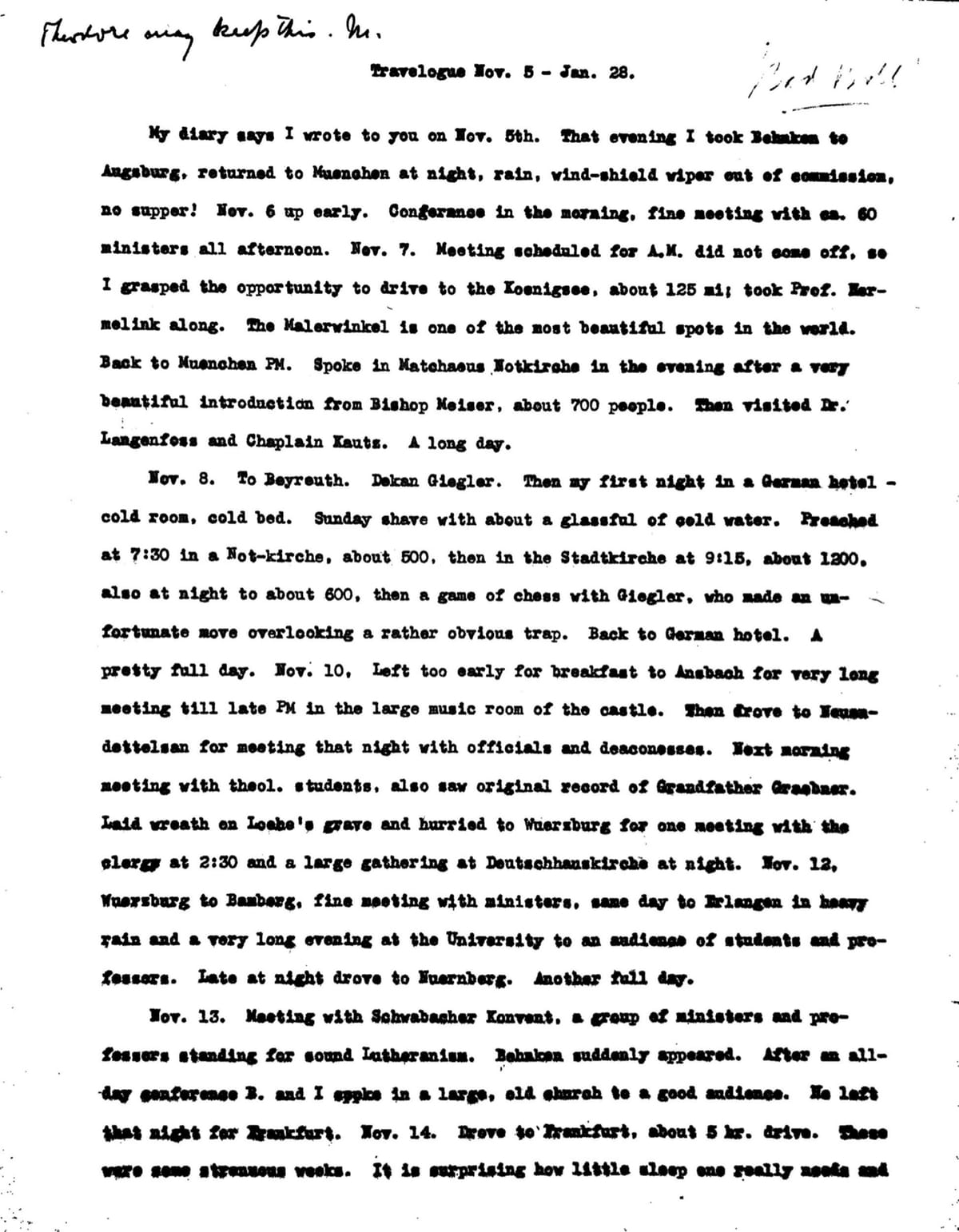
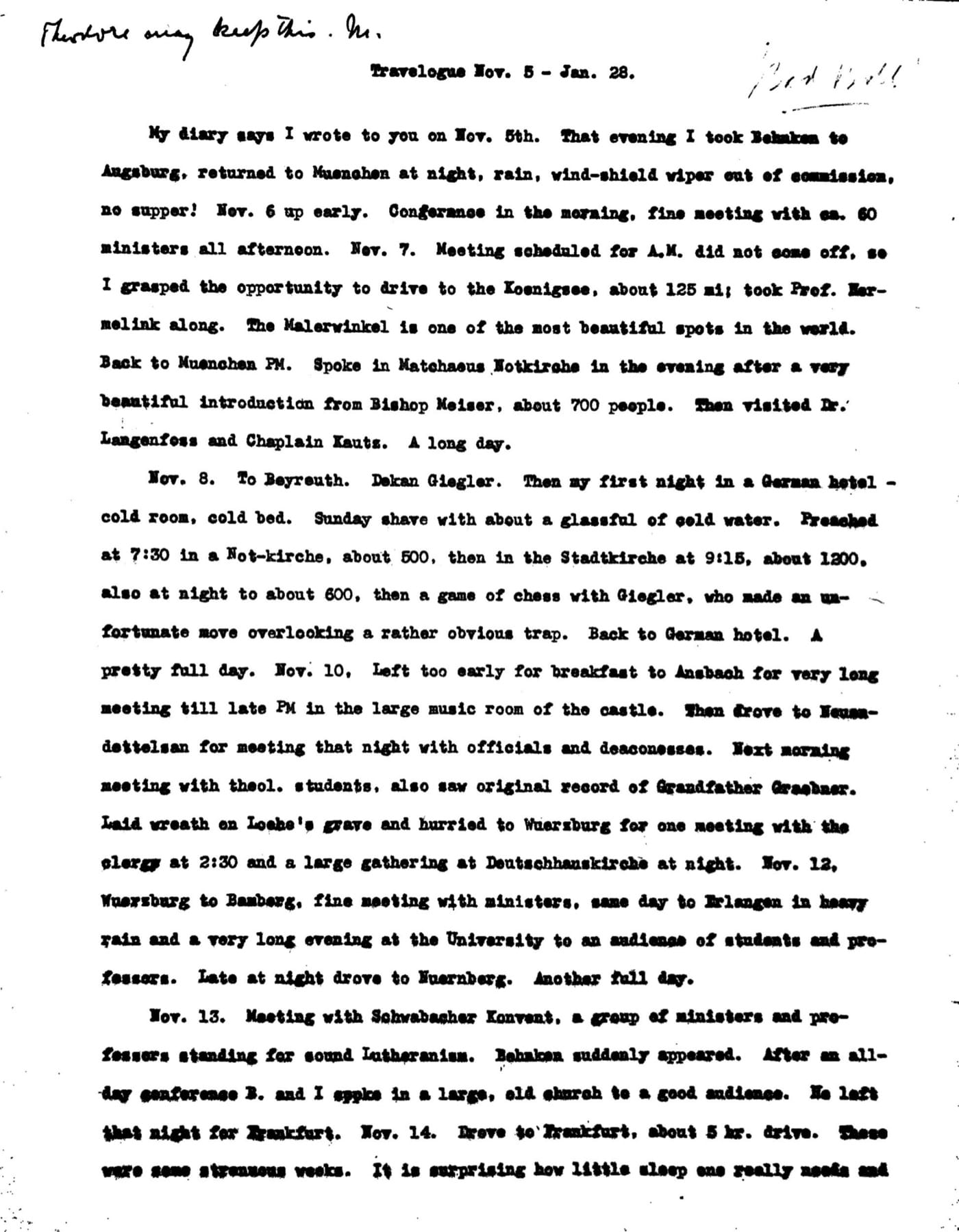
The figure at the head of this post is the first page of a travel diary kept by the Missouri Synod's man in Europe through that winter, with "Bad Boll" written across its head in cursive — the enterprise's name, on a working document, before the enterprise existed. The diary records the drive to Stuttgart for the December 3 meeting.
It also preserves a puzzle worth confessing in public. Arndt, printing his documentary history of these months thirty years later, lists the presiding American as Dr. Theodore Graebner of Concordia Seminary, Saint Louis. But his own note of the second meeting says only "Dr. Graebner, Mo. Synod," and the Missouri man actually resident in Europe that winter — the keeper of this diary — was Martin Graebner, a kinsman. The page itself testifies on the point: across its head a hand has written "Theodore may keep this. M." The diary went from an M. to a Theodore; it was not Theodore's own. Which Graebner sat in the living room on December 3 cannot be settled from the documents; the identification is a memory, made three decades after the fact, and the diary was made in the week itself. When a document and a memory disagree, the historian's rule is simple: trust the paper made at the time, and say plainly when the paper falls silent.
From a living room to a printed form
The machinery moved quickly after that. Saint Louis reviewed the Stuttgart transactions in an all-day session just before Christmas; Behnken's letters of invitation to the prospective American essayists went out on the last day of 1947. What came back was not a chorus of acceptance. Richard Caemmerer declined: "I do not converse in German and would be tremendously handicapped in discussing so controversial a subject." F. E. Mayer declined on his physician's orders, telling Behnken that "declining the invitation means a real sacrifice to me because my heart is in that work" — by spring he was on the roster anyway, and no document explains the reversal beyond that sentence. Paul Bretscher, "so completely overwhelmed" that he could hardly formulate a reaction, accepted three weeks later, after "long, but also careful and prayerful, consideration." These were not eager conferees; they were overworked men who understood the weight of the assignment.
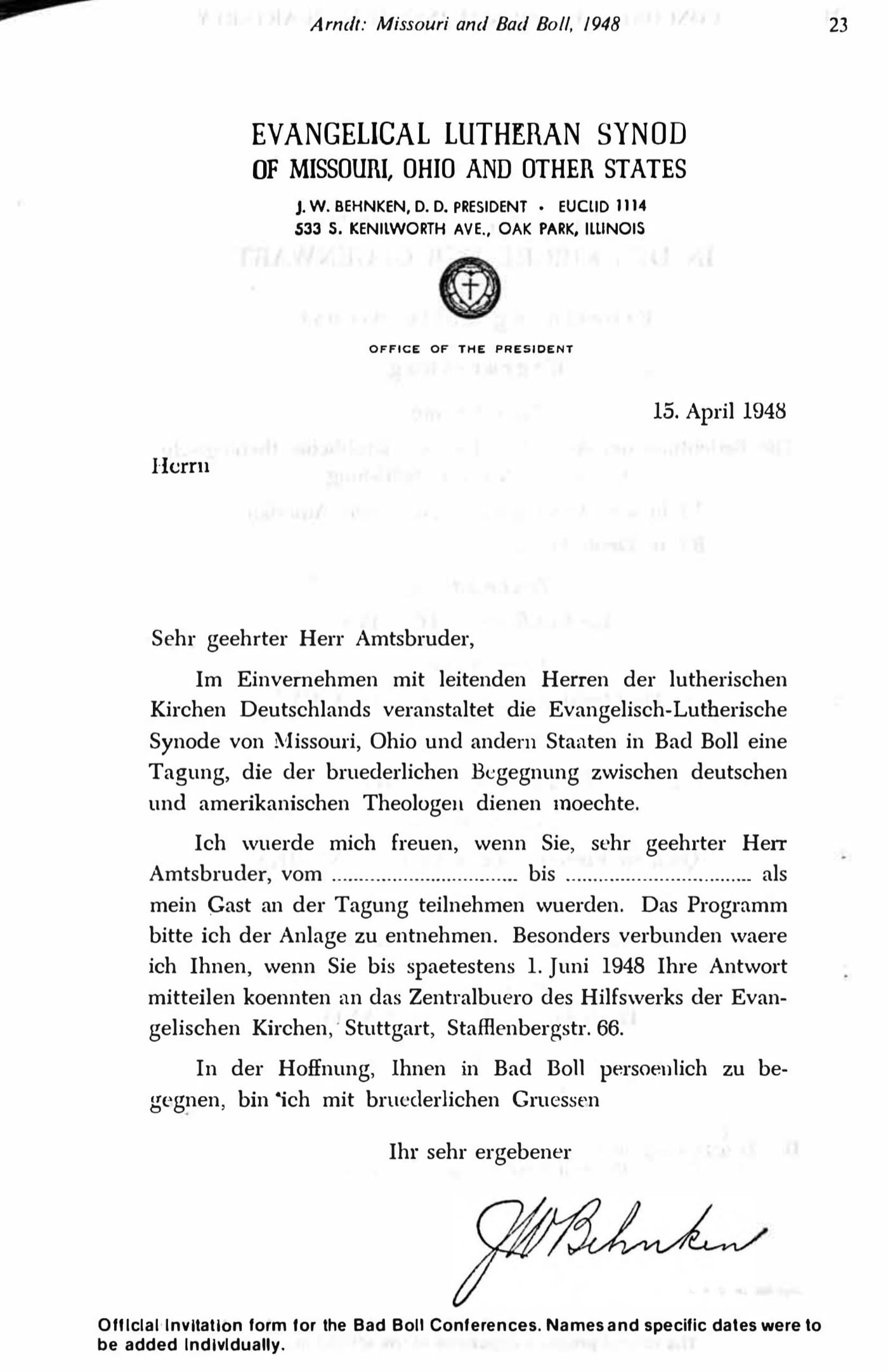
By mid-April the Begegnung had its paperwork: the printed invitation whose two German sentences the reader has already met, over President Behnken's signature, addressed to each recipient as Herr Amtsbruder — brother in office — with blanks left for name and session, and replies due by June 1 to the Hilfswerk's office in Stuttgart. A living room in December; a printed form in April; a ship in June. Whatever is providential in this story — and this series will not pretend to adjudicate providence — moved at the speed of committees, which may be the most Lutheran sentence I will write this autumn.
Stand at the end of it and look back, and the plainest fact about the planning of Bad Boll is how much walking-toward had already happened before anyone drew up a program: the milk, the clothing, the catechisms, the five thousand dollars in Meiser's hand, two years of it. The encounter was possible because the approach had been long. Congregations know this grammar today as well as they knew it in 1947. The meeting that matters is rarely the one that gets convened; it is the one that two parties have been walking toward, sometimes for years, before either of them names a date.
The walking was not all toward, however. The planning winter also produced a cable from Stuttgart — an ultimatum in telegraph grammar, carrying a name this series has already met once, at Erlangen, in a quieter and heavier sentence. What that cable demanded, and what its demand cost, is next Thursday's post.
Sources and notes: This post walks the planning documents of chapter 3 of the book. The December 3, 1947 meeting at 285 Am Kräherwald, those present, Präses Petersen’s prayer, Bishop Meiser’s plea, Gerstenmaier’s “least corruptible guardian” concession, the January 8 meeting, and the dispute over placing verbal inspiration first are Karl J. R. Arndt, “Missouri and Bad Boll, 1948,” Concordia Historical Institute Quarterly 52, no. 1 (1979), which prints the planning correspondence; the invitation form of April 15, 1948 is reproduced there in facsimile, and its German — including the typewriter’s umlaut-less spellings — is quoted as printed. The travel diary is Graebner, “Travelogue Nov. 5 – Jan. 28,” typescript, Concordia Historical Institute; the question of which Graebner presided is examined in the book’s chapter 3. The Caemmerer, Mayer, and Bretscher letters of January 1948 are held at Concordia Historical Institute. Herman Gockel’s gloss of Begegnung as “a meeting of minds” is from “Lorry Meyer, the Memorable Maverick Who Lifted Missouri into the 20th Century,” Concordia Historical Institute Quarterly 54, no. 2 (1981). The book carries the full apparatus in chapter 3.
Researched and written by Dr. Albert B. Collver III, from the archives behind the forthcoming book Bad Boll: Missouri at the Crossroads (Concordia Historical Institute). Corrections, recollections, and documents of your own are welcome at info@badbollbook.com.
© 2026 Albert B. Collver III · Thursdays at Bad Boll. Archival documents are reproduced by courtesy of the holding institutions, as credited; the research, text, and annotations are the author’s. Please cite or link rather than republish.