A Letter from Württemberg
The last post said the next would come in September. A reader in Württemberg had other ideas, and sent three pages that changed the book.


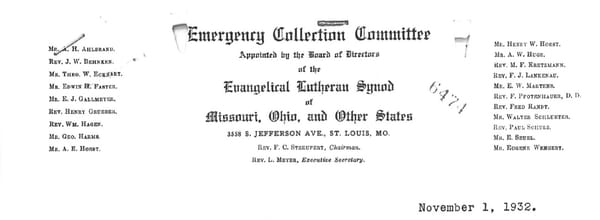
The last post ended with a promise: that the next one would come on the third of September, and that it would begin in 1932, with a letterhead.
That post is written. It is still coming. It will not be next.
Within a day of the first post appearing, more than thirty people had subscribed — to a series that had not begun, about a book that is not out, on a subject with no obvious claim on anyone's attention. By Sunday afternoon it was nearly sixty. By the standards of the internet that is nothing at all. By the standards of a theological conference held in a Württemberg spa town between 1948 and 1954, it is a crowd.
So the series starts now. Three Thursdays in August, and then the run as advertised.
The first of them belongs to a reader, because a reader has already changed the book.
The letter
It came the same day the first post did.
Johannes Oesch is a retired parish pastor of the Evangelical Landeskirche in Württemberg, with a Th.M. from Princeton, who spent his working life in the churches of the country this book keeps returning to. He wrote to say that one of his grandfathers had been at Bad Boll, as the family lore has it. He claimed no more than that.
Then he asked two questions.
How were my contacts with the church archives in Stuttgart? And how were my contacts with the Evangelical Academy at Bad Boll as it exists today?
Both questions are courteous. Both are one line long. The honest answer to each of them is: none.
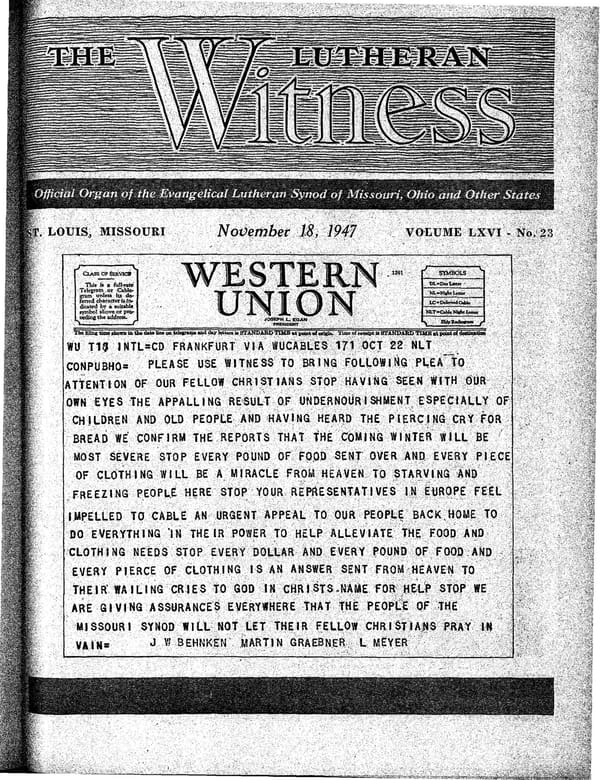
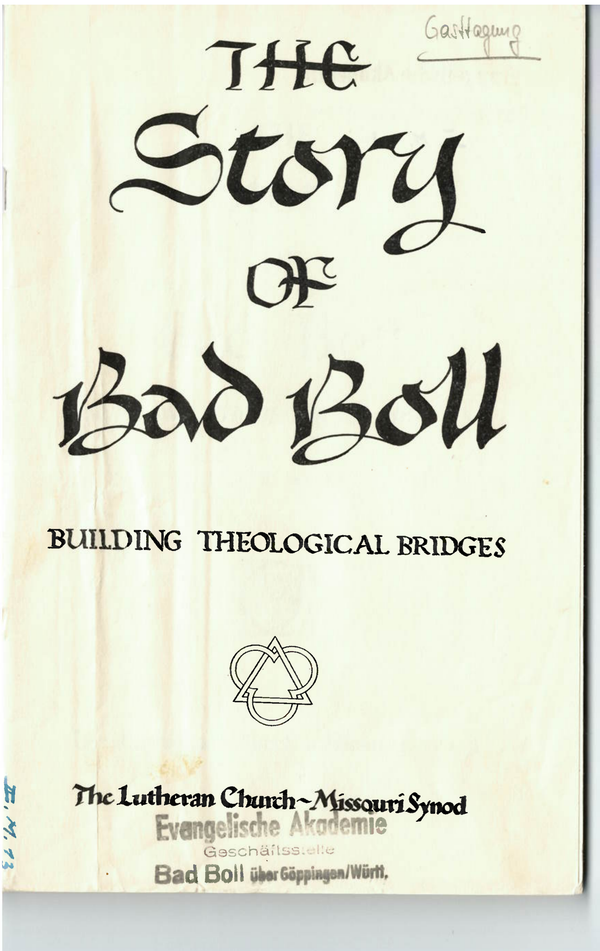
This book was written from American papers. Its documentary base is the Concordia Historical Institute in St. Louis — the Behnken presidential files, the Graebner papers, the correspondence of the Emergency Planning Council — with the Synod's own periodicals alongside, and, for 1948, Karl Arndt's documentary history in the Concordia Historical Institute Quarterly of 1979. That is a full record of what the Americans believed they were doing at Bad Boll. It is not, and cannot be, a record of what Württemberg made of them.
I have been at this since 2019, though the manuscript itself is the work of the past year — and for most of that time the reading has run one way. In the course of it I did find two letters of Hermann Sasse that no bibliography had caught: one to President Behnken of 14 May 1948, on the Bad Boll conferences themselves, which is not in Feuerhahn's Sasse bibliography at all; and the Open Letter to Bishop Meiser dated Reformation Day 1948. I translated both, the first with Charles Schaum, and published them in the Concordia Historical Institute Quarterly. That is the kind of find that makes a man think his sources are in hand. They were in St. Louis. Both of them were about Germany.
That the manuscript exists at all is owing in no small part to Dr. Daniel Harmelink and Dr. Lawrence Rast, who have cajoled and encouraged me toward the end of it, as they have with every project I have undertaken.
A retired pastor found the hole in two sentences, and was too well mannered to say so.
Archeion
The word archive comes through the Latin archivum from the Greek archeion, which does not mean a place for old paper. It means the magistrate's house. The office where the man with authority sat — and therefore the place where what he wrote down stayed.
That etymology explains the shape of nearly every archive there is, and it explains this one. The Bad Boll papers are in St. Louis because St. Louis is where the office was: Behnken's office, Lawrence Meyer's office, the Emergency Planning Council's office. What those men wrote, and what was written to them, went into their files and remained there. It is a magnificent record and this book would not exist without it.
But Württemberg kept its own archeion, and keeps it still. It sits in Stuttgart-Möhringen, it holds something close to fifteen kilometres of shelving, and nothing in this book has come out of it. Or nothing had, until this past Monday. That, too, is getting ahead of the story.
That is a limitation rather than a scandal. A man works with what he can reach, and the Atlantic is wide. But it is a limitation, and it ought to be said aloud in the same series that promises to put a document in front of you every week.
What he sent
Three scans, and a reference.
The reference is to a book published last year: Hermann Ehmer, Württembergische Kirchengeschichte: Von der Christianisierung bis zur Gegenwart — the history of the Württemberg church from its christianization to the present. Eight hundred and ninety-seven pages, from Calwer Verlag in Stuttgart. It appeared after this manuscript was drafted, and I had not seen it.
He pointed me to one section: 9.3 b, on the church policy of the occupying powers. And there, on pages 698 and 699, running across the gutter of the book, are two paragraphs and a photograph about the American I have been working on since 2019.
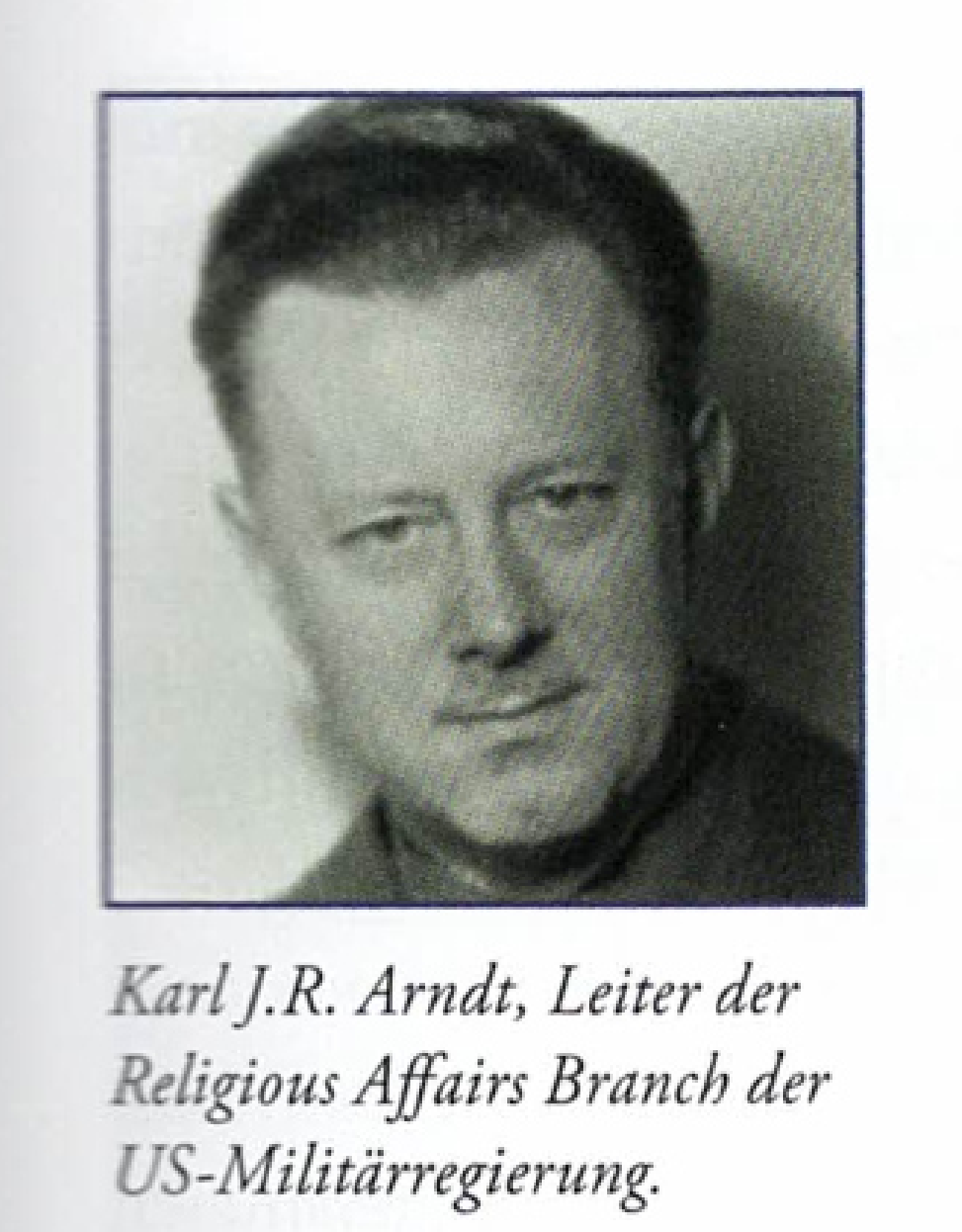
The photograph first, because it stopped me. A studio portrait, half length, dark jacket, a man in his middle forties looking slightly past the camera. The caption gives him by his office: Karl J. R. Arndt, head of the Religious Affairs Branch of the US Military Government. I have worked on Karl Arndt for seven years and had never seen his face.
Then the paragraphs. Ehmer is drawing the difference between French and American church policy in the occupied southwest — the French secular and rigorous, the Americans out of a free-church background but, he says, far better trained and better informed for the work. And then he comes to the man:
The man decisive for church affairs in the American Military Government, responsible for Württemberg-Baden, head of the Religious Affairs Branch, was — until 1950 — Karl Arndt, a professor of German literature who had received his education, among other places, at the Concordia Seminary of the conservative-Lutheran Missouri Synod.

What that is worth
Three things, and the third was not what I expected.
First, my own chapters say what Ehmer says: that Arndt was the indispensable man. But they say it largely out of Arndt's papers and his own retrospective account, written thirty years afterward — and a historian ought to be uneasy resting a central claim on a man's account of his own importance. Ehmer works from the German side, from German records, with no stake in the Missouri Synod's story, and reaches the same verdict by another road.
Second, the clause about the seminary. It is a small thing with a long reach: the Württemberg church knew perfectly well whose man the American officer was, and dealt with him anyway. The double suspicion this enterprise worked under — proselytism from one side, unionism from the other — gets sharper once you know that everyone could see it.
Third, one further clause in that same paragraph answers a question my third chapter has to leave open. I am not going to spoil it here. It comes on the first of October, with the cable it belongs to.
One caution, since this series is meant to show its work. Ehmer also reports that a German churchman's study journey to America was made at Arndt's instigation, and that President Truman received him. My files have that journey as a Missouri Synod invitation, issued from St. Louis in December 1947, with the Synod paying. The Truman reception appears in none of my sources at all. Until I have seen what Ehmer was working from, it stays out of the book. A survey history is an excellent place to learn something and a poor place to prove it.
The grandfathers
Which brings me back to the lore he opened with, and to the part I did not expect.
I wrote back and asked for a name. He sent two.
Both of his grandfathers taught at the Free Church seminary at Oberursel across the whole span of these conferences, 1948 to 1954. One was Professor Wilhelm Oesch, born in Colorado, a member of the Missouri Synod until 1945, teaching dogmatics on behalf of the Saxon Free Church, and by all accounts unimpressed by where the Missouri Synod was heading. The other was Dr. Martin Kiunke of Breslau, church historian, an official of the old Prussian Lutheran church that the Silesians called the Breslau Synod — and, it turns out, a doctoral student of Hermann Sasse.
I went to the appendix. Both men are in it. Neither of us knew.
Kiunke is there three times: in 1948, the founding year, reading on the Lord's Supper in the third series; in 1950, on the trials and tribulations of the church; and in 1953, on Christ as the propitiation for sin, opposite Martin Franzmann. And he is in the book once more, in a place I had not connected to him at all. I print a letter Sasse wrote from Erlangen on 19 May 1949 — a bitter, cornered letter about Werner Elert, written four months before Sasse gave up on Germany and sailed for Australia. It is addressed to Kiunke. I had understood it as a senior theologian writing to a Free Church rector. It was a man writing to his own former student. I had the document for years and did not have the relationship, and the relationship changes how the document reads.
Then he sent the certificate.
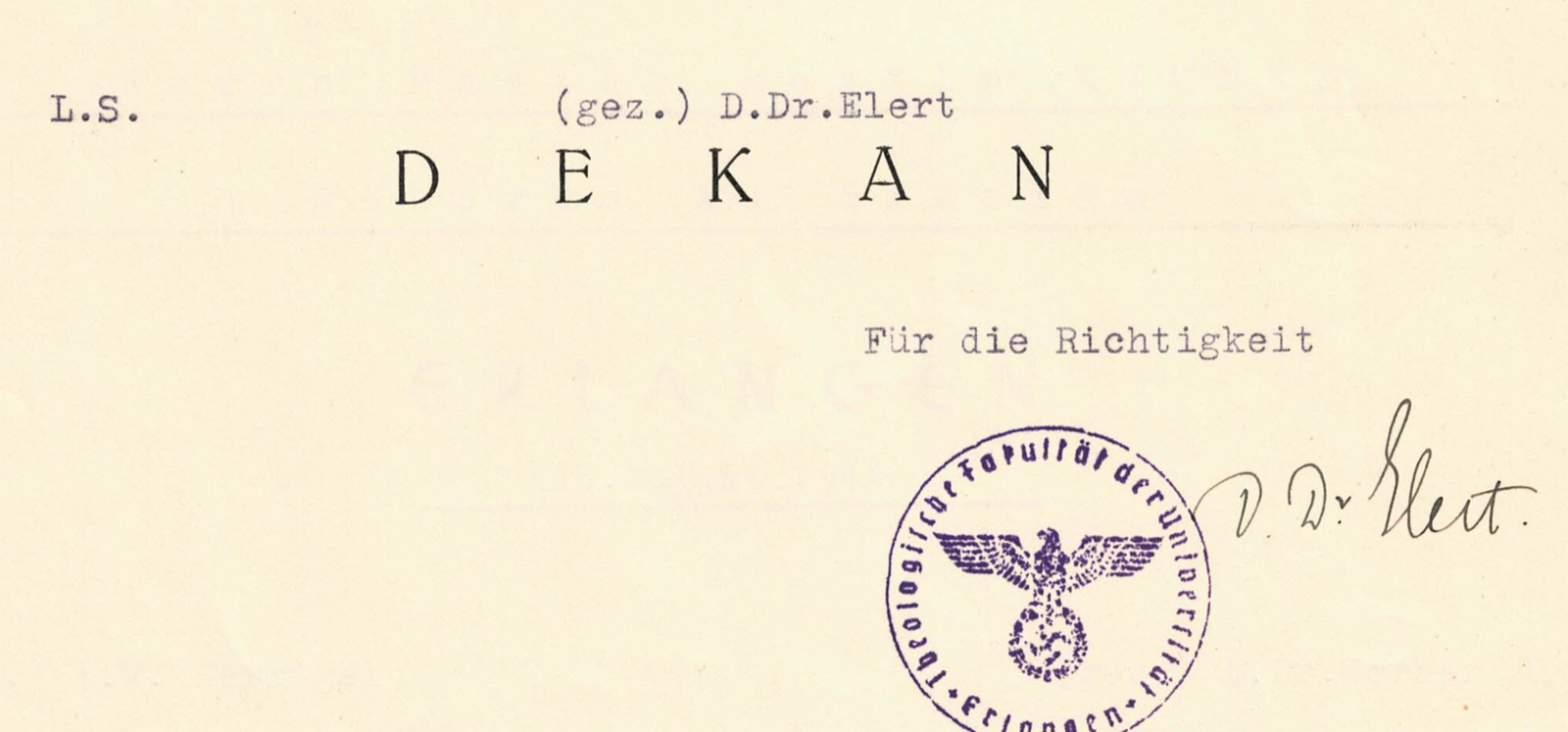
Erlangen conferred the degree on 15 August 1941: a Licentiat of theology rather than a doctorate, which was the usual thing then and was commuted afterward. The oral examination had been two years earlier, in June 1939, and the verdict was sehr gut. The dissertation was on Johann Gottfried Scheibel, the man who led the Silesian Old Lutherans out of a forced union with the state — a subject a Breslau pastor might be expected to choose, examined in the Germany of 1939, under a seal with an eagle on it.
And at the foot of the sheet, printed once and then written again by hand beneath the words Für die Richtigkeit — for correctness — is the dean who signed it.
Werner Elert.
So the letter is not a senior theologian unburdening himself to a Free Church rector, and it is not only a man writing to his own student. It is Sasse telling that student that the man who certified him has lost his nerve. I have had that letter for years. What made it legible reached me last week from the grandson of the man it was addressed to.
The other grandfather is in the 1950 roster, on the subject of the Christian man. And that name I already knew, because twenty-one years ago I published a paper disagreeing with him — "In Statu Confessionis: Origins and Development," in Logia, Eastertide 2005. His essay on status confessionis and selective fellowship is one of the texts I take up in it, and I argued that the guidelines he and others set down for protesting against one's own church body trace not to the Formula of Concord, where everyone said they came from, but to Karl Barth. Telling a certain kind of Missouri Synod reader that caused a good deal of consternation, and I heard about it.
That is a story for another Thursday. What matters here is smaller and stranger. My eleventh chapter argues that when the men of Missouri's crisis looked back in the 1960s, not one of them named Bad Boll — Sasse does not, in five pages to J. A. O. Preus in 1966; and Wilhelm Oesch does not, in sixty-nine pages diagnosing the sickness of the Synodical Conference in 1960. I had him in that chapter as one of the silent. If the 1950 essayist is the same man — and the surname in that roster stands alone, so I want the programme with his initials on it before I say so in print — then he was not merely silent about the conferences.
He was silent about a conference at which he had himself read a paper.
The address is not a formality
So the appeal stands, and it is no longer hypothetical.
This book rests in part on the participant records for all seven summers — the printed programmes, the address lists, the registration rolls, and for some years even the badge records. Three hundred and eleven men attended in 1948 alone. Their names are on paper.
If your family holds that a grandfather was at Bad Boll, send the name, the parish or the church district he served, and whatever year anyone remembers. Where a name turns up, I will send you the page and the source it came from. And where it does not, I will say so plainly, because the alternative is worse: the surviving lists are not complete, and absence from a list is not absence from the room. That rule applies to the Germans in my chapters and it applies to your grandfather too.
The address is info@badbollbook.com. It appeared in the last post as a formality. One letter later, a photograph I had never seen, a relationship I had missed inside a document I was already printing, and two names in my own appendix that I had walked past for years.
And then the archive answered. This past Monday a letter arrived from the archivist of the Evangelisches Archiv Baden und Württemberg — the same fifteen kilometres this post just confessed to never having touched — writing from the archive's holdings at Bad Boll itself, addressed to Pastor Oesch, with this book's address in the copy line: what she could find quickly, she wrote, and an offer to scan more. Six documents. The house's own paperwork for 1948: the letters in which the Academy's director rearranged his entire summer programme to clear July for the Lutherans; the Kurhaus's terms — eighty-five beds and sixty-five cots, five meals a day, the Americans to supply everything but the vegetables; a press bulletin from 1954 this series will come to in its season. The German file has already confirmed the American record in several particulars, helped settle a conference the published scholarship had dated to the wrong year, and put one question honestly beyond reach: the papers show the first 1948 series moved two days earlier — into the very week of the currency reform — and do not say why.
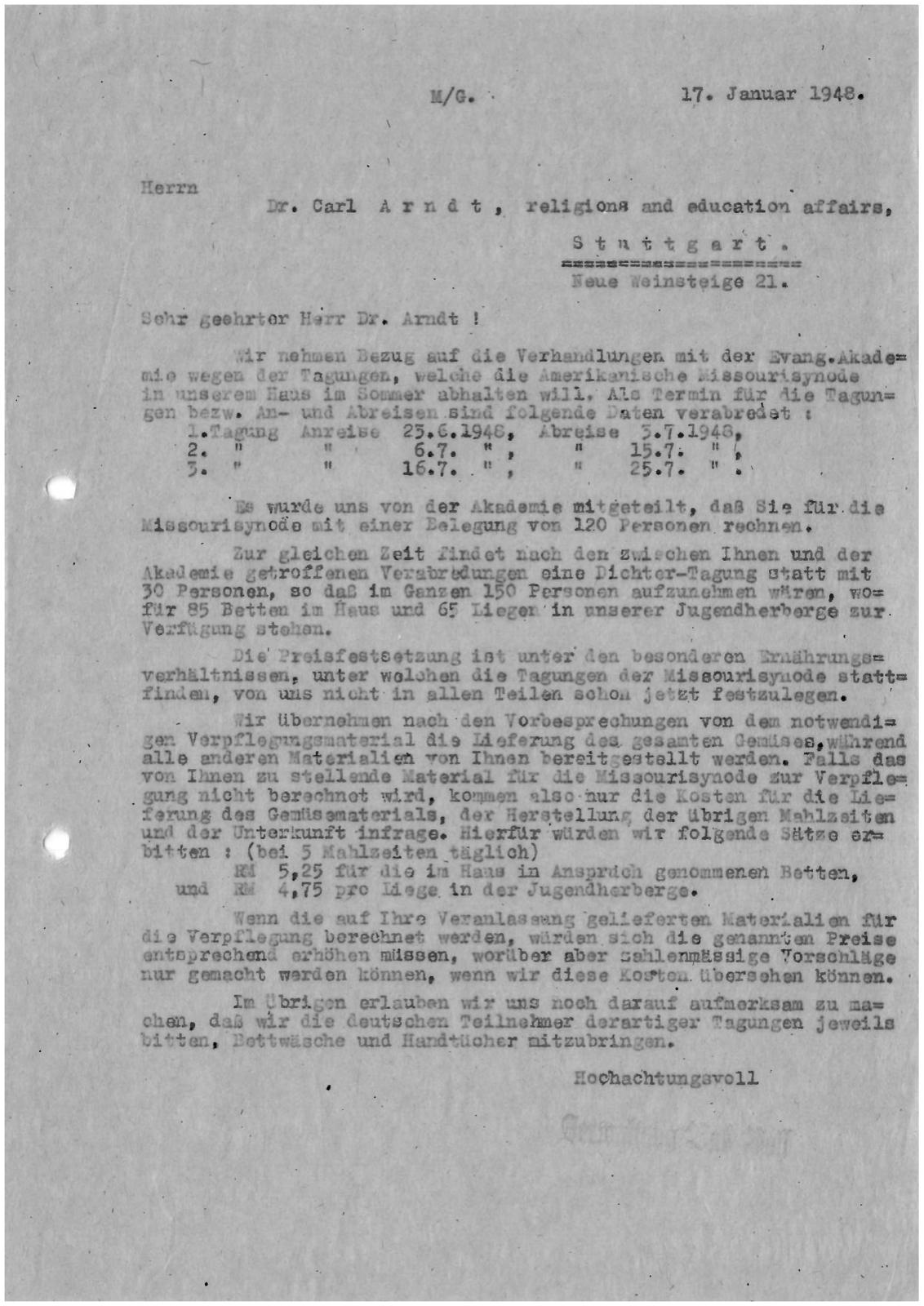
So a sentence in the middle of this post was true when I drafted it and is false as it publishes, which is the best fate a sentence like that can meet. Nothing in this book had come out of Württemberg's archive. Something now has — because a reader asked two courteous questions and then went and opened the door himself.
Next Thursday, the man in the photograph. He was born in Minnesota, grew up in China, spent four years at a St. Louis seminary and never became a pastor, and gave his scholarly life to a party of Württemberg separatists who sailed for America in 1803. Then he came back to Württemberg with an American army.
Bad Boll: Missouri at the Crossroads is forthcoming from Concordia Historical Institute. If you have material, a correction, or a memory of any of this, the address is info@badbollbook.com. Corrections are the point.